
Loading, please wait...
_900x900.jpg "Viking Age Bronze Trefoil Strap Junction")
_200x200.jpg "Viking Age Bronze Trefoil Strap Junction")
.jpg "Viking Age Bronze Trefoil Strap Junction")
LOT 1677
Viking Age Bronze Trefoil Strap Junction
9TH-11TH CENTURY A.D.
3 1/2 in. (15.5 grams, 89 mm).
Composed of a slightly domed openwork body, the central arms with simple incised geometric detailing and central boss, free-running attachment bars above. [No Reserve]
ProvenanceFrom the collection of a North American gentleman, formed in the 1990s.
CONDITIONTimeLine Auctions follows a vetting process to ensure the authenticity and legality of all items, reinforcing our commitment to integrity and responsible trading. Each antiquity, antique, and coin lot undergoes thorough examination by a vetting committee of at least ten external specialists, professional trade association members, scientists, and archaeologists: Our Vetting Process
AUCTIONS:
TimeLine is a leading auction house specialising in antiquities, ancient art, collectables, natural history, coins, medals, and books. Our auctions offer museums, collectors, historians, and enthusiasts the opportunity to acquire unique and historically significant pieces.
-
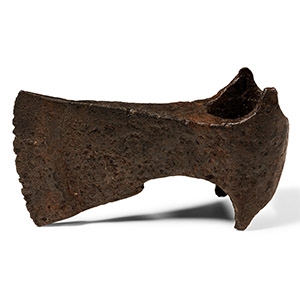
Viking Age Finno-Ugrian Socketted Axe Head
10th-13th century A.D.Sold for (Inc. bp): £286
A Finno-Ugrian or Baltic hand-forged iron axehead with triangular-section narrow blade widening to a broad bevelled edge with square chin and spur to the rear, socket with flanges to the rear. 694 grams, 14.2 cm
From the private collection of a London gentleman, from his grandfather's collection formed before the early 1970s.
During the mid 13th century, the axes were favourited by Baltic people. For instance, the Curonian army included lightly armed soldiers who fought with spears, shields, fighting knives and axes. A heavily armed soldier could also carry a sword, a helmet, a shield and a wide bladed axe. -
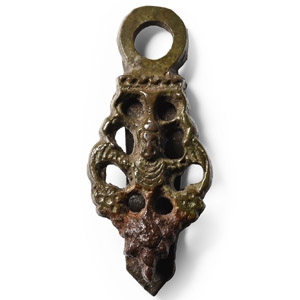
Anglo-Scandinavian Viking Bronze Bound Loki Suspension Mount
10th-11th century A.D.Sold for (Inc. bp): £520
Belt mount with loop above and strap to reverse; openwork frame with rosettes and central facing mask. 3..25 grams, 32 mm
Acquired in Germany after WWII. Ex property of a lady living in Kent, UK; formerly part of her grandfather's collection. From an old private collection of Norfolk, UK, gentleman, formed since 1998.
The image is often interpreted as the trickster-god Loki bound to a rock, as he was said to be in Norse myth (e.g. the poem Völuspá, verse 35). -
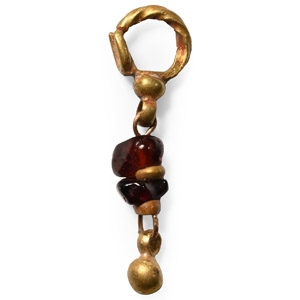
Viking Age Gold Pendant with Natural Garnets
Circa 9th-11th century A.D.Sold for (Inc. bp): £286
Hoop with cell and dangle with irregular garnet beads, spherical dangle finial. 1.54 grams, 27 mm
Ex property of a late Japanese collector, 1970-2000s.
