
Loading, please wait...
_900x900.jpg "Viking Age Bronze Sword Scabbard Chape Collection")
_200x200.jpg "Viking Age Bronze Sword Scabbard Chape Collection")
.jpg "Viking Age Bronze Sword Scabbard Chape Collection")
LOT 1423
Viking Age Bronze Sword Scabbard Chape Collection
9TH-11TH CENTURY A.D.
21/8 - 3 3/8 in. (145 grams total, 55-85 mm).
Comprising: one heater-shaped with openwork raven motif to each face; one similar with openwork raven enmeshed in tendrils; one with fleur-de-lys to the centre of each upper edge and a lobed spur to each side; one with openwork quatrefoil to each face and knop finial to the apex. [4]
ProvenanceFrom the collection of a North American gentleman, formed in the 1990s.
LiteratureCf. Paulsen, P., Schwertortbänder der Wikingerzeit, Stuttgart, 1953, items 6, 31, 74, 177, for types.
CONDITIONTimeLine Auctions follows a vetting process to ensure the authenticity and legality of all items, reinforcing our commitment to integrity and responsible trading. Each antiquity, antique, and coin lot undergoes thorough examination by a vetting committee of at least ten external specialists, professional trade association members, scientists, and archaeologists: Our Vetting Process
AUCTIONS:
TimeLine is a leading auction house specialising in antiquities, ancient art, collectables, natural history, coins, medals, and books. Our auctions offer museums, collectors, historians, and enthusiasts the opportunity to acquire unique and historically significant pieces.
-
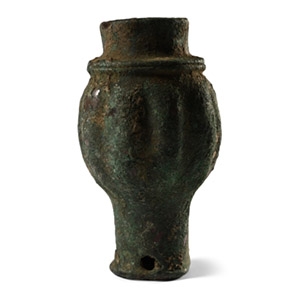
Luristan Bronze Macehead
13th-7th century B.C.Estimate: £100 - 140 (+bp*)
Opening Bid: £50
Comprising a cylindrical shaft with flared mouth, rounded flanges around the swollen head, horizontal stepped bands; Sara Gorz type. 416 grams, 98 mm
Acquired 1980-2015. Ex Abelita family collection. This lot is accompanied by an illustrated lot declaration signed by the Head of the Antiquities Department, Dr Raffaele D’Amato. This lot is accompanied by an illustrated lot declaration signed by the Head of the Antiquities Department, Dr Raffaele D'Amato. -
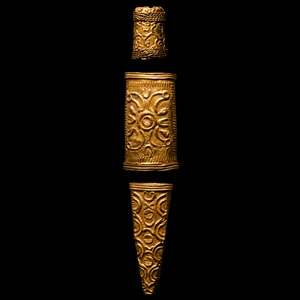
Indian Gold Dagger Scabbard Suite
17th-18th century A.D.Estimate: £2,500 - 3,500 (‡+bp*)
Opening Bid: £1,250
Belonging to a dagger and its scabbard, comprising: a tubular pommel cap with filigree ropework, repoussé floral motifs; an elliptical-section scabbard throat with billetted border, reeded edges and floral motif; a triangular chape with reeded strip to the mouth. 27 grams total, 29-64 mm
From the collection of a North American gentleman, formed in the 1990s. -
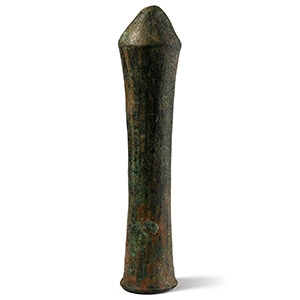
Luristan Bronze Macehead
2nd-1st millennium B.C.Sold for (Inc. bp): £156
With long tubular shank lared at the mouth, carinated bulb. 364 grams, 17.5 cm
Ex London, UK, collection, 1990s.
