
Loading, please wait...
_900x900.jpg "Viking Age Bronze Sword Scabbard Chape Collection")
_200x200.jpg "Viking Age Bronze Sword Scabbard Chape Collection")
.jpg "Viking Age Bronze Sword Scabbard Chape Collection")
LOT 1431
Viking Age Bronze Sword Scabbard Chape Collection
9TH-11TH CENTURY A.D.
21/8 - 3 3/8 in. (145 grams total, 55-85 mm).
Comprising: one heater-shaped with openwork raven motif to each face; one similar with openwork raven enmeshed in tendrils; one with fleur-de-lys to the centre of each upper edge and a lobed spur to each side; one with openwork quatrefoil to each face and knop finial to the apex. [4]
ProvenanceFrom the collection of a North American gentleman, formed in the 1990s.
LiteratureCf. Paulsen, P., Schwertortbänder der Wikingerzeit, Stuttgart, 1953, items 6, 31, 74, 177, for types.
CONDITIONTimeLine Auctions follows a vetting process to ensure the authenticity and legality of all items, reinforcing our commitment to integrity and responsible trading. Each antiquity, antique, and coin lot undergoes thorough examination by a vetting committee of at least ten external specialists, professional trade association members, scientists, and archaeologists: Our Vetting Process
AUCTIONS:
TimeLine is a leading auction house specialising in antiquities, ancient art, collectables, natural history, coins, medals, and books. Our auctions offer museums, collectors, historians, and enthusiasts the opportunity to acquire unique and historically significant pieces.
LOT 1431
Viking Age Bronze Sword Scabbard Chape Collection
Estimate £500 - 700€580 - 810 (for guidance only)$680 - 950 (for guidance only)
-
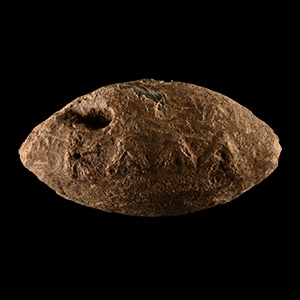
Hellenistic Rhodian Lead Slingshot with Scorpion
3rd century B.C.Sold for (Inc. bp): £234
Lentoid-section and depicting a stylised scorpion to one side and inscription 'ΚΑΛΑ' on the other. 26 grams, 31 mm
Ex Cummings collection, UK, 1990s.
Together with the Balearic slingers, Rhodian slingers were considered to be the best of the Hellenistic world, and they were also used in the Roman army. The slingshots with an image of a scorpion on one side and with an inscription ΚΑΛΑ on the other are believed to originate from the Island of Rhodes. On these sling bullets ΚΑΛΑ should be translated as “nice things.” Of course, ironically, these “nice things” were designed to kill enemies and to sting like a scorpion, and the message of those with the image of a scorpion could be understood, as proposed ny M. Manov and N. Torbov, as: “nice things sting like a scorpion.” -
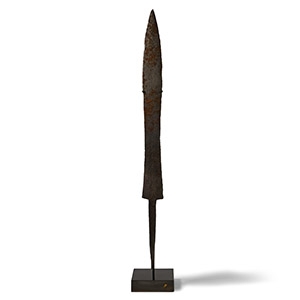
Roman Iron Gladius Sword with Bird Triskeles
Circa 1st-2nd century A.D.Sold for (Inc. bp): £2,600
With fish-shaped blade of piled iron construction with square shoulder and flat-section tang; incised triskele motif to one face, each arm terminating in a bird's head with curved beak and lentoid eye; accompanied by a custom-made display stand. 870 grams total, 67 cm high including stand
Acquired in the 2000s. From the private collection of John Lawton, Surrey, UK. -
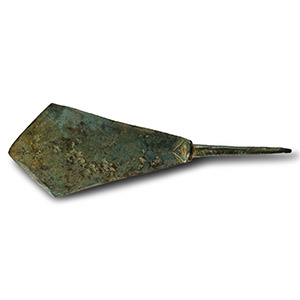
Medieval Bronze Arrowhead
Circa 12th-14th century A.D.Sold for (Inc. bp): £91
Tanged arrowhead with broad kite-shaped blade. 15 grams, 97 mm
Acquired on the London art market in the late 1980s-1990s. From the family collection of an East London, UK, gentleman.
