Loading, please wait...
LOT 1370
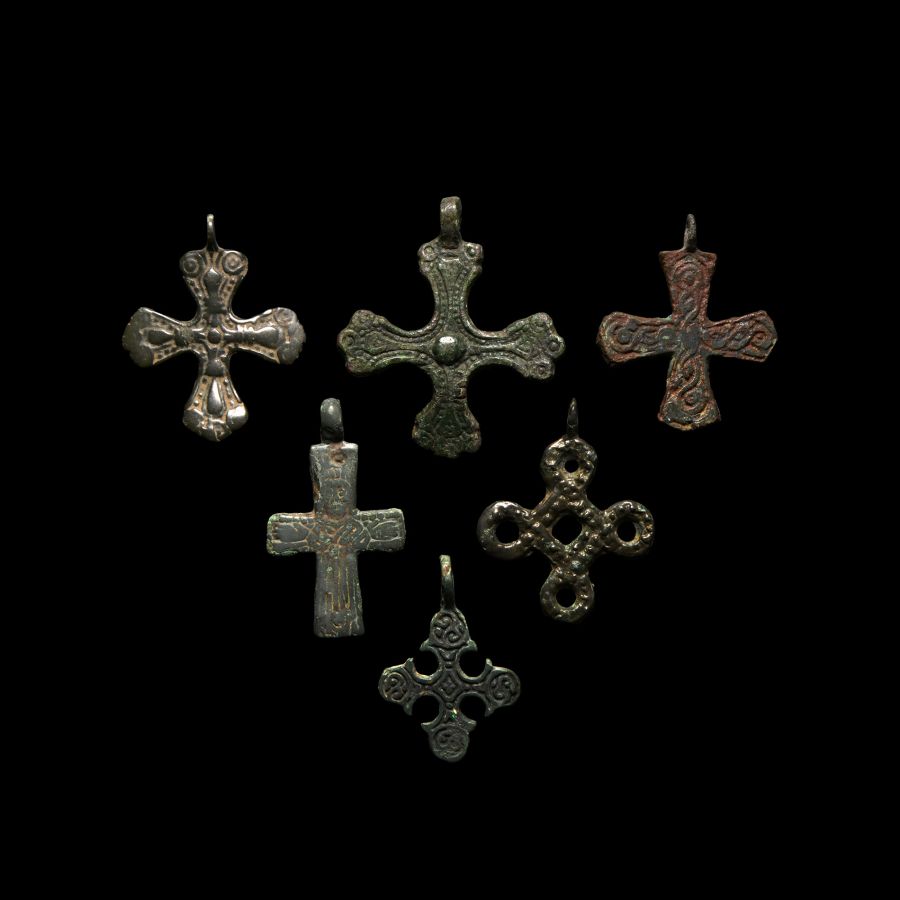
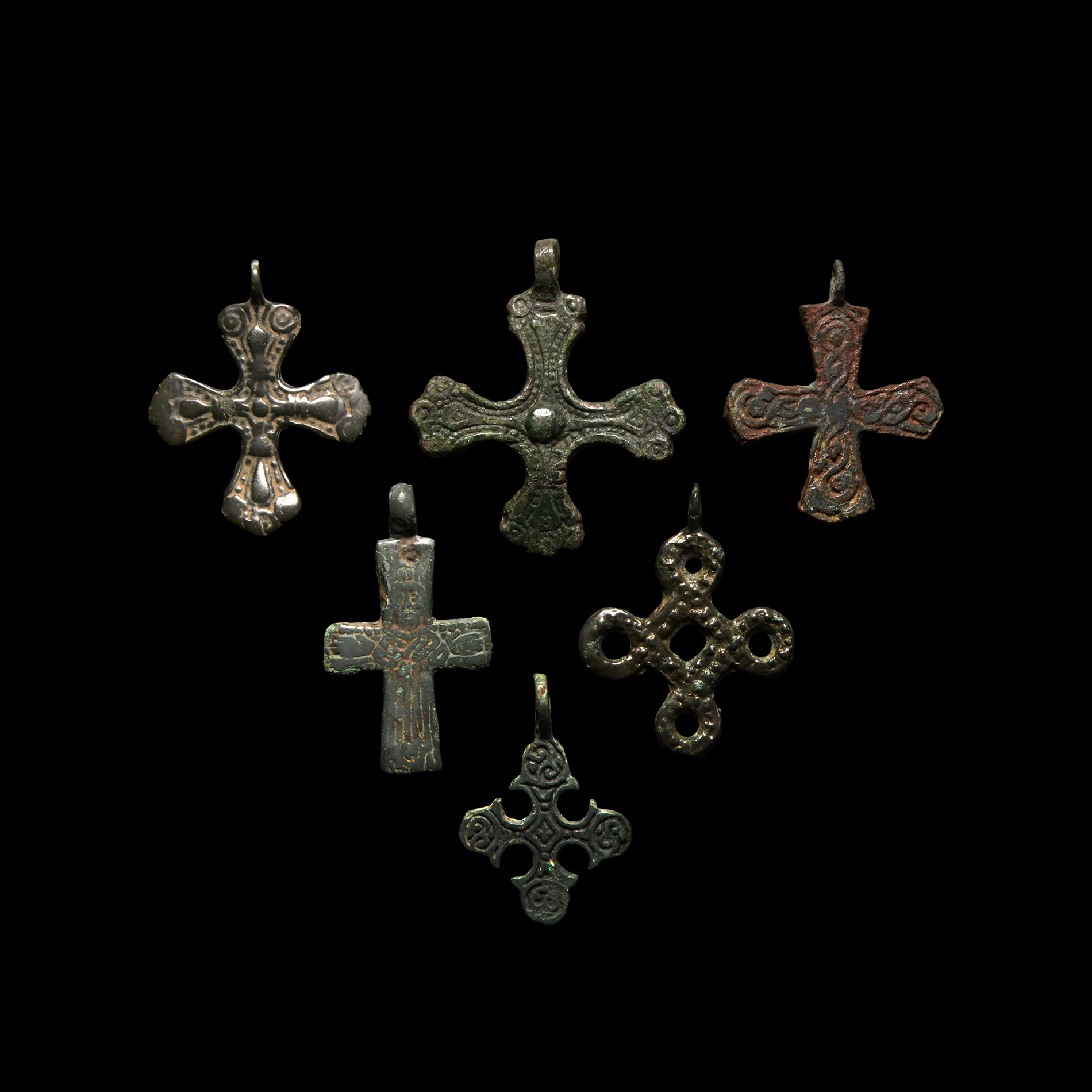
Viking Age Bronze Cross Pendant Collection
9TH-11TH CENTURY A.D.
1 1/4 - 1 5/8 in. (29 grama total, 33-42 mm).
Including openwork and bifacial examples, each decorated with a different design and a suspension loop. [6, No Reserve]
ProvenanceFrom the collection of a North American gentleman, formed in the 1990s.
CONDITIONTimeLine Auctions follows a vetting process to ensure the authenticity and legality of all items, reinforcing our commitment to integrity and responsible trading. Each antiquity, antique, and coin lot undergoes thorough examination by a vetting committee of at least ten external specialists, professional trade association members, scientists, and archaeologists: Our Vetting Process
AUCTIONS:
TimeLine is a leading auction house specialising in antiquities, ancient art, collectables, natural history, coins, medals, and books. Our auctions offer museums, collectors, historians, and enthusiasts the opportunity to acquire unique and historically significant pieces.
-
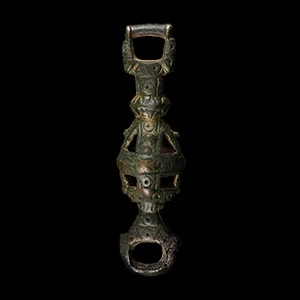
Viking Age Silver-Gilt Cross Pendant with Head of a Beast
11th-12th century A.D.Sold for (Inc. bp): £1,170
In Romanesque style, cruciform with openwork cross at centre, three oval terminals and a fourth modelled as a hound's head, the beast's mouth forming the suspension loop. 5.4 grams, 40 mm
From the family collection of a Hertfordshire, UK, gentleman since the 1970s. with Bonhams, London, Sale 17880, 7 December 2010, lot 6. Accompanied by a copy of the online Bonhams catalogue page, and the original lot ticket.
The original function of this rare and unusual pendant remains elusive. The use of expensive materials and the fine and detailed casting indicate that it would have been a highly prized object. The fusion of Christian and pagan religious motifs is typical of Iceland where the worship of the old gods continued into the 11th century. The Christian cross was used as a symbol of the new faith but the pendant also includes elements of pre-Christian ideas. Comparable objects appeared in an exhibition of English Romanesque Art 1066-1200, held at the Hayward Gallery, London, 5 April - 8 July 1984. The catalogue for this exhibition illustrates numerous small metal and gilded articles with similar grotesque terminals- No. 254 illustrated a late 12th century finial from a shrine, which is in the Victoria and Albert Museum (M.25 1962). -
Viking Twisted Silver Wire Ring
9th-11th century A.D.Sold for (Inc. bp): £208
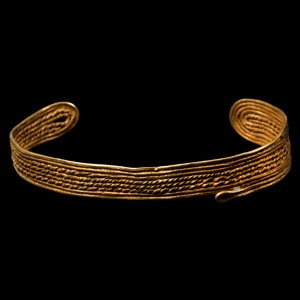
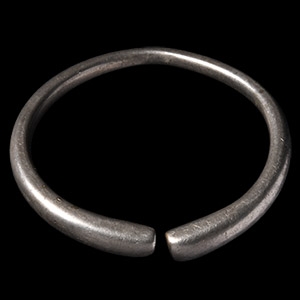
Comprising a hoop formed from overlapping arms and plaited bezel embellished with slender twisted wire thread. 6.60 grams, 26.91 mm overall, 19.95 mm internal diameter (approximate size British S 1/2, USA 9 1/4, Europe 20.63, Japan 19)
From the collection of a North American gentleman, formed in the 1990s. -
Scandinavian Viking Gilt Bronze 'Great Beast' Weather Vane Terminal
11th century A.D.Estimate: £4,000 - 6,000 (+bp*)
Opening Bid: £2,000
In Ringerike style; a finial for a Viking long-ship weather vane or other similar nautical piece of equipment, formed in the round as a standing quadruped with scrolls to the hips and shoulders, raised head with almond-shaped eye; iron rivets at the feet to a rectangular plate with scalloped edges and corners removed, the plate with four slots for attachment. 111 grams, 66 mm wide
Private collection formed in Europe in the 1980s. Westminster collection, central London, UK. This lot has been checked against the Interpol Database of stolen works of art and is accompanied by search certificate no.204123.
The navigation techniques in use in Iron Age Northern Europe were very sophisticated, as would be expected from people bordering the Baltic, North Sea and North Atlantic where boat- and ship-building traditions have been perfected over more than a thousand years. A carved wooden panel from Bergen, Norway, shows a number of Viking longships at sea, some with weathervanes mounted on the stempost. They are mounted vertically with the beast on the outer end. Gilded bronze weathervanes appear on the roofs of medieval churches in Sweden, Norway and Finland where they are often regarded as ornamental: symbols of access to resources and craftsmanship for the important families who endowed such buildings. These weathervanes in many cases originally adorned ships and were used as part of the navigational equipment. They may have inspired the medieval Norman custom of attaching a gilded weathervane or cock to church roofs, which eventually spread to secular buildings such as castles in France and Italy where their use was restricted to certain ranks of nobility (Lindgrén, 1983). Weathervanes were used for determining the strength and direction of the wind, in conjunction with the sólarsteinn (sunstone) Icelandic feldspar which polarises sunlight and allows the sun's position to be determined in overcast conditions. A wooden bearing-dial fragment was found in Greenland - a destination colonised by Icelanders in the 11th century - with the 'horizon' divided into 32 sectors. This would give an accuracy of about 11 degrees per sector, which would make landfall using latitude sailing a straightforward matter. Engström & Nykänen (1996) suggested that the vanes were decorated with holes or markers on the outer edge which enabled the helmsman to make an assessment of the sun's height from the position and length of the shadow, and thus to work out his position by rule of thumb. These holes may have been used to attach streamers as a visual aid. The ships equipped with these weathervanes may have been the 'flagships' of their fleets, taking the lead in navigation and in manoeuvring. The dragon on the weathervane may thus have signified the position of the fleet's leader, and may even have given rise to the name drakka (dragon) for the largest type of Viking period ship.