
Loading, please wait...
_900x900.jpg "Viking Age Bronze Chained Equal-Arm Brooch Set")
_200x200.jpg "Viking Age Bronze Chained Equal-Arm Brooch Set")
.jpg "Viking Age Bronze Chained Equal-Arm Brooch Set")
LOT 0350
Viking Age Bronze Chained Equal-Arm Brooch Set
CIRCA 10TH CENTURY A.D.
30 3/4 in. (252 grams total, 78 cm long).
Each link in the chain composed of three separate hoops, the equal-arm brooches with decoration in high-relief and remains of pin-lugs and catchplate to reverse.
ProvenanceFrom the collection of a North American gentleman, formed in the 1990s.
LiteratureCf. Arbman, H., Birka I: Die Gräber, Uppsala, 1940, pl.80.
CONDITIONTimeLine Auctions follows a vetting process to ensure the authenticity and legality of all items, reinforcing our commitment to integrity and responsible trading. Each antiquity, antique, and coin lot undergoes thorough examination by a vetting committee of at least ten external specialists, professional trade association members, scientists, and archaeologists: Our Vetting Process
AUCTIONS:
TimeLine is a leading auction house specialising in antiquities, ancient art, collectables, natural history, coins, medals, and books. Our auctions offer museums, collectors, historians, and enthusiasts the opportunity to acquire unique and historically significant pieces.
LOT 0350
Viking Age Bronze Chained Equal-Arm Brooch Set
Estimate £800 - 1,000€930 - 1,160 (for guidance only)$1,080 - 1,350 (for guidance only)
-
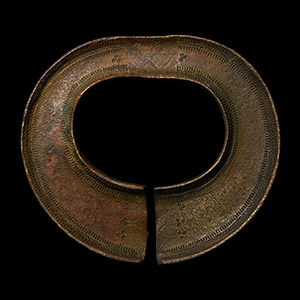
Large Viking Period Decorated Bronze Armlet
Circa 11th century A.D.Sold for (Inc. bp): £442
Of penannular form, with raised perimeters to both faces and bifacial punched geometric motifs, including to the side edge. 215 grams, 10.3 cm
From the collection of a North American gentleman, formed in the 1990s. -
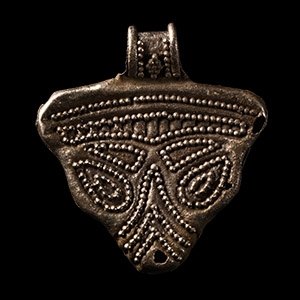
Viking Age Silver Filigree Wolf's Head Pendant
9th-11th century A.D.Estimate: £300 - 400 (‡+bp*)
Opening Bid: £138
Of triangular form with integral suspension loop, the face delineated using granules to form almond-shaped eyes beneath eyebrows, concentric chevrons to the nasal line; applied granules and straps to the loop. 1.79 grams, 26 mm
Acquired on the German art market before 2000. From a London W1, UK, collection. -
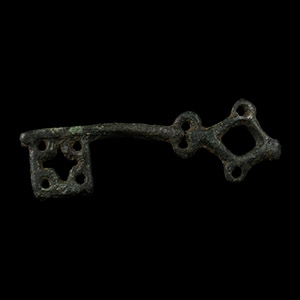
Viking Age Bronze Key with Quatrefoil-Shaped Handle
9th-13th century A.D.Sold for (Inc. bp): £160
In openwork, circular lugs to the bow and stem, cruciform and circular motifs to the bit. 15.3 grams, 77 mm
From the collection of a North American gentleman, formed in the 1990s.
