
Loading, please wait...

LOT 0363
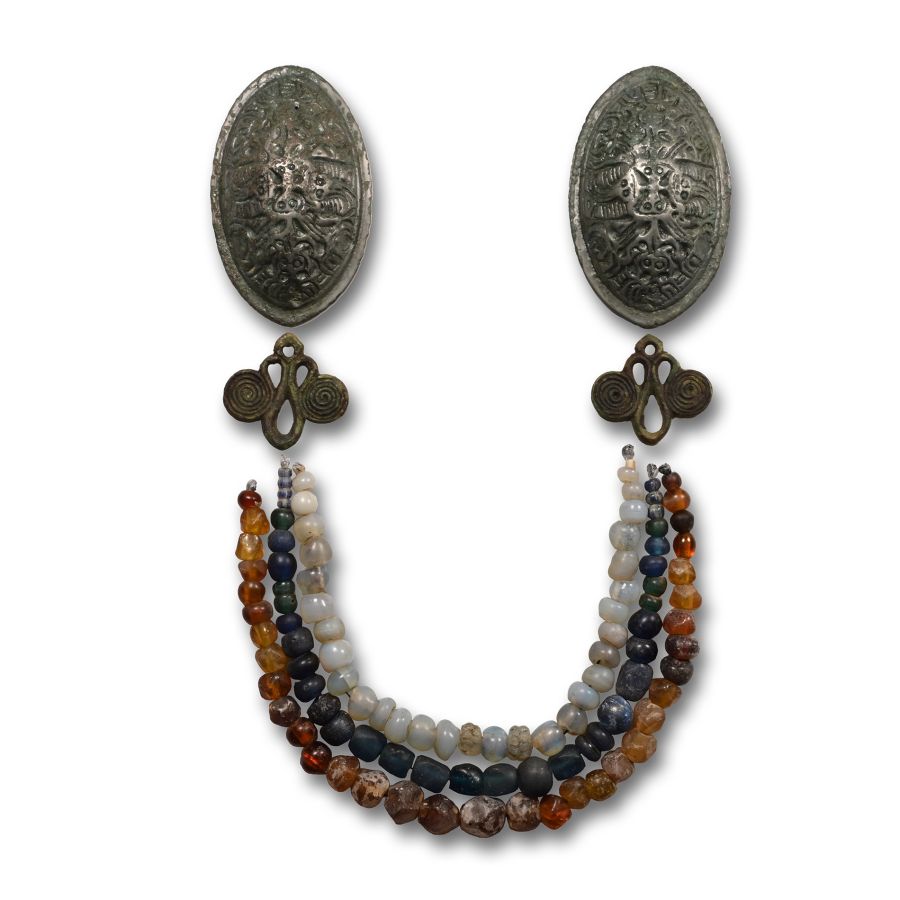
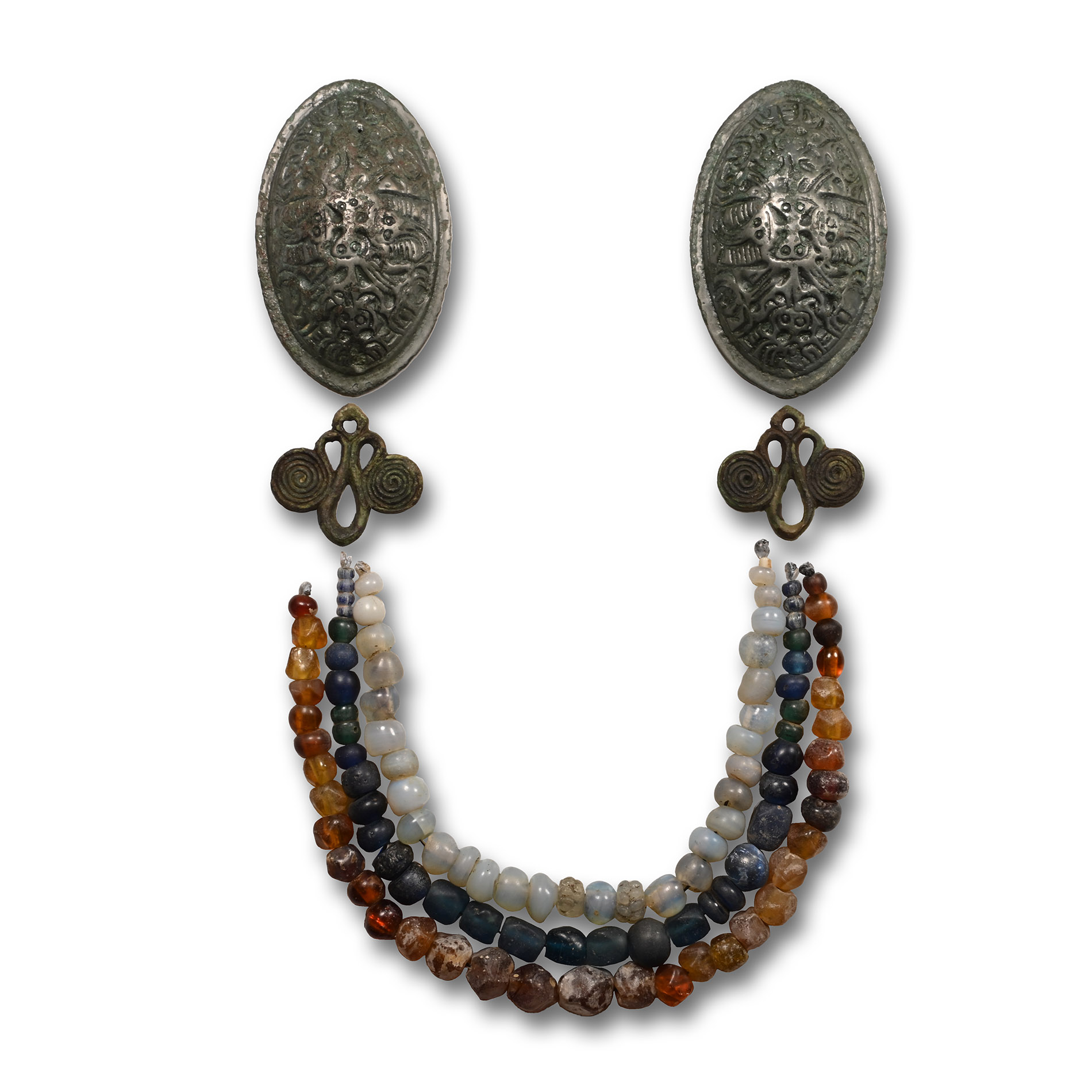
Viking Age Bronze Borre Style Tortoise Brooch Set
10TH-12TH CENTURY A.D.
22 1/2 in. (310 grams total, 57 cm total long).
Comprising: two elliptical bronze tortoise brooches, each domed with raised ornament of four Borre-style faces with pellet eyes to the centre of a panel of body parts and hatching with two more faces to the narrow ends, wide flange, catchplate, pin-hinge and pendant attachment bar to the reverse; two suspension links, each an omega-shaped loop with lateral coiled ends and ring above; three swags of graduated beads (restrung) - upper: pale blue glass oblate beads, crystal annular beads, melon beads; middle: deep blue and dark green glass and lapis lazuli polyhedral and annular beads; lower: oblate and polyhedral amber and glass beads.
ProvenanceFrom the private collection of a London gentleman, from his grandfather's collection formed before the early 1970s.
LiteratureFor similar brooches see Arbman, H., Birka I: Die Gräber, Uppsala, 1940, pls.58ff. and in particular 62-63, 67; see also Graham-Campbell, J. & Kidd, D., The Vikings, London, 1980, figs.52-53, for similar brooches from Norway.
FootnotesThe most characteristic items of Viking period women's jewellery are oval brooch pairs, called 'tortoise brooches' in the literature. As in this example, the brooches themselves were usually connected by swags of coloured beads or by chains supporting tools such as tweezers or a small knife, as well as amulets.
CONDITIONTimeLine Auctions follows a vetting process to ensure the authenticity and legality of all items, reinforcing our commitment to integrity and responsible trading. Each antiquity, antique, and coin lot undergoes thorough examination by a vetting committee of at least ten external specialists, professional trade association members, scientists, and archaeologists: Our Vetting Process
AUCTIONS:
TimeLine is a leading auction house specialising in antiquities, ancient art, collectables, natural history, coins, medals, and books. Our auctions offer museums, collectors, historians, and enthusiasts the opportunity to acquire unique and historically significant pieces.
-
.jpg)
Large Viking Age Silver Bucket with Animal Figures
8th-9th century A.D.Estimate: £30,000 - 40,000 (+bp*)
Opening Bid: £15,000
A spectacular Sogdian sheet-silver bucket with drum-shaped body, narrow discoid repoussé base, bands of repoussé foliage to the body beneath a raised collar and fluted neck and rim; handle held by two securing hoops formed as miniature rams. 1.2 kg, 26.5 cm wide
From an old private collection. with Oxus Fine Arts Pte. Ltd, Singapore. Acquired by the current owner in London, 2012. This lot has been checked against the Interpol Database of stolen works of art and is accompanied by a search certificate number no.12288-220840.
Dr. Grigoriev, in his studies on Sogdian silver artworks, has traced specific Sogdian features of metalwork prototypes on the basis of the ceramic replicas. Some of these features were distinguished on gold and silver vessels which possess many other characteristics bringing them together. In our bucket, the style and the decoration of the flowers resemble those of the bucket with deer from Shirokovskoe (Perm, see Marshak, 1971, T,35), while the bands of repoussé foliage to the body beneath the raised collar and fluted neck and rim recall the decoration of the dish with deer from Rep’evka, in Samara Province (Darkevich, 1976, n.12). -
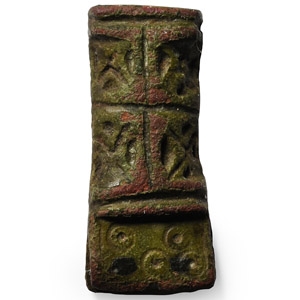
Anglo-Scandinavian Viking Bronze Strap End
10th-11th century A.D.Sold for (Inc. bp): £169
With split attachment plate held by two rivets and featuring ring-and-dot detailing; D-section segmented lower panel with geometric ornament. 7.38 grams, 31 mm
Found Lincolnshire, UK. From an old private collection of Norfolk, UK, gentleman, formed since 1998. -
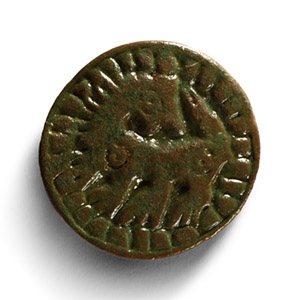
Anglo-Scandinavian Viking Bronze Beast Facing Back Brooch
9th-11th century A.D.Sold for (Inc. bp): £338
Disc brooch with low-relief regardant beast motif within a segmented border; loop to the reverse. 6.71 grams, 29 mm
Found Costessey, Norfolk, UK. Recorded with the British Museum's Portable Antiquities Scheme (PAS) with report no.NMS-AAD19D.
