Loading, please wait...

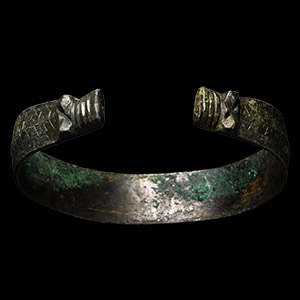
Viking Age Bronze Beast-Head Staff Terminal Viking Age Bronze Beast-Head Staff Terminal Viking Age Bronze Beast-Head Staff Terminal
Use mousewheel to zoom in and out, click to enlarge
Details

LOT 1331

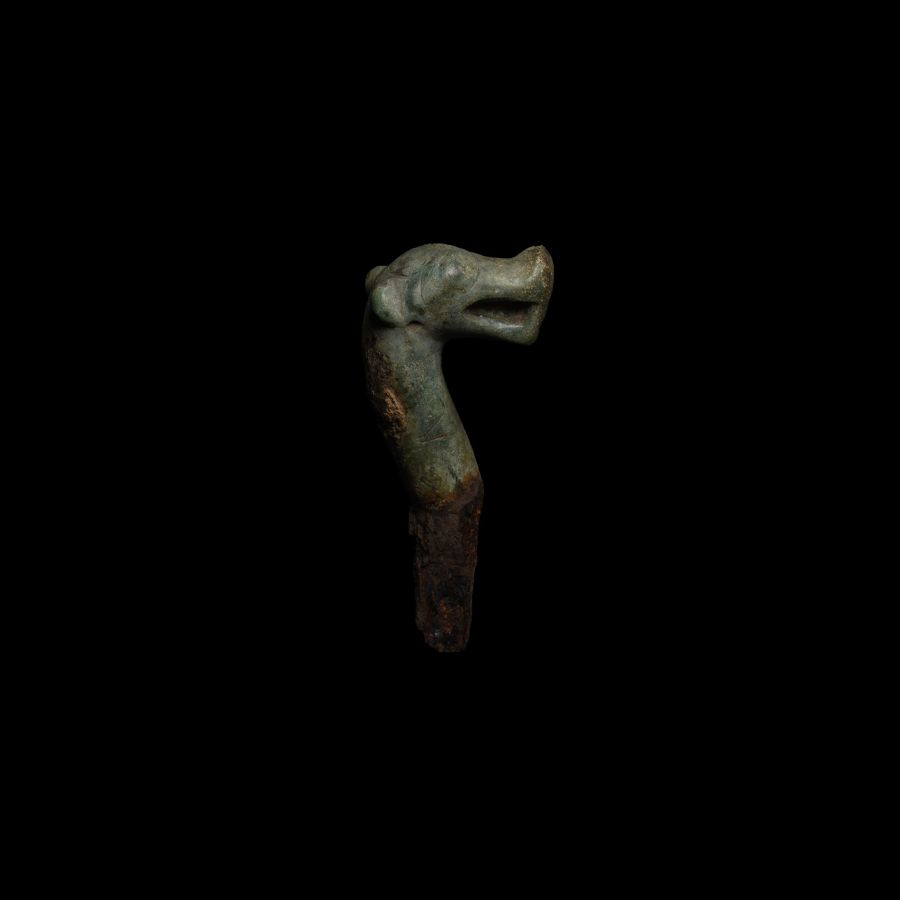
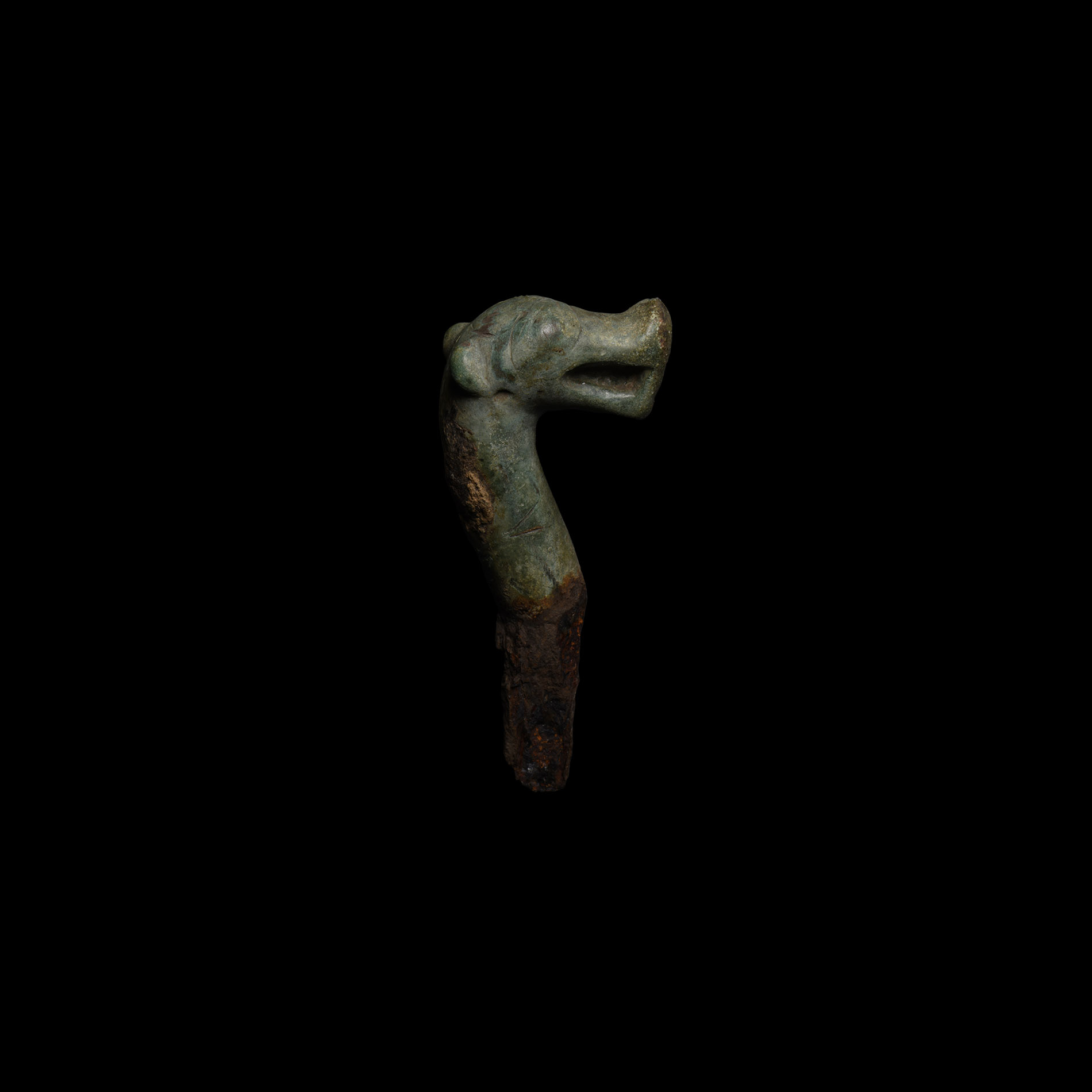
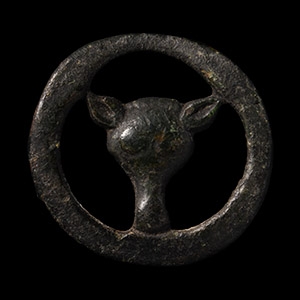
Viking Age Bronze Beast-Head Staff Terminal

9TH-11TH CENTURY A.D.

2 1/4 in. (41.7 grams, 58 mm).

Comprising a hollow socket with iron rod inserted, terminal formed as a beast-head with open jaws, lobed snout, canine teeth prominent, ribbed brow and bulbous eyes, D-shaped ears to the rear. [No Reserve]

Provenance

Acquired in the 1990s.
Ex property of a German collector.

Literature

Cf. Graham-Campbell, J., The Viking World, London, 1980, p.134-5, for similar animal-heads carved on the wagon found in the Oseberg ship-burial at Tønsberg, Vestfold, Norway; the Oseberg burial marks the beginning of Viking Age art. It is dated dendrochronologically to 834 A.D.

CONDITION
VETTING:

TimeLine Auctions follows a vetting process to ensure the authenticity and legality of all items, reinforcing our commitment to integrity and responsible trading. Each antiquity, antique, and coin lot undergoes thorough examination by a vetting committee of at least ten external specialists, professional trade association members, scientists, and archaeologists: Our Vetting Process


AUCTIONS:

TimeLine is a leading auction house specialising in antiquities, ancient art, collectables, natural history, coins, medals, and books. Our auctions offer museums, collectors, historians, and enthusiasts the opportunity to acquire unique and historically significant pieces.

LOT 1331

Viking Age Bronze Beast-Head Staff Terminal

Sold for (Inc. bp): £234

Print page

RELATED LOTS
  • Viking Silver Urnes Style Rattle Pendant
    Viking Silver Urnes Style Rattle Pendant
    9th century A.D.

    Sold for (Inc. bp): £2,600

    Formed from a hollow vesica-shaped silver mount which rattles when shaken, probably a horse-harness fitting; with Urnes style interlaced dragons in low relief surrounding a facing bearded mask with large staring eyes (Thor?). 67 grams, 73 mm


    Formerly acquired on the German art market in the early 1980s. Previously in a European collection in the 1990s. From an important central London collection. This lot has been checked against the Interpol Database of stolen works of art and is accompanied by searcher certificate no. 200377.

    The last phase of Viking art is the Urnes style from about 1050-1150. The Urnes style has gracefully curved lines of different width - swelling, tapering - but always in a curve. The tendril clusters from the Ringerike style are abandoned. The Urnes style developed shortly before the middle of the 11th century.

    Lot Details

  • Viking Age Silver Filigree Wolfs Head Pendant
    Viking Age Silver Filigree Wolf's Head Pendant
    9th-11th century A.D.

    Estimate: £300 - 400 (‡+bp*)

    Opening Bid: £138

    Of triangular form with integral suspension loop, the face delineated using granules to form almond-shaped eyes beneath eyebrows, concentric chevrons to the nasal line; applied granules and straps to the loop. 1.79 grams, 26 mm


    Acquired on the German art market before 2000. From a London W1, UK, collection.

    Lot Details

  • Viking Gilt Gotland-Type Fish Pendant
    Viking Gilt Gotland-Type Fish Pendant
    9th-10th century A.D.

    Sold for (Inc. bp): £494

    Composed of a tapering, round-section body with flat base and inverted triangular mouth holding a moveable bar, suspended on a ring with twisted wire coils and stamped with small circles repeated on the bar below; the fish body decorated with four panels of low-relief Mammen Style interlacing with remains of gilding; two circular piercings to each side of the body. 23.2 grams, 72 mm high

    Fine condition.

    Private collection formed in Europe in the 1980s. Ex Westminster collection, central London, UK.

    Originally produced as a necklace element, refashioned at an unspecified point in antiquity into a pendant, possibly as early as the 9th-10th century A.D. Pendants of this type were worn strung together in groups, the tapering profile allowing them to sit comfortably as a collar below the neck. They were often worn suspended between two zoomorphic brooches. This example has been taken from a necklace and mounted on a suspension ring for use as an amuletic pendant.

    Lot Details

Stay up-to-date with the latest from TimeLine Auctions by joining our mailing list