
Loading, please wait...
LOT 1039
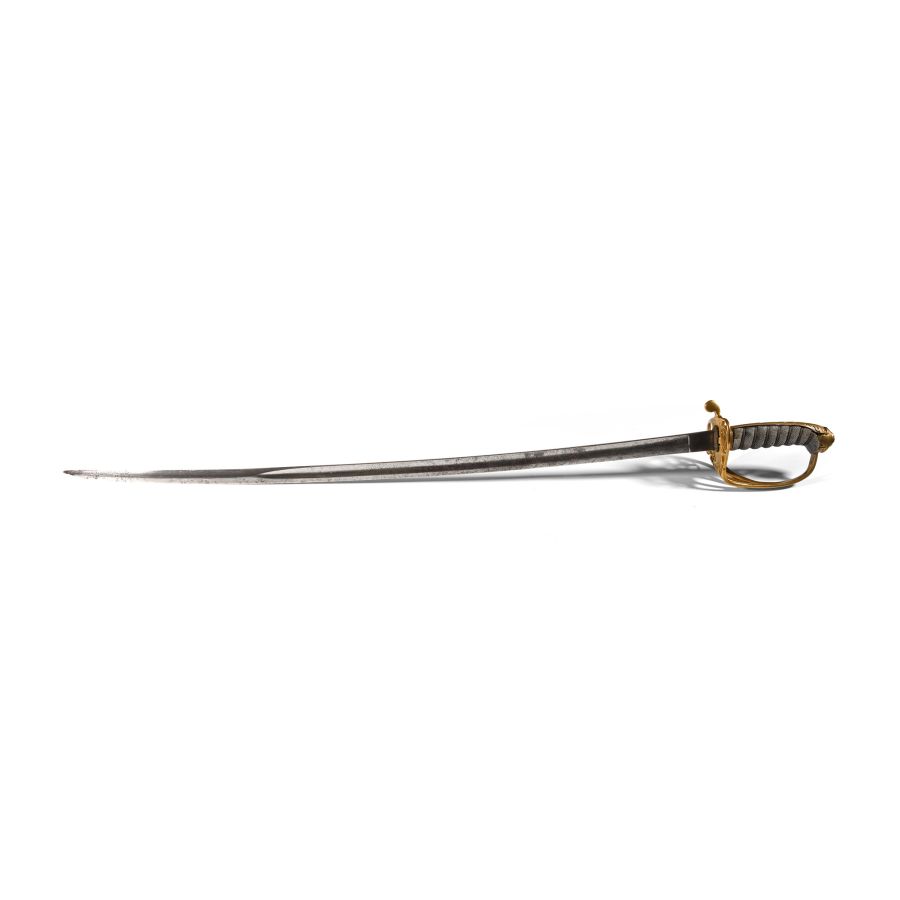
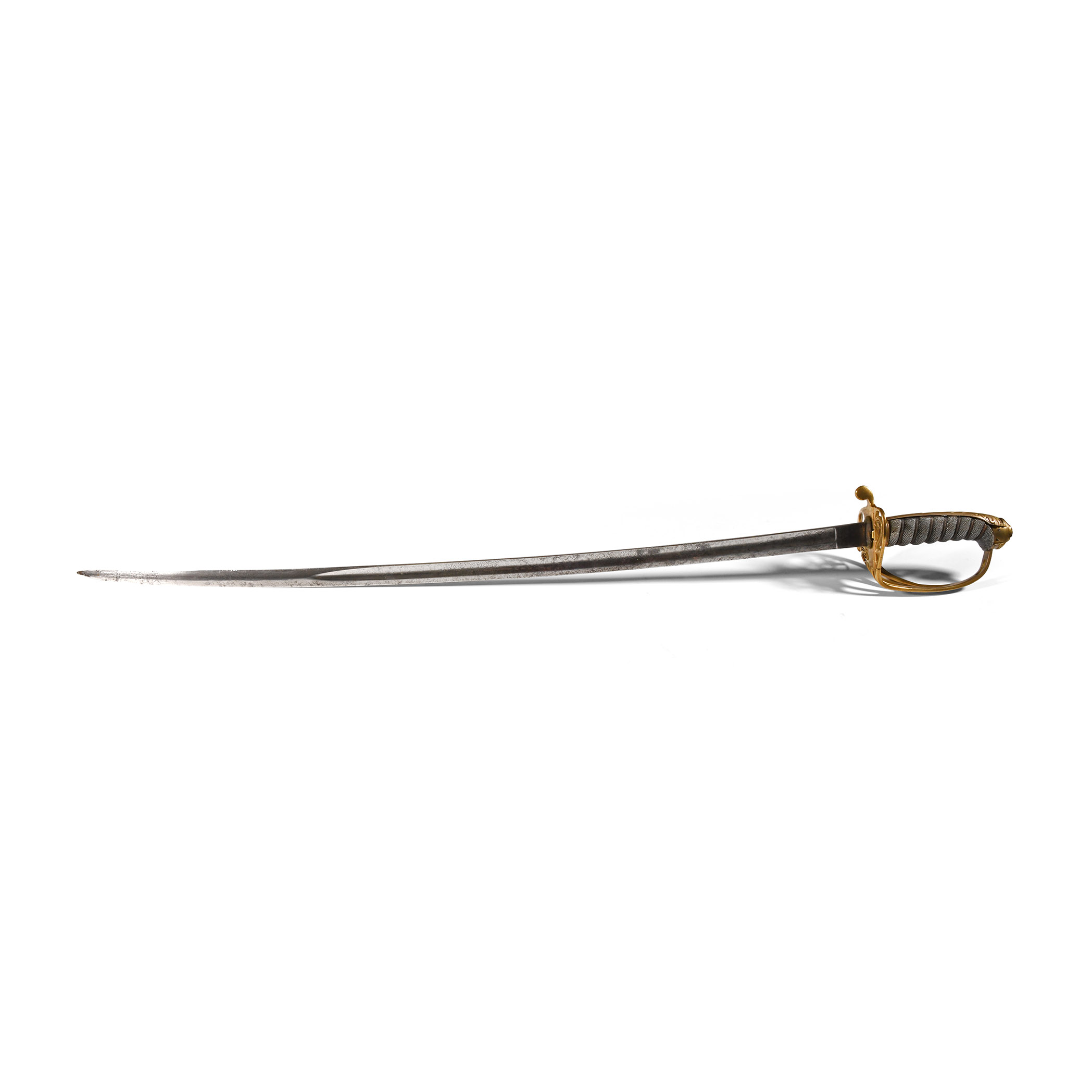
Victorian 1845 Pattern Officer's Sword by Buckmaster
19TH CENTURY A.D.
38 1/4 in. (733 grams, 97 cm).
Composed of a slightly curved and fullered blade with crowned VR monograms, royal arms and maker's name and London address; with half-basket pierced brass guard and hilt bearing openwork crowned VR monogram; ray skin hilt with wire binding,
ProvenanceAcquired from ROA Antique Arms, UK.
The Kusmirek Collection, UK.
Accompanied by a copy of the ROA purchase invoice and listing.
TimeLine Auctions follows a vetting process to ensure the authenticity and legality of all items, reinforcing our commitment to integrity and responsible trading. Each antiquity, antique, and coin lot undergoes thorough examination by a vetting committee of at least ten external specialists, professional trade association members, scientists, and archaeologists: Our Vetting Process
AUCTIONS:
TimeLine is a leading auction house specialising in antiquities, ancient art, collectables, natural history, coins, medals, and books. Our auctions offer museums, collectors, historians, and enthusiasts the opportunity to acquire unique and historically significant pieces.
LOT 1039
Victorian 1845 Pattern Officer's Sword by Buckmaster
Estimate £200 - 300€230 - 350 (for guidance only)$270 - 410 (for guidance only)
-
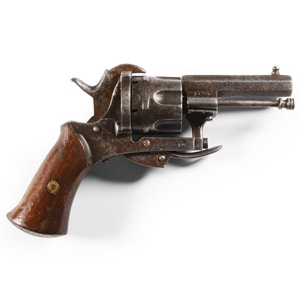
Belgian Pinfire Pocket Revolver
1877-1900 A.D.Sold for (Inc. bp): £143
Six-shot 7mm calibre double action Belgian proofed revolver with 55mm (2¼") barrel with hinged loading gate, extractor mounted at right side, folding trigger and fitted with plain wood butt scales; action stiff. 245 grams, 14 cm
Acquired from ROA Antique Arms Ltd. The Kusmirek Collection, UK. Accompanied by copy of the ROA listing.
Sold as an exempt item under Section 58 (2) of the Firearms Act, 1968, to be held as a curiosity or ornament. No license required but buyer must be over 18 years of age. Overseas bidders should note that, due to UK regulations governing export of all firearms, overseas buyers will need to make arrangements for shipping this lot out of the UK directly, by air freight, with a specialist company or agent. -
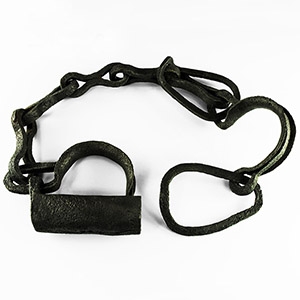
Medieval Prisoner's Iron Shackle and Fetter
14th-15th century A.D.Sold for (Inc. bp): £260
Comprising five rectangular-section doubled links with curved fetter and two loops to one end, barrel lock and hasp to the other. 2.2 kg, 87 cm
Fine condition; lock mechanism absent.
Acquired in the 1990s. From an important English collection. -
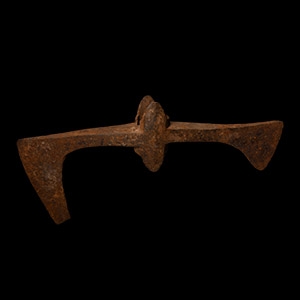
Eastern Roman Iron Double Axehead
11th-14th century A.D.Sold for (Inc. bp): £221
Composed of a central circular socket with flanges, one head with extended lower blade, the other with a wedge-shaped head. 1.8 kg, 36 cm
Acquired 1990s-early 2000s. East Anglian private collection.
This kind of 'Tzikourion' is found in all the Eastern Roman territories from 11th to 14th century A.D., and in many South East European territories. The overall design and the massive T-shaped hafting socket are very similar to those of an 11th century war axe from Cozanesti, Moldova, and from various14th century A.D. specimens from Bulgaria.
