
Loading, please wait...
LOT 1433
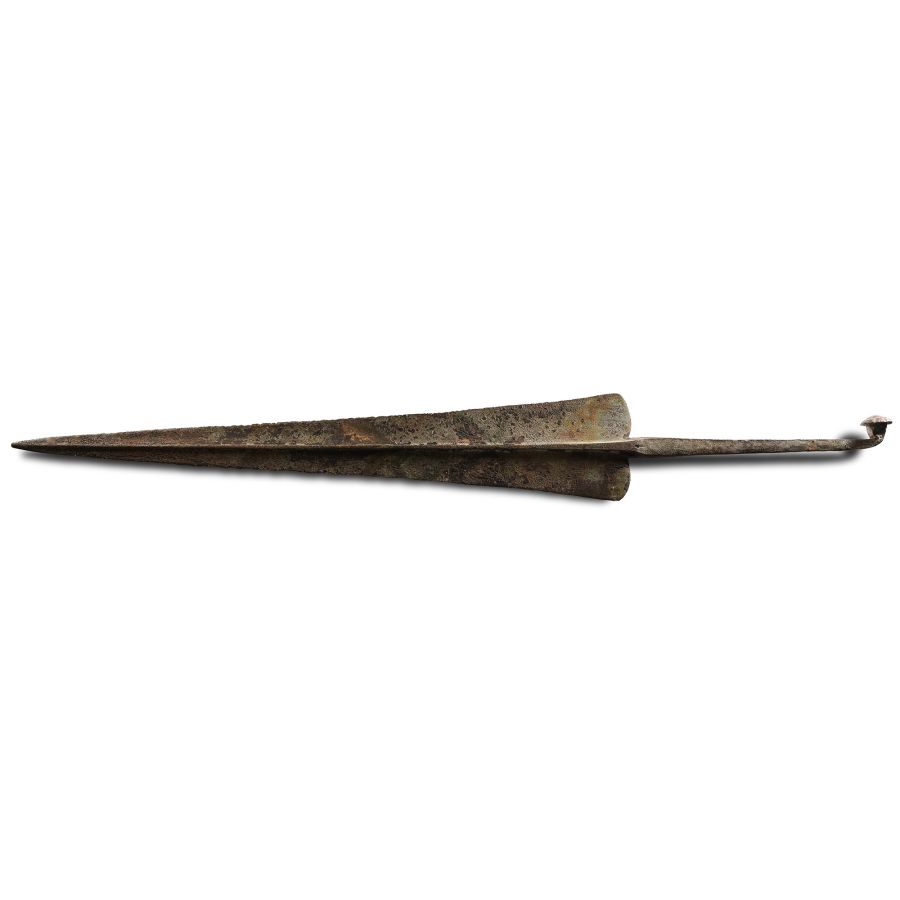
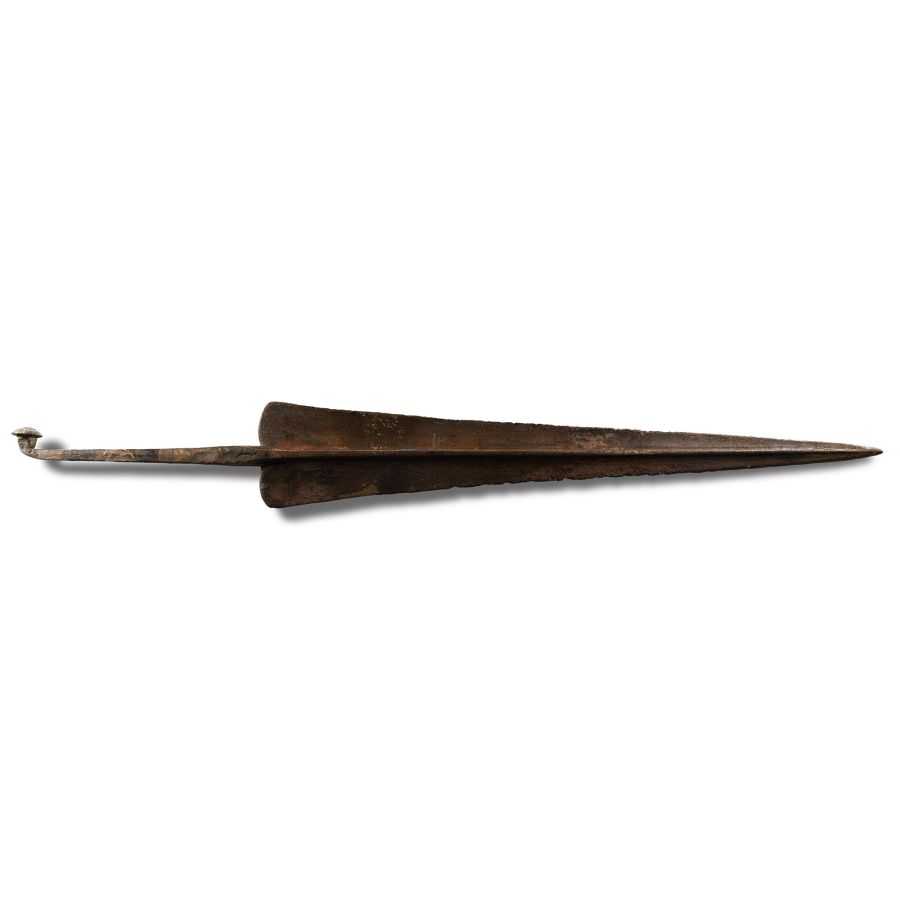
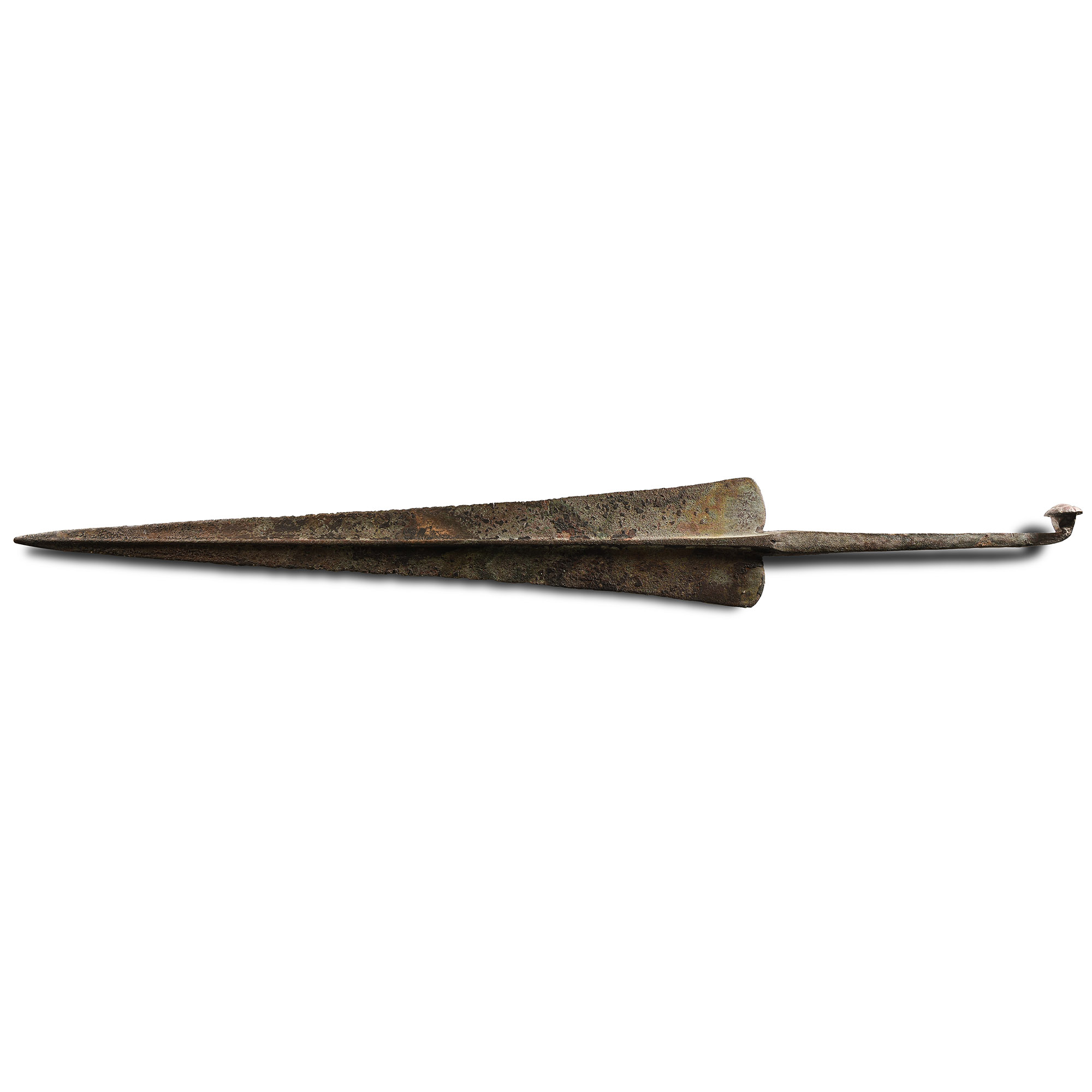
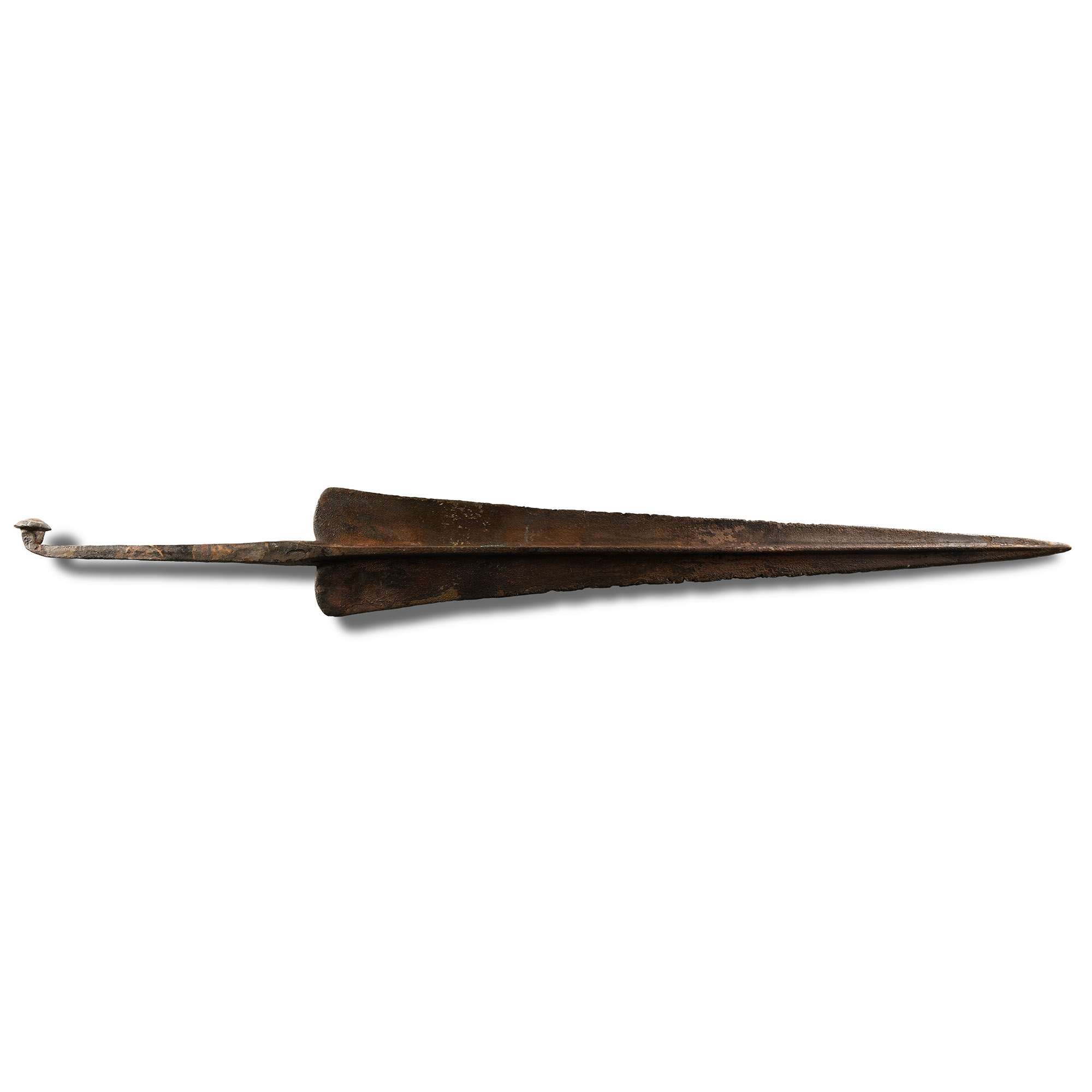
Very Large Tanged Bronze Spear
1900-1650 B.C.
28 3/4 in. (1.06 kg, 73 cm).
Each side rising to a pointed ridge, curved tang for attaching to a shaft. [No Reserve]
ProvenanceFrom a collection acquired on the UK art market from various auction houses and collections mostly before 2000.
From an important Cambridgeshire estate; thence by descent.
Cf. Comstock, M., Vermeule Cornelius, Greek, Etruscan & Roman Bronzes in the Museum of Fine Arts Boston, New York, 1971, p.397, no. 555, for similar; D'Amato, R., Salimbeti, A., Early Aegean Warrior 5000-1450 BC, Oxford, 2013, p.13, for similar specimens in the British Museum; cf. also Gernez, G., L’armament en métal au Proche et Moyen-Orient: des origines a 1750 av. J.C., Paris, 2007, fig.2.81, p.284.
FootnotesThe characteristic point is the hooked tang, the end of which was fitted with a button. The spear was inserted into a wooden barrel and then held in place with a series of leather laces (Gernez, 2007, p.312).
CONDITIONTimeLine Auctions follows a vetting process to ensure the authenticity and legality of all items, reinforcing our commitment to integrity and responsible trading. Each antiquity, antique, and coin lot undergoes thorough examination by a vetting committee of at least ten external specialists, professional trade association members, scientists, and archaeologists: Our Vetting Process
AUCTIONS:
TimeLine is a leading auction house specialising in antiquities, ancient art, collectables, natural history, coins, medals, and books. Our auctions offer museums, collectors, historians, and enthusiasts the opportunity to acquire unique and historically significant pieces.
-
North-West Persian Bronze Short Sword with Blood Channels
2nd-1st millennium B.C.Estimate: £250 - 350 (+bp*)
Opening Bid: £125
Shaped as a two-edged bronze blade, leaf-shape with short rectangular tang with fastening hole, corrugated midrib extending almost to the tip and flared at the shoulder. 439 grams, 44.2 cm
Acquired 1980-2015. Ex Abelita family collection.
The metalworking techniques used in making bronze weapons in Luristan were very complex. Surfaces were often finished in repoussé work, and some of the weapons were chased and others engraved. Many of the graves dating from the era of Kassite hegemony contain bronze and iron artefacts, including various type of weapons. These swords with shallow fullers tapering to a sharp tip have been dated by P.R.S. Moorey to the end of the 2nd millennium B.C. -
.jpg)
Western Asiatic Bronze Arrowheads, Javelin Heads and Daggers
3rd millennium-7th century B.C.Sold for (Inc. bp): £195
Comprising ten slender tanged arrowheads, javelin heads and daggers, some lozenge-section and some with raised midribs. 329 grams total, 14-21.5 cm
Acquired 1980-2015. Ex Abelita family collection.
Most of these blades are bipartite, but the definition of the bipartite type is not absolute as it brings together weapons of very different and unrelated designs. In fact, some weapons do not have a sufficiently characteristic shape to be interpreted as a spear, dagger, or long arrowhead. The javelin heads classified by Gernez as type Type L 3 are characterized by the simplicity of their design. They have a sharp and/or pointed active part, a flat, elliptical or rhomboidal cross-section and an elongated tang with a rectangular, square or circular section, ending in a pointed, widened, curved or folded blade. -
100 Civil War Period Lead Musket Balls
Circa 17th-18th century A.D.Sold for (Inc. bp): £78
Mixed group of lead-alloy musket and carbine balls,some with casting seam and sprue nipple. 1.57 kg total, 9-19 mm
Found Hertfordshire, UK.
