
Loading, please wait...
LOT 0537
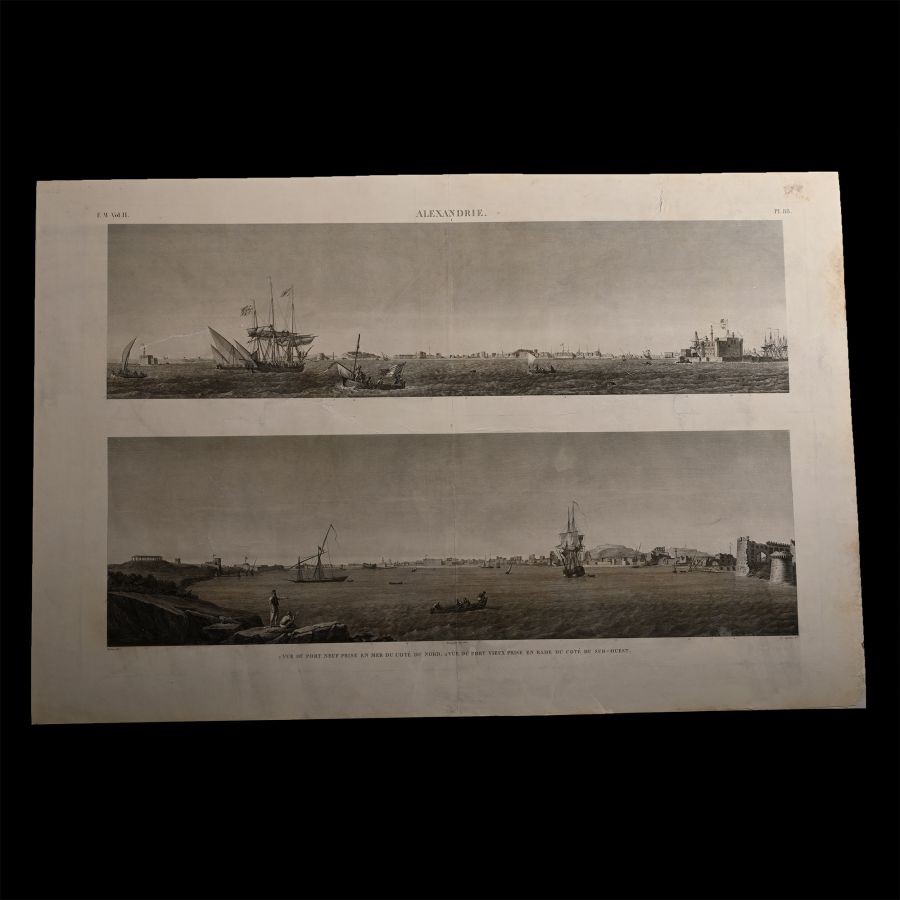
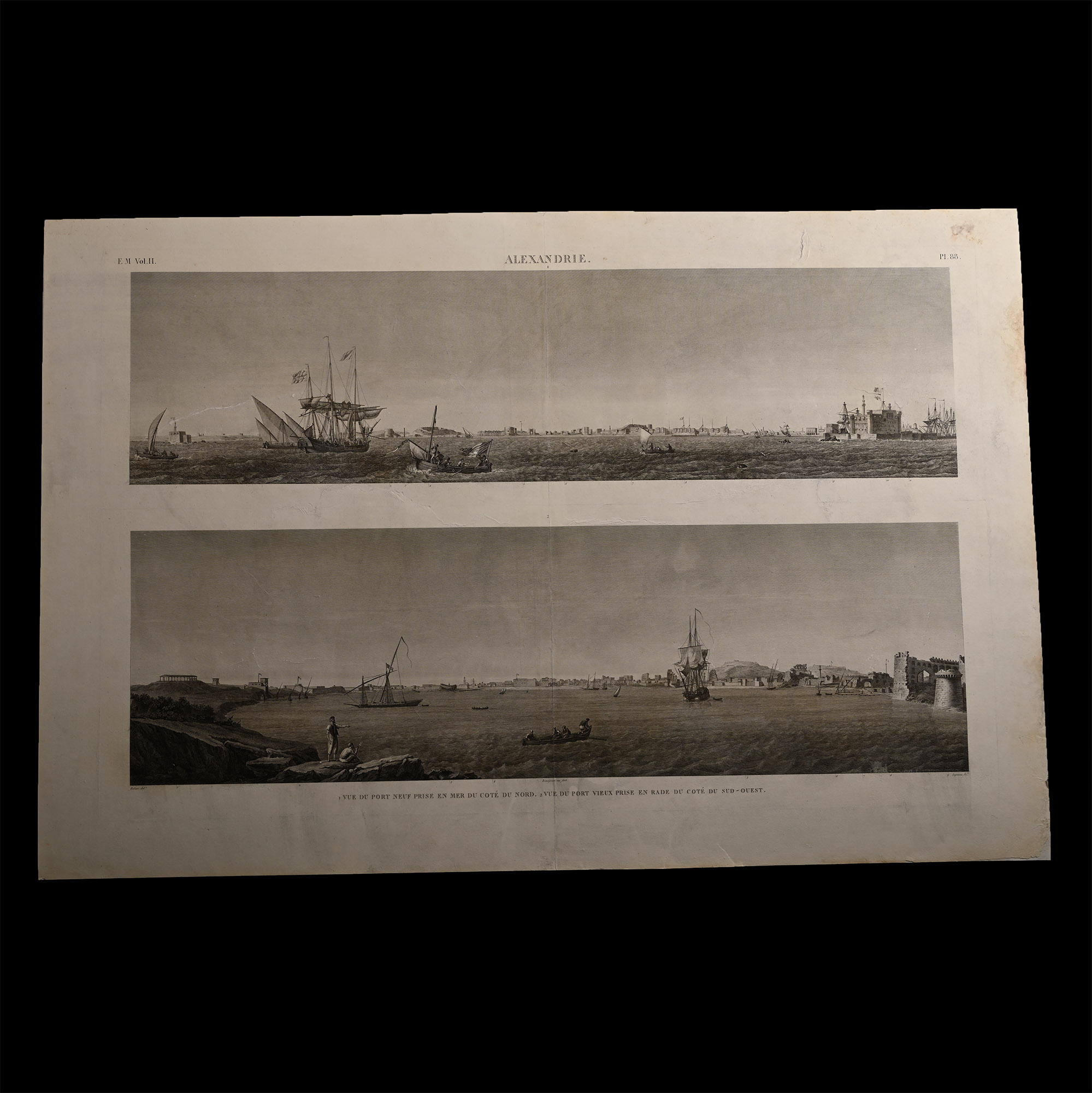
Very Large Egyptian Expedition Lithograph of Views of Alexandria
EARLY 19TH CENTURY A.D.
41 1/8 x 27 1/8 in. (259 grams, 104.5 x 69 cm).
Proof etching on laid paper of plate 88 from Description de l'Égypte : ou, Recueil des observations et des recherches qui ont été faites en Égypte pendant l'expédition de l'armée française. entitled 1. Vue du port neuf en mer du cote du nord. 2. Vue du port vieux prise en rade du cote du sud-ouest.
ProvenanceFrom the collection of a North American priest.
Acquired between 1981-1996.
Property of a North American collector.
Produced between February 1802 and 1830 on the orders of Napoleon Bonaparte; published between 1809 and 1828. Just 1,000 copies were distributed to various institutions, printed on laid paper with an 'Égypte ancienne et moderne' watermark. The book is subtitled Recueil des observations et des recherches qui ont été faites en Égypte pendant l’expédition de l’Armée française, publié par les ordres de Sa Majesté l’Empereur Napoléon le Grand (Gathering of observations and discoveries which were made in Egypt during the expedition of the French army, published on the orders of His Majesty the Emperor Napoleon the Great). It was the world's first encyclopedia devoted exclusively to the remains of ancient Egypt. The plates of this book are the first to present the archaeological sites of Thebes (Luxor).
CONDITIONTimeLine Auctions follows a vetting process to ensure the authenticity and legality of all items, reinforcing our commitment to integrity and responsible trading. Each antiquity, antique, and coin lot undergoes thorough examination by a vetting committee of at least ten external specialists, professional trade association members, scientists, and archaeologists: Our Vetting Process
AUCTIONS:
TimeLine is a leading auction house specialising in antiquities, ancient art, collectables, natural history, coins, medals, and books. Our auctions offer museums, collectors, historians, and enthusiasts the opportunity to acquire unique and historically significant pieces.
LOT 0537
Very Large Egyptian Expedition Lithograph of Views of Alexandria
Estimate £100 - 140€120 - 160 (for guidance only)$140 - 190 (for guidance only)
-
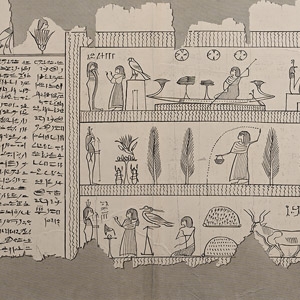
Very Large Egyptian Expedition Lithograph of the Hypogees Papyrus Manuscript from Thebes
Early 19th century A.D.Estimate: £100 - 140 (+bp*)
Opening Bid: £50
Proof etching on laid paper of plate 63 from Vol.II of Description de l'Égypte : ou, Recueil des observations et des recherches qui ont été faites en Égypte pendant l'expédition de l'armée française. entitled Thèbes. Hypogées. Manuscrit sur papyrus. 3eme partie. 272 grams, 103.5 x 69 cm
From the collection of a North American priest. Acquired between 1981-1996. Property of a North American collector.
Produced between February 1802 and 1830 on the orders of Napoleon Bonaparte; published between 1809 and 1828. Just 1,000 copies were distributed to various institutions, printed on laid paper with an 'Égypte ancienne et moderne' watermark. The book is subtitled Recueil des observations et des recherches qui ont été faites en Égypte pendant l’expédition de l’Armée française, publié par les ordres de Sa Majesté l’Empereur Napoléon le Grand (Gathering of observations and discoveries which were made in Egypt during the expedition of the French army, published on the orders of His Majesty the Emperor Napoleon the Great). It was the world's first encyclopedia devoted exclusively to the remains of ancient Egypt. The plates of this book are the first to present the archaeological sites of Thebes (Luxor). The papyrus manuscript was recovered from an underground tomb chamber (hypogeum). The scene depicts the Fields of Iaru, a verdant paradise in the ancient Egyptian afterlife, where the deceased could enjoy abundant harvests. -
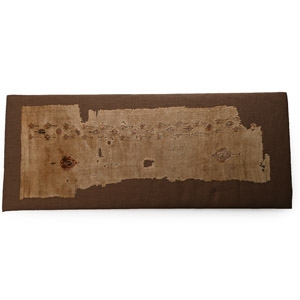
Large Mounted Egyptian Coptic Textile
Circa 5th-7th century A.D.Sold for (Inc. bp): £1,430
Possibly a fragment of a cloak, wool on linen, S-twist tapestry, decorated with a band of lanceolate leaves and two bigger opposed leaves in red, green and yellow colour. 345 grams total, mount: 86.5 cm
Acquired 1970s-1996. Property of a North American collector. London collection, 2016.
A. Gayet, who excavated the Necropolis of Antinoe, showed that the cloaks of Coptic-era nobles could be ornate, with decoration applied or woven into the fabric. Realised in dark blue, red, orange, yellow, green, brown and off-white linen and wool, the leaves are usually positioned inside a central medallion, also lanceolate, divided by a small leaf surmounted by a flower. -
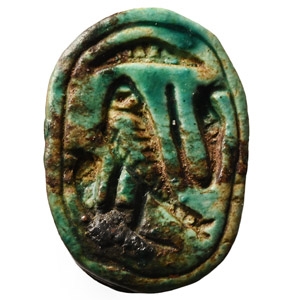
Egyptian Steatite Scarab with Horus and Uraeus
Late Period, 664-332 B.C.Sold for (Inc. bp): £104
Detailed carapace and head, underside with a rearing cobra and Horus in falcon form. 3.42 grams, 19 mm
Mrs Allinson to Mrs Foster, 1867 and thence by descent to the current owner, Stanley Crescent, London, UK.
