
Loading, please wait...
LOT 0413
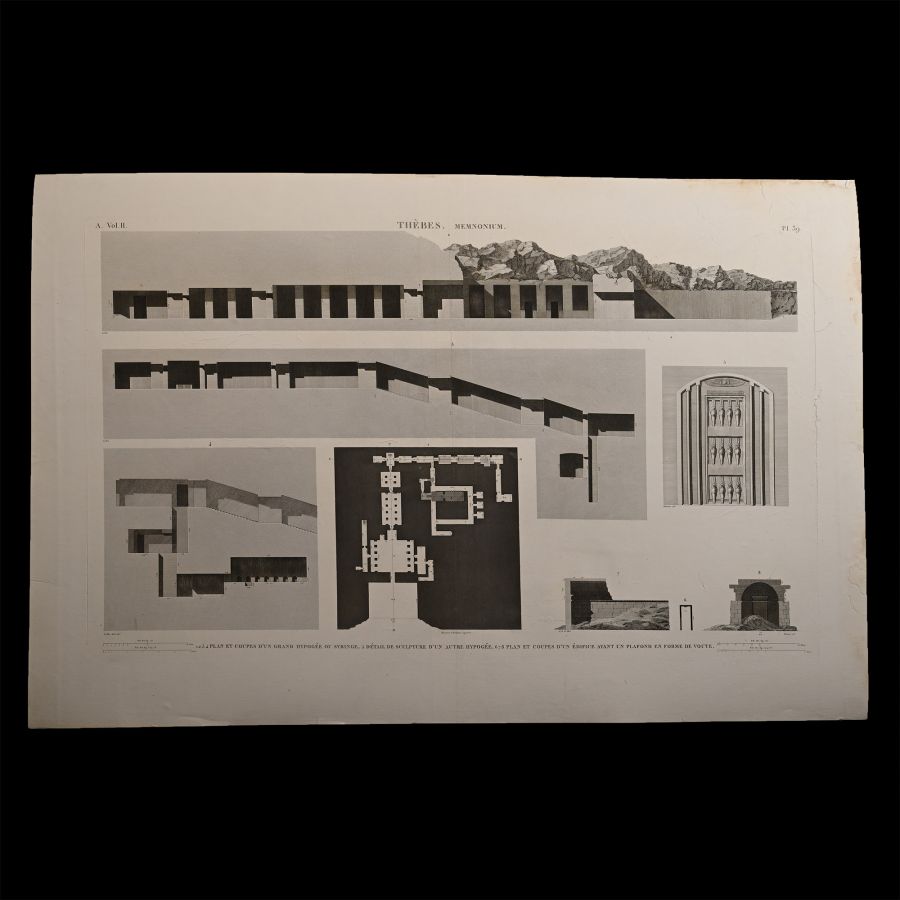
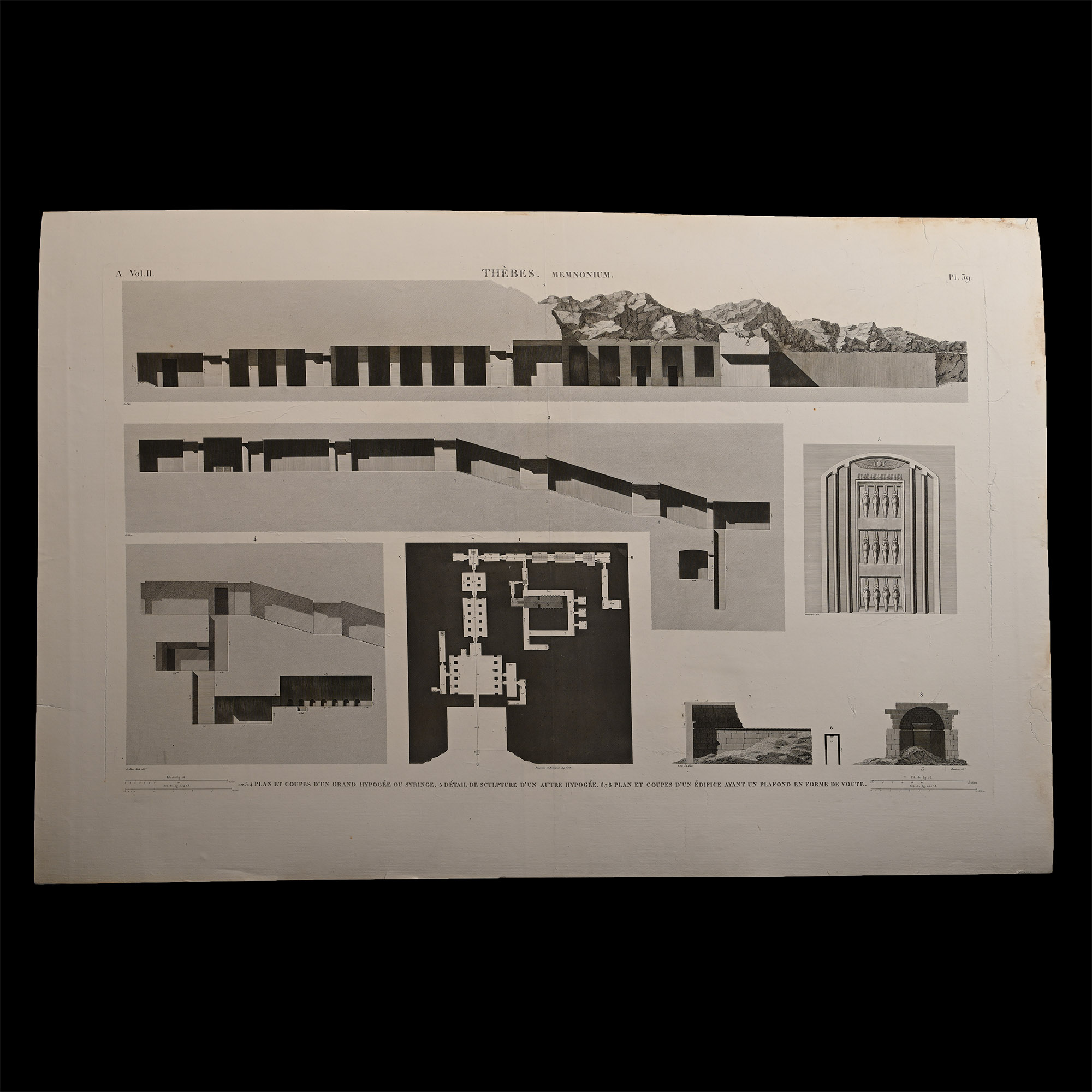
Very Large Egyptian Expedition Lithograph of the Memnonium at Thebes
EARLY 19TH CENTURY A.D.
40 3/4 x 27 1/4 in. (200 grams, 103.5 x 69.5 cm).
Proof etching on laid paper of plate 39 from Vol.II of Description de l'Égypte : ou, Recueil des observations et des recherches qui ont été faites en Égypte pendant l'expédition de l'armée française. entitled Thèbes. Memnonium. Plan et coupes d'un grand hypogée ou syringe. Détail de sculpture d'un autre hypogée. Plan et coupes d'un édifice avant un plafond en form de voûte.
ProvenanceFrom the collection of a North American priest.
Acquired between 1981-1996.
Property of a North American collector.
Produced between February 1802 and 1830 on the orders of Napoleon Bonaparte; published between 1809 and 1828. Just 1,000 copies were distributed to various institutions, printed on laid paper with an 'Égypte ancienne et moderne' watermark. The book is subtitled Recueil des observations et des recherches qui ont été faites en Égypte pendant l’expédition de l’Armée française, publié par les ordres de Sa Majesté l’Empereur Napoléon le Grand (Gathering of observations and discoveries which were made in Egypt during the expedition of the French army, published on the orders of His Majesty the Emperor Napoleon the Great). It was the world's first encyclopedia devoted exclusively to the remains of ancient Egypt. The plates of this book are the first to present the archaeological sites of Thebes (Luxor).
CONDITIONTimeLine Auctions follows a vetting process to ensure the authenticity and legality of all items, reinforcing our commitment to integrity and responsible trading. Each antiquity, antique, and coin lot undergoes thorough examination by a vetting committee of at least ten external specialists, professional trade association members, scientists, and archaeologists: Our Vetting Process
AUCTIONS:
TimeLine is a leading auction house specialising in antiquities, ancient art, collectables, natural history, coins, medals, and books. Our auctions offer museums, collectors, historians, and enthusiasts the opportunity to acquire unique and historically significant pieces.
LOT 0413
Very Large Egyptian Expedition Lithograph of the Memnonium at Thebes
Sold for (Inc. bp): £117
-
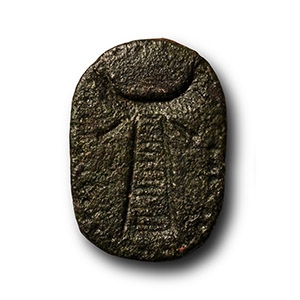
Phoenicio-Egyptian Dark Green Stone Scarab
Circa 9th-8th century B.C.Sold for (Inc. bp): £195
With textured carapace, bull-horned column to the reverse, possibly a symbol of Tanit. 3.94 grams, 15 mm
From the property of the late Mr SM, London, UK, 1969-1999. This lot is accompanied by an illustrated lot declaration signed by the Head of the Antiquities Department, Dr Raffaele D'Amato.
The widespread adoption of the scarab, both as a symbol linked to the concept of rebirth, and in its function as a seal, exemplifies the extent of Egyptian influence on Phoenician culture, from its origins in the Levant to its spread across the Mediterranean. -
.jpg)
Large Egyptian Red Stone Scarab
Late Period, 664-332 B.C.Sold for (Inc. bp): £468
Plano-convex in section, carved in the half-round scarab with segmented carapace; underside plain. 56.6 grams, 42 mm
with Archaeologia, Switzerland, before 1983. Ex private North American collection. London private collection, 2016. -
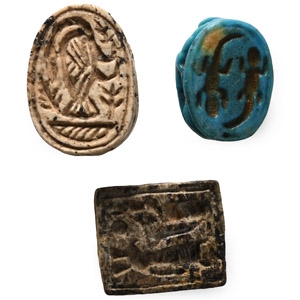
Egyptian Steatite and Faience Scarab Group
Late Period, 664-332 B.C.Sold for (Inc. bp): £299
Comprising: a vibrant blue scarab with two crocodiles on the underside; a cream-coloured scaraboid with a trussed duck on the underside; a square plaque with two scarabs on the upper side, and a hawk-headed god before a seated figure of Amun on the underside. 7.3 grams total, 15-19 mm
From the collection of a gentleman, acquired on the London art market in the 1990s.
