
Loading, please wait...
LOT 0524
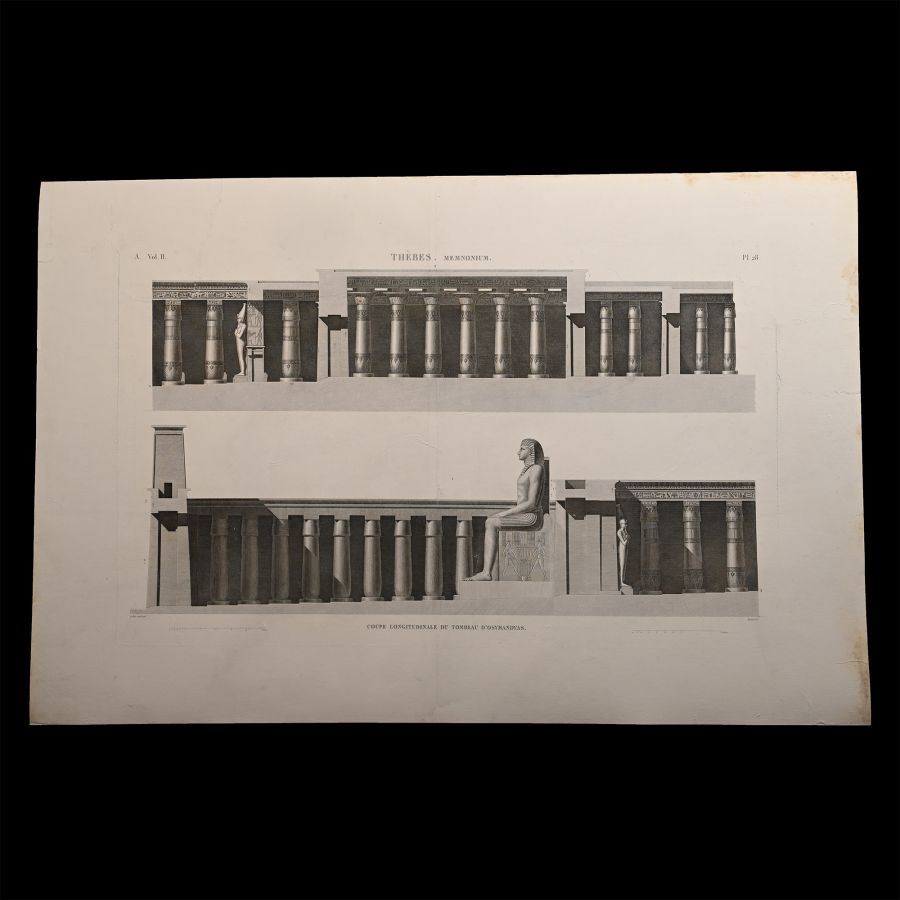
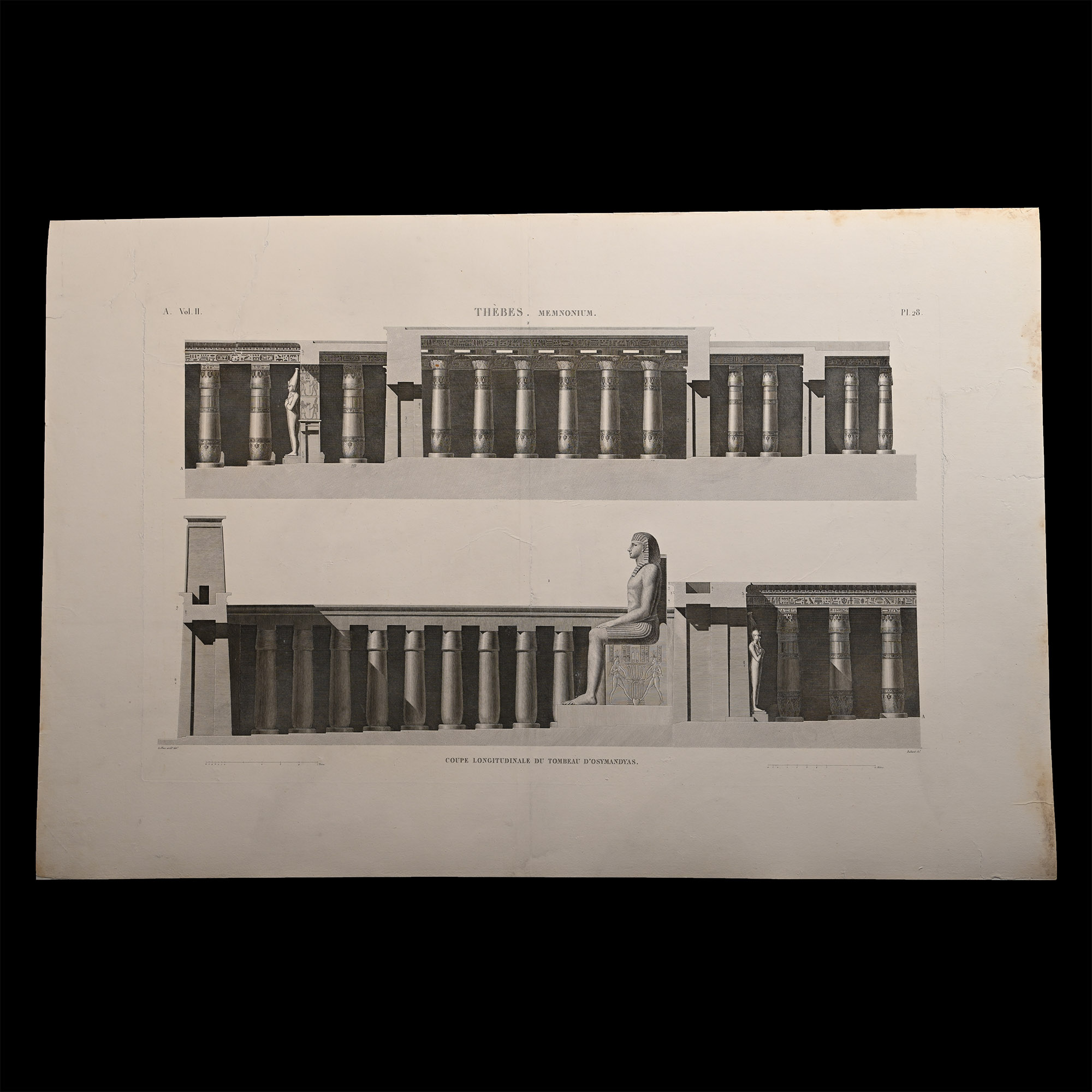
Very Large Egyptian Expedition Lithograph of the Memnonium at Thebes and Tomb of Ozymandias
EARLY 19TH CENTURY A.D.
41 1/4 x 27 1/8 in. (225 grams, 104.5 x 69 cm).
Proof etching on laid paper of plate 28 from Vol .I of Description de l'Égypte : ou, Recueil des observations et des recherches qui ont été faites en Égypte pendant l'expédition de l'armée française. entitled Thèbes. Memnonium. Coupe longitudinale du tombeau d'Osymandyas.
ProvenanceFrom the collection of a North American priest.
Acquired between 1981-1996.
Property of a North American collector.
Produced between February 1802 and 1830 on the orders of Napoleon Bonaparte; published between 1809 and 1828. Just 1,000 copies were distributed to various institutions, printed on laid paper with an 'Égypte ancienne et moderne' watermark. The book is subtitled Recueil des observations et des recherches qui ont été faites en Égypte pendant l’expédition de l’Armée française, publié par les ordres de Sa Majesté l’Empereur Napoléon le Grand (Gathering of observations and discoveries which were made in Egypt during the expedition of the French army, published on the orders of His Majesty the Emperor Napoleon the Great). It was the world's first encyclopedia devoted exclusively to the remains of ancient Egypt. The plates of this book are the first to present the archaeological sites of Thebes (Luxor). The "Memnonium" is the Greek name for the mortuary temple of Ramesses II, now known as the Ramesseum.
CONDITIONTimeLine Auctions follows a vetting process to ensure the authenticity and legality of all items, reinforcing our commitment to integrity and responsible trading. Each antiquity, antique, and coin lot undergoes thorough examination by a vetting committee of at least ten external specialists, professional trade association members, scientists, and archaeologists: Our Vetting Process
AUCTIONS:
TimeLine is a leading auction house specialising in antiquities, ancient art, collectables, natural history, coins, medals, and books. Our auctions offer museums, collectors, historians, and enthusiasts the opportunity to acquire unique and historically significant pieces.
LOT 0524
Very Large Egyptian Expedition Lithograph of the Memnonium at Thebes and Tomb of Ozymandias
Estimate £100 - 140€120 - 160 (for guidance only)$140 - 190 (for guidance only)
-
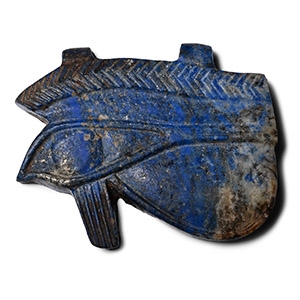
Egyptian Lapis Lazuli Wedjat Eye
Third Intermediate Period-Late Period, 1069-332 B.C.Sold for (Inc. bp): £2,210
Sizeable and finely detailed Eye of Horus, wedjat, with both falcon and human elements, visible gold flecks in places (characteristic of this stone), and two suspension loops on the top. 18.8 grams, 46 mm
From the collection of a gentleman, acquired on the London art market in the 1990s. This lot is accompanied by an illustrated lot declaration signed by the Head of the Antiquities Department, Dr Raffaele D'Amato.
This finely carved wedjat-eye amulet is a representation of the healed eye of the god Horus, featuring both human and falcon elements. The name wedjat in ancient Egyptian means ‘the one that is sound.’ According to Egyptian mythology, Horus' eye was wounded or taken by the god Seth and restored by Thoth. The wedjat-eye amulet was thought to protect its wearer and bestow the power of recovery and regeneration onto them. It was very popular and used by both the living and the dead. -
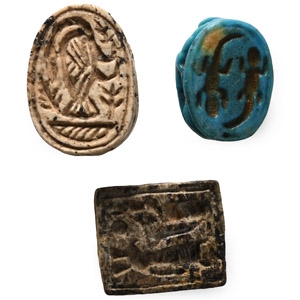
Egyptian Steatite and Faience Scarab Group
Late Period, 664-332 B.C.Sold for (Inc. bp): £299
Comprising: a vibrant blue scarab with two crocodiles on the underside; a cream-coloured scaraboid with a trussed duck on the underside; a square plaque with two scarabs on the upper side, and a hawk-headed god before a seated figure of Amun on the underside. 7.3 grams total, 15-19 mm
From the collection of a gentleman, acquired on the London art market in the 1990s. -
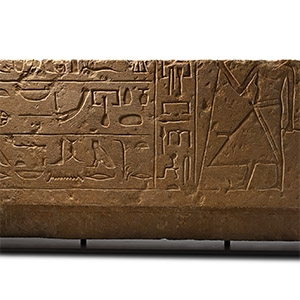
Egyptian Limestone Relief of Shepset
Old Kingdom, 5th-6th Dynasty, circa 2513-2200 B.C.Sold for (Inc. bp): £9,360
Rectangular relief featuring three horizontal bands of hieroglyphic text, which preserve part of an offering formula and two titles: Overseer of all fruit trees (ı͗my-rꜢ ḫt nb(t) bnrt) and Overseer of the King’s repast (ı͗my-rꜢ Ꜥbw-rꜢ nswt); a vertical panel displays two more titles: Courtier of the (royal) house (smr pr), Director of the Dining Hall of the Great House (ḫrp sḥ pr-ꜤꜢ), and the deceased's name Shepset (šps.t); to the right, there is a standing figure of the deceased dressed in a long kilt and holding a staff of office; mounted on a custom-made display stand. 27.3 kg total, 70 cm wide including stand
Acquired 1970s-1996. Private collection, Switzerland. with a North American collector. London collection, 2016. Accompanied by an academic report by Egyptologist Paul Whelan. This lot has been checked against the Interpol Database of stolen works of art and is accompanied by search certificate number no.12944-244463.
The deceased's name is somewhat unusual. The name ends with a bread loaf sign, suggesting it belongs to a female, which is clearly not the case here. Even if one reads the seated figure as a determinative, which would render the name as Set (st), this too would belong to a female. It could simply be an error by the layout scribe and/or sculptor, or the name may be incomplete. The lower border was a decorative feature used both horizontally and vertically to define distinct zones, or registers, in tomb reliefs. The original position of the present fragment may be suggested by a similarly arranged text-and-figure composition decorating the lintel of the doorway leading to the funerary chapel in a tomb at Giza belonging to a man named Ankhaf. Although oriented in the opposite direction, the staff-holding, standing figure of Ankhaf is depicted before a vertical column of inscription, with three longer horizontal bands of text to the right. The first two horizontal lines contain an offering formula invoking Anubis and Osiris, while the third line lists his titles. These are partly repeated in the vertical column, followed by Ankhaf’s name. The decorative border beneath the inscriptions on the present example would not seem out of place in such a setting. Another plausible location for the original placement of the present fragment would be the architrave of a tomb’s false door – the symbolic portal through which the deceased could re-enter the world of the living and partake in food offerings made by priests or relatives. In either location, the composition identifies the tomb owner by image and name, states his official credentials, and designates him as the sole recipient of the offerings listed in the accompanying formula.
