
Loading, please wait...
LOT 0466
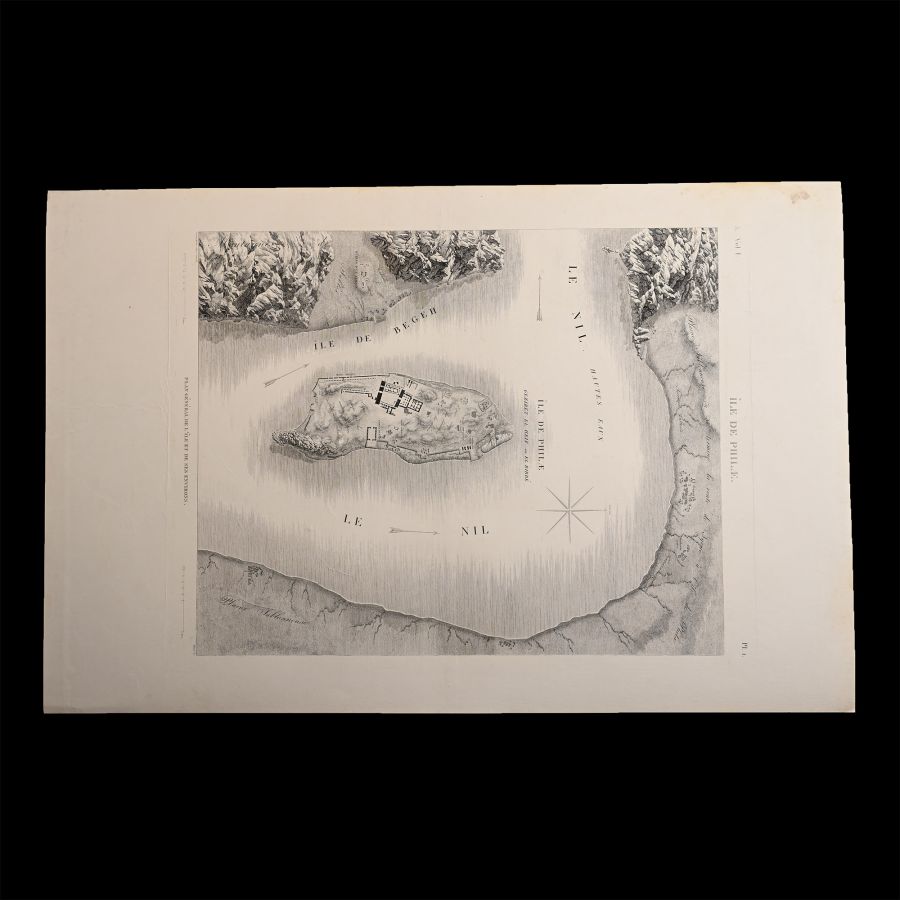
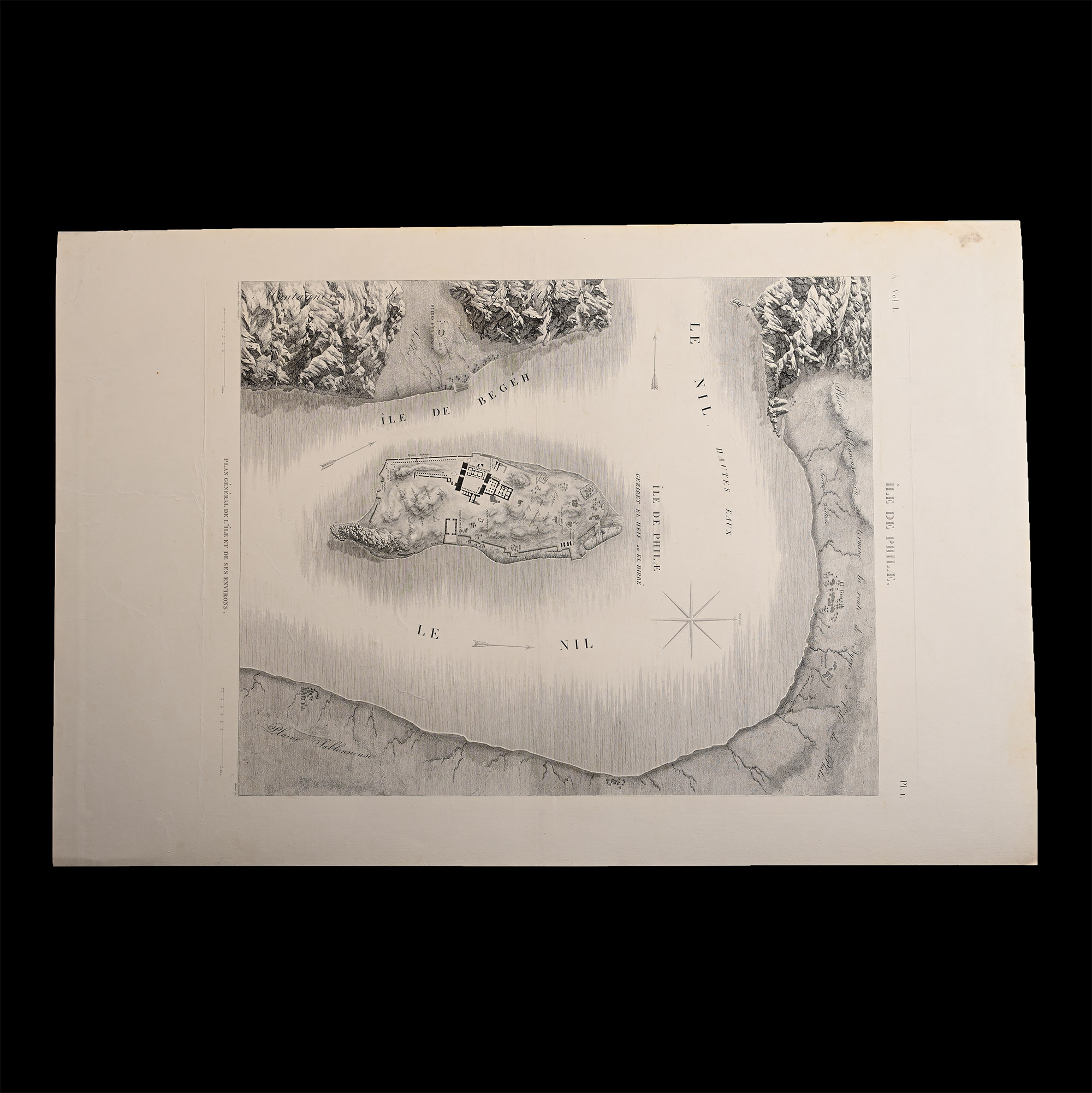
Very Large Egyptian Expedition Lithograph of the Isle of Philae
EARLY 19TH CENTURY A.D.
41 x 27 1/8 in. (255 grams, 104 x 69 cm).
Proof etching on laid paper of plate 1 from Île de Philae entitled Plan Général de l'île et de ses environs.
ProvenanceFrom the collection of a North American priest.
Acquired between 1981-1996.
Property of a North American collector.
Produced between February 1802 and 1830 on the orders of Napoleon Bonaparte; published between 1809 and 1828. Just 1,000 copies were distributed to various institutions, printed on laid paper with an 'Égypte ancienne et moderne' watermark. The book is subtitled Recueil des observations et des recherches qui ont été faites en Égypte pendant l’expédition de l’Armée française, publié par les ordres de Sa Majesté l’Empereur Napoléon le Grand (Gathering of observations and discoveries which were made in Egypt during the expedition of the French army, published on the orders of His Majesty the Emperor Napoleon the Great). It was the world's first encyclopedia devoted exclusively to the remains of ancient Egypt. The plates of this book are the first to present the archaeological sites of Thebes (Luxor). The Philae temple complex was one of the monuments moved during the construction of the Aswan High Dam. It was carefully dismantled piece by piece and reassembled on the island of Agilkia.
CONDITIONTimeLine Auctions follows a vetting process to ensure the authenticity and legality of all items, reinforcing our commitment to integrity and responsible trading. Each antiquity, antique, and coin lot undergoes thorough examination by a vetting committee of at least ten external specialists, professional trade association members, scientists, and archaeologists: Our Vetting Process
AUCTIONS:
TimeLine is a leading auction house specialising in antiquities, ancient art, collectables, natural history, coins, medals, and books. Our auctions offer museums, collectors, historians, and enthusiasts the opportunity to acquire unique and historically significant pieces.
LOT 0466
Very Large Egyptian Expedition Lithograph of the Isle of Philae
Estimate £100 - 140€120 - 160 (for guidance only)$140 - 190 (for guidance only)
-
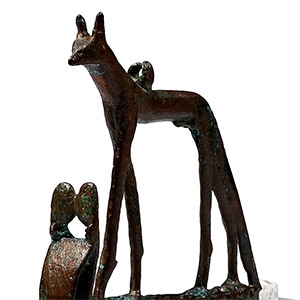
Large Egyptian Bronze Wepwawet Amulet
Third Intermediate-Late Period, 1069-332 B.C.Estimate: £3,500 - 4,500 (‡+bp*)
Opening Bid: £1,750
Showing the jackal deity Wepwawet standing with ears pricked on a sledge, the slender body modelled with long legs and a tail, suspension loop on the back; two rearing cobras before the jackal; mounted on a custom-made display stand. 54 grams, 91 mm (162 grams total, 11.7 cm including stand )
Ex Dr R. and Mrs L.B., Zumikon, Switzerland. with Galerie Rhéa, Zurich, Switzerland. This lot has been checked against the Interpol Database of stolen works of art and is accompanied by a search certificate number no.12627-236406.
Wepwawet, meaning "Opener of the Ways," was an ancient Egyptian god associated primarily with warfare, protection, and funerary practices. Depicted as a jackal or a man with a jackal's head—often mistaken for Anubis—Wepwawet was believed to guide souls through the afterlife and open paths both in battle and in the spiritual realm. He originated in Asyut (ancient Lycopolis) in Upper Egypt and was one of the oldest deities in the Egyptian pantheon, with worship dating back to at least the First Dynasty (c. 3100–2900 BCE). Over time, Wepwawet became closely linked to Anubis, and the two were sometimes conflated, though Wepwawet retained his distinct identity as a god who preceded and cleared the way. In military contexts, Wepwawet was invoked to "open the way" for pharaohs and armies, ensuring victory and safe passage. In funerary texts, he was described as clearing the path to the afterlife, acting as a scout or guide for the deceased. -
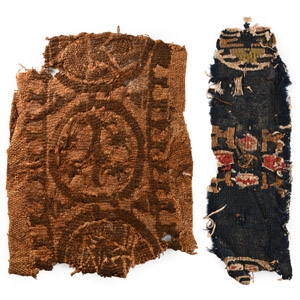
Egyptian Coptic Textile Fragment Group
Circa 4th-5th century A.D.Sold for (Inc. bp): £91
Comprising: a fragment of a clavus of tunic in purple wool on linen, embroidered with vegetal motifs patterned inside orbiculi, framed by straight borders with external crenellation; a fragment of segmentum in yellow, green and red wool, S torsion, embroidered with floral and geometric patterns. 46 grams total including package, 15-16 cm
Acquired 1970s-1996. Property of a North American collector. London collection, 2016.
The fragments are decorative parts of tunics. These are fabrics of great decorative finesse, with some elements displaying an unusual and extremely well-preserved color palette. The plant designs recall Iranian motifs. -
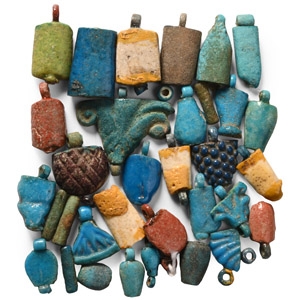
Egyptian Glazed Faience Bead and Amulet Collection
New Kingdom, 1550-1070 B.C.Sold for (Inc. bp): £143
Comprising various glazed amulets and beads, including grape bunch, lotus flower, and other types. 8.3 grams total, 2-19 mm
Ex Norri collection, Milton Keynes, UK, 1980s-1990s.
