
Loading, please wait...
LOT 0592
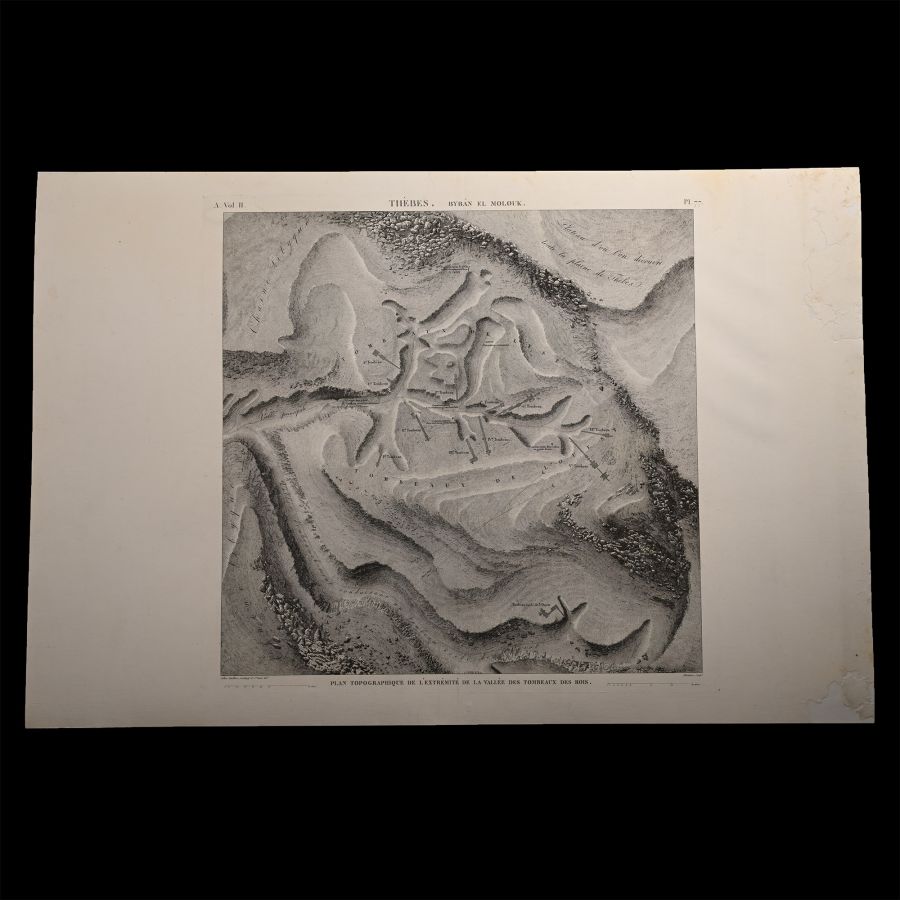
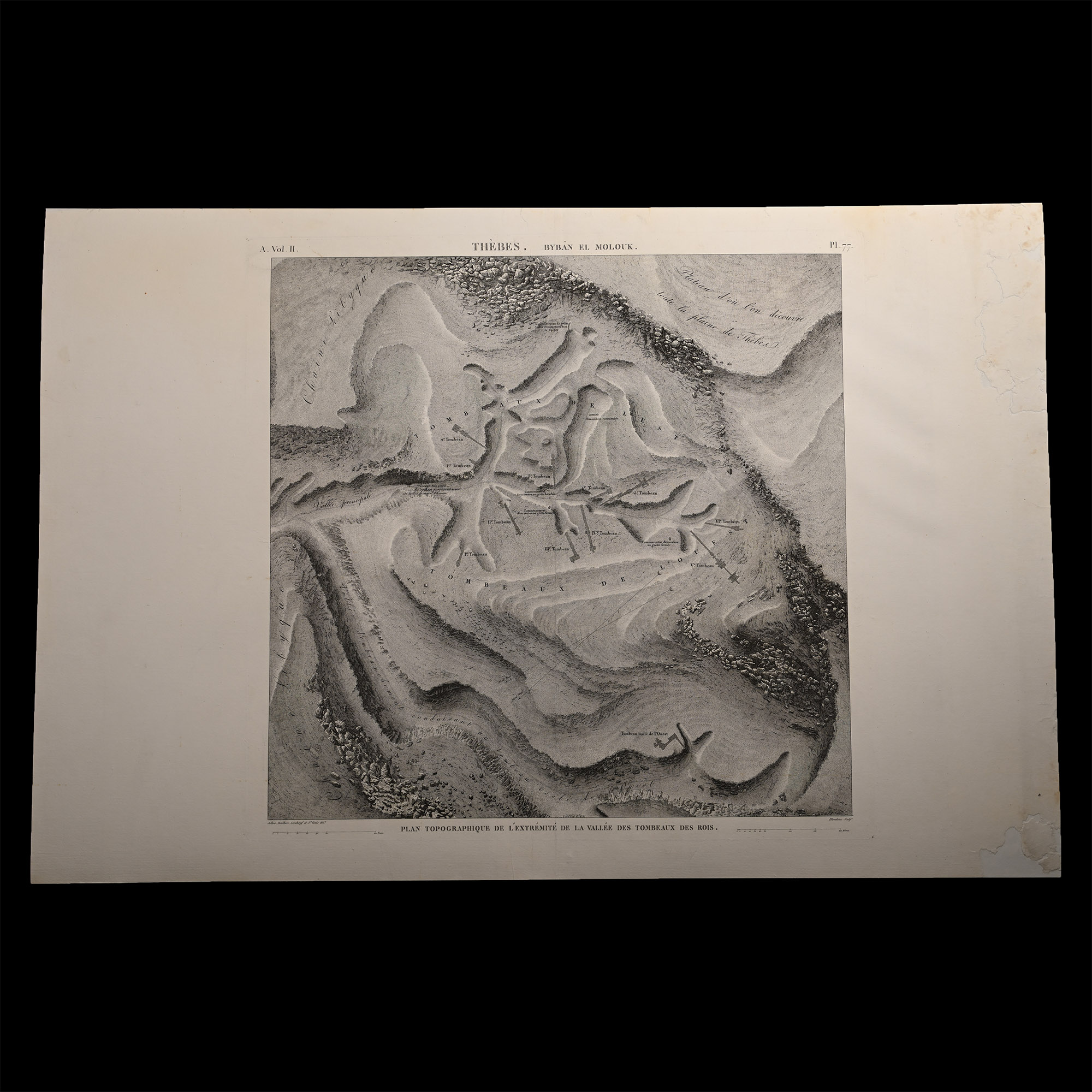
Very Large Egyptian Expedition Lithograph of a Plan of Thebes
EARLY 19TH CENTURY A.D.
40 3/8 x 27 1/8 in. (532 grams, 102.5 x 69 cm).
Proof etching on laid paper of plate 77 from Description de l'Égypte : ou, Recueil des observations et des recherches qui ont été faites en Égypte pendant l'expédition de l'armée française. entitled Thèbes. Bybân el-Molouk [Bîbân al-Mulûk]. Plan topographique de l'extrémité de la Vallée des Tombeaux des Rois.
ProvenanceFrom the collection of a North American priest.
Acquired between 1981-1996.
Property of a North American collector.
Produced between February 1802 and 1830 on the orders of Napoleon Bonaparte; published between 1809 and 1828. Just 1,000 copies were distributed to various institutions, printed on laid paper with an 'Égypte ancienne et moderne' watermark. The book is subtitled Recueil des observations et des recherches qui ont été faites en Égypte pendant l’expédition de l’Armée française, publié par les ordres de Sa Majesté l’Empereur Napoléon le Grand (Gathering of observations and discoveries which were made in Egypt during the expedition of the French army, published on the orders of His Majesty the Emperor Napoleon the Great). It was the world's first encyclopedia devoted exclusively to the remains of ancient Egypt. The plates of this book are the first to present the archaeological sites of Thebes (Luxor).
CONDITIONTimeLine Auctions follows a vetting process to ensure the authenticity and legality of all items, reinforcing our commitment to integrity and responsible trading. Each antiquity, antique, and coin lot undergoes thorough examination by a vetting committee of at least ten external specialists, professional trade association members, scientists, and archaeologists: Our Vetting Process
AUCTIONS:
TimeLine is a leading auction house specialising in antiquities, ancient art, collectables, natural history, coins, medals, and books. Our auctions offer museums, collectors, historians, and enthusiasts the opportunity to acquire unique and historically significant pieces.
LOT 0592
Very Large Egyptian Expedition Lithograph of a Plan of Thebes
Sold for (Inc. bp): £169
-
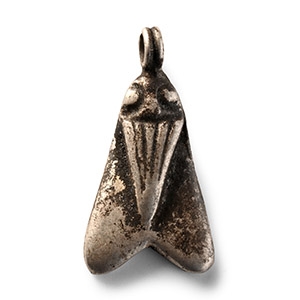
Egyptian Silver Fly Amulet
Late Period, 664-332 B.C.Sold for (Inc. bp): £195
With textured detailing to wings and body, loop for suspension. 1.33 grams, 20 mm
From a gentleman's family collection, 2000s. -
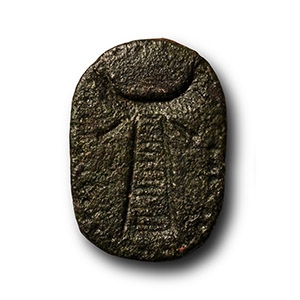
Phoenicio-Egyptian Dark Green Stone Scarab
Circa 9th-8th century B.C.Sold for (Inc. bp): £195
With textured carapace, bull-horned column to the reverse, possibly a symbol of Tanit. 3.94 grams, 15 mm
From the property of the late Mr SM, London, UK, 1969-1999. This lot is accompanied by an illustrated lot declaration signed by the Head of the Antiquities Department, Dr Raffaele D'Amato.
The widespread adoption of the scarab, both as a symbol linked to the concept of rebirth, and in its function as a seal, exemplifies the extent of Egyptian influence on Phoenician culture, from its origins in the Levant to its spread across the Mediterranean. -
.jpg)
Egyptian Hardstone Scarab
Late Period, 664-332 B.C.Estimate: £500 - 700 (+bp*)
Opening Bid: £250
With detailed clypeus and head, raised ridge separating the wing case, resting on an oval base with plain underside. 10.1 grams, 27 mm
From the property of a London, UK, gentleman, 1970-2000s.
The scarab, which represented the dung beetle, was the most popular amulet in ancient Egypt for approximately two thousand years until the Ptolemaic Period when it gradually fell out of favour. The popularity of scarabs extended beyond the borders of Egypt, and they were also distributed and produced in other regions, such as Phoenicia and Israel. The beetle is named khepri, derived from the verb 'to come into existence', and was considered the embodiment of the creator god Khepri, who was self-created. The ancient Egyptians mistakenly believed that the young beetle emerging from the dung ball was the result of an act of self-creation.
