
Loading, please wait...
_900x900.jpg "Urartu Bull-Headed Bronze Cauldron Applique Pair")
_200x200.jpg "Urartu Bull-Headed Bronze Cauldron Applique Pair")
.jpg "Urartu Bull-Headed Bronze Cauldron Applique Pair")
LOT 0248
Urartu Bull-Headed Bronze Cauldron Applique Pair
8TH CENTURY B.C.
3 1/8 - 5 1/8 in. (790 grams total, 8-13 cm wide).
Matched pair of bovine-head mounts, each formed as a pair of D-shaped wings and a tail with low-relief feather detailing and holes to accept rivets; central head and neck of a bull with prominent horns, bands of curly hair to the pate and throat, large scaphoid eyes, incised contour detailing to muzzle, socket to reverse. [2]
ProvenanceFrom the warehouse of Lane Hope Ltd, London, UK, 1980s (company dissolved December 1991).
Private collection, UK; anonymous sale, Gorny & Mosch, Munich, Auction 206, 20 June 2012, no.85.
European private collection, acquired at Gorny & Mosch, 2012.
Accompanied by a copy of an Art Loss Register certificate, no.6210.AM.
Accompanied by a copy of the relevant Gorny & Mosch catalogue pages.
This lot has been checked against the Interpol Database of stolen works of art and is accompanied by a search certificate number no.12696-234610.
This lot has been cleared against the Art Loss Register database, and is accompanied by an illustrated lot declaration signed by the Head of the Antiquities Department, Dr Raffaele D'Amato.
Cf. Mildenburg Collection, no.18 (Reign of Argishti II, King of Urartu, 713-685 B.C.); also see Sotheby's, New York, 17 December 1998, no.218, for a similar single example ($25,000-$35,000).
CONDITIONTimeLine Auctions follows a vetting process to ensure the authenticity and legality of all items, reinforcing our commitment to integrity and responsible trading. Each antiquity, antique, and coin lot undergoes thorough examination by a vetting committee of at least ten external specialists, professional trade association members, scientists, and archaeologists: Our Vetting Process
AUCTIONS:
TimeLine is a leading auction house specialising in antiquities, ancient art, collectables, natural history, coins, medals, and books. Our auctions offer museums, collectors, historians, and enthusiasts the opportunity to acquire unique and historically significant pieces.
LOT 0248
Urartu Bull-Headed Bronze Cauldron Applique Pair
Estimate £18,000 - 24,000€20,880 - 27,840 (for guidance only)$24,300 - 32,400 (for guidance only)
-
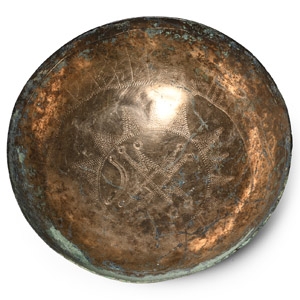
Sasanian Decorated Bronze Bowl
3rd-7th century A.D.Sold for (Inc. bp): £286
Hemispherical bowl with a decorative frieze to the inner rim, central solar motif surrounding a stylised cross motif. 118 grams, 14.3 cm
Acquired 1980-2015. Ex Abelita family collection. This lot has been cleared against the Art Loss Register database, and is accompanied by an illustrated lot declaration signed by the Head of the Antiquities Department, Dr Raffaele D'Amato. -
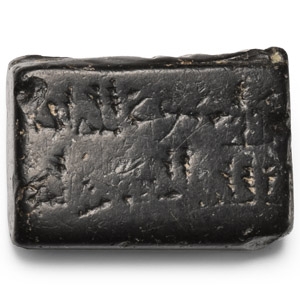
Western Asiatic Inscribed Stone Tablet
1st millennium B.C.Estimate: £180 - 240 (+bp*)
Opening Bid: £100
Rectangular in plan with pointillé cuneiform text to both broad faces. 9.8 grams, 27 mm
From the 'S' collection, acquired 1970-1990s. The collection was seen and studied by W.G. Lambert, late Professor of Assyriology at the University of Birmingham, 1970-1993. This lot has been cleared against the Art Loss Register database, and is accompanied by an illustrated lot declaration signed by the Head of the Antiquities Department, Dr Raffaele D'Amato. -
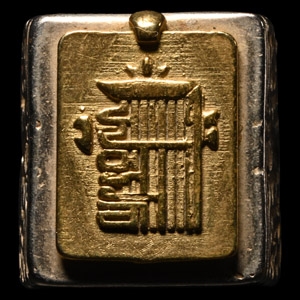
Western Asiatic Ring with Arabic Inscription
19th-20th century A.D.Sold for (Inc. bp): £33
A white metal ring with adjustable hoop, D-shaped shoulders with tendrils decoration, square bezel with openwork underside and applied gilt plaque bearing an Arabic inscription above. 19.78 grams, 26.18 mm overall, 18.33 mm internal diameter (approximate size British Q, USA 8, Europe 17.49, Japan 16)
Private collection, London, UK. This lot has been cleared against the Art Loss Register database, and is accompanied by an illustrated lot declaration signed by the Head of the Antiquities Department, Dr Raffaele D'Amato.
