
Loading, please wait...
LOT 0302
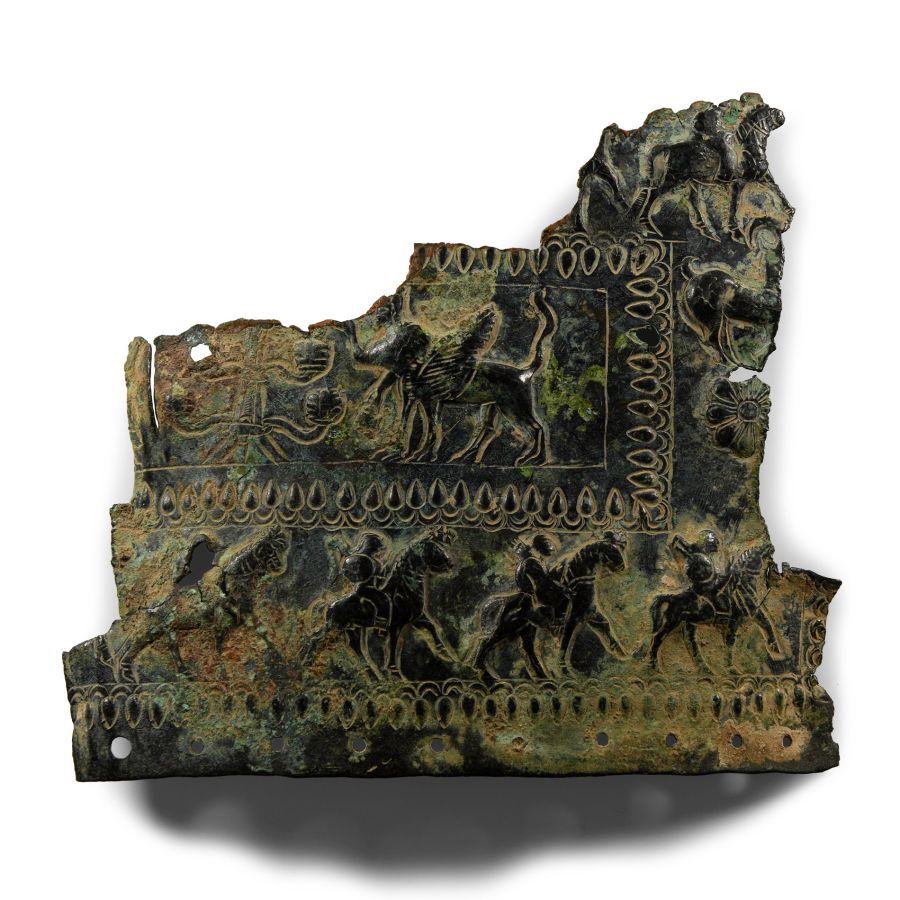
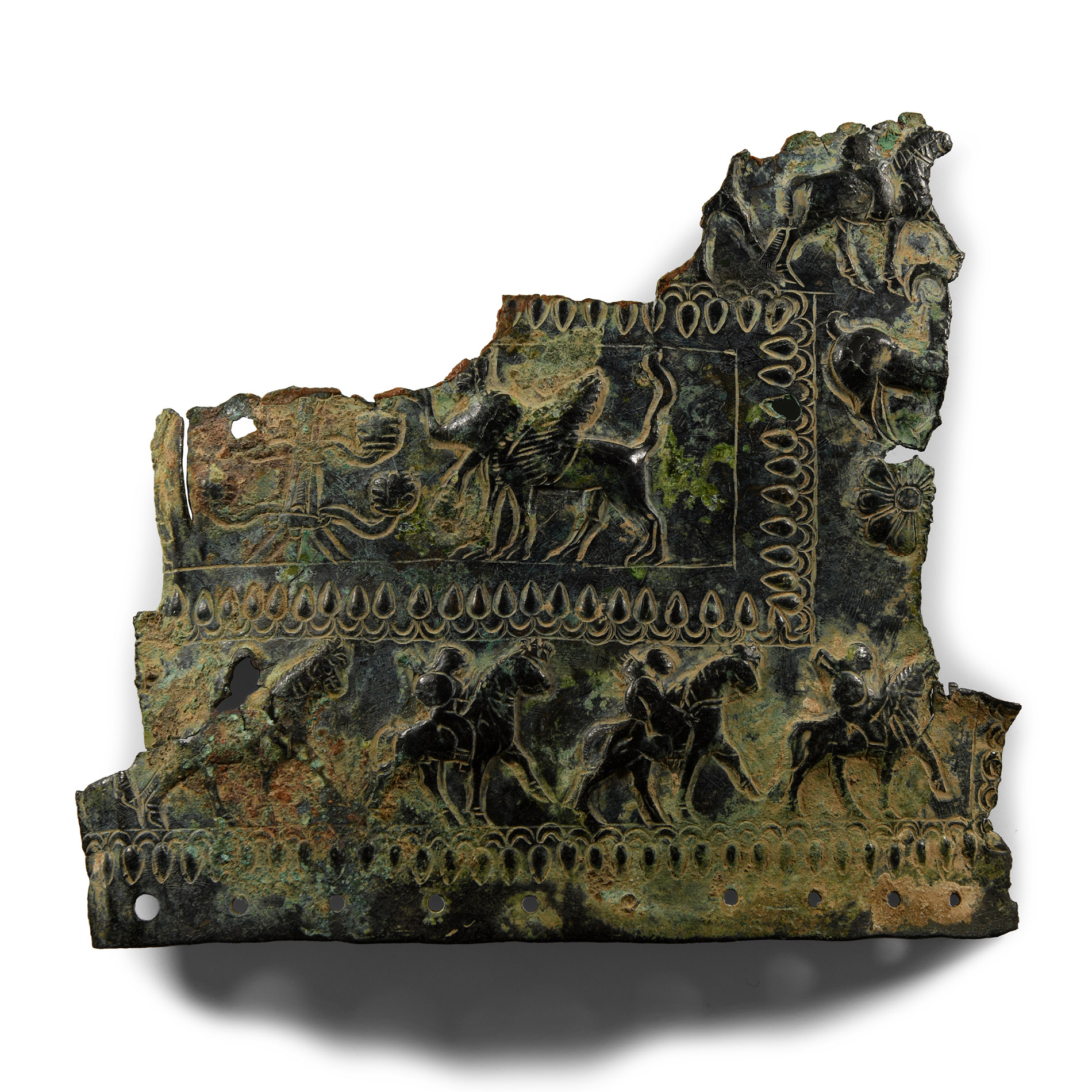
Urartu Bronze Repoussé Fragment with Advancing Warriors on Horseback
CIRCA 9TH-7TH CENTURY B.C.
4 1/2 in. (41 grams, 12 cm wide).
The rectangular fragment with repoussé leaf borders, the outer scene composed of advancing warriors on horseback, each rider holding a round shield and a quiver of arrows on his back, a horned animal and a rosette to the right; the central scene with a winged human-headed bull flanking a tree, possibly a pomegranate tree or a tree of life; the lower edge pierced for attachment.
ProvenanceFrom the property of the late Mr SM, London, UK, 1969-1999.
Accompanied by a previous catalogue information slip.
TimeLine Auctions follows a vetting process to ensure the authenticity and legality of all items, reinforcing our commitment to integrity and responsible trading. Each antiquity, antique, and coin lot undergoes thorough examination by a vetting committee of at least ten external specialists, professional trade association members, scientists, and archaeologists: Our Vetting Process
AUCTIONS:
TimeLine is a leading auction house specialising in antiquities, ancient art, collectables, natural history, coins, medals, and books. Our auctions offer museums, collectors, historians, and enthusiasts the opportunity to acquire unique and historically significant pieces.
LOT 0302
Urartu Bronze Repoussé Fragment with Advancing Warriors on Horseback
Sold for (Inc. bp): £1,560
-
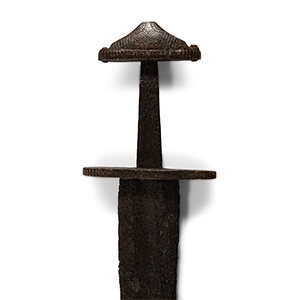
Viking Age Sword with Engraved Mammen Style Hilt
8th-9th century A.D.Sold for (Inc. bp): £6,500
Pattern-welded, double-edged tapering blade with a tapering tang; the boat-shaped lower guard, pommel, and upper guard decorated in Mammen Style with silver inlay; professionally conserved. 955 grams, 90.5 cm
Some light pitting in evidence along with minor edge loss, some delamination visible on the blade’s surface; professionally treated and preserved according to Museum’s standard.
From the Bornhauser collections. Ex A. Green private collection. Ex Balticum. with Army of Tennessee Relics, Knoxville, USA. Accompanied by an Army of Tennessee certificate of authenticity dated 5th October 2017. Accompanied by an academic report by Dr Raffaele D’Amato. This lot has been checked against the Interpol Database of stolen works of art and is accompanied by search certificate number no.12021-214091.
This beautiful Viking sword (probably a river find) shows engraved decoration in Mammen style (700-800 A.D.) and is an early type A according to the Petersen’s typology and classification. This category of swords evolved from the swords of the Vendel Period in Scandinavia, especially from the Swedish ones. Petersen originally individuated eight examples of this sword’s typology, one of the first categories of Viking swords, although these swords were also widely used in the Carolingian Empire. -
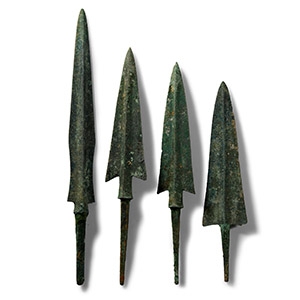
Luristan Spear Tip Group
13th-6th century B.C.Sold for (Inc. bp): £156
Comprising four tips with triangular blades; each with a raised midrib and a long tang. 143 grams total, 13.5-18.2 cm
Acquired 1980-2015. Ex Abelita family collection.
Although some of them are different in shape, these arrowheads are apparently related types of a polythetic group. Two basic deltoid forms are represented: one has a sharp, flat blade, the ends of which extend to form wings or barbs, and a prominent midrib extending into a long tang that often has a stop; the blade shape varies from deltoid to more manifestly triangular. The other form has no barbs, but it has a prominent midrib extending to the tang, and a narrow leaf-shaped blade. -
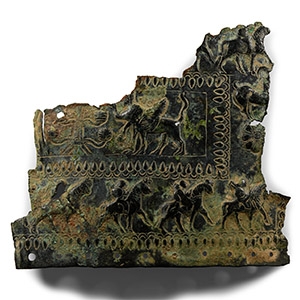
Urartu Bronze Repoussé Fragment with Advancing Warriors on Horseback
Circa 9th-7th century B.C.Sold for (Inc. bp): £1,560
The rectangular fragment with repoussé leaf borders, the outer scene composed of advancing warriors on horseback, each rider holding a round shield and a quiver of arrows on his back, a horned animal and a rosette to the right; the central scene with a winged human-headed bull flanking a tree, possibly a pomegranate tree or a tree of life; the lower edge pierced for attachment. 41 grams, 12 cm wide
From the property of the late Mr SM, London, UK, 1969-1999. Accompanied by a previous catalogue information slip.
