Details
LOT 4329
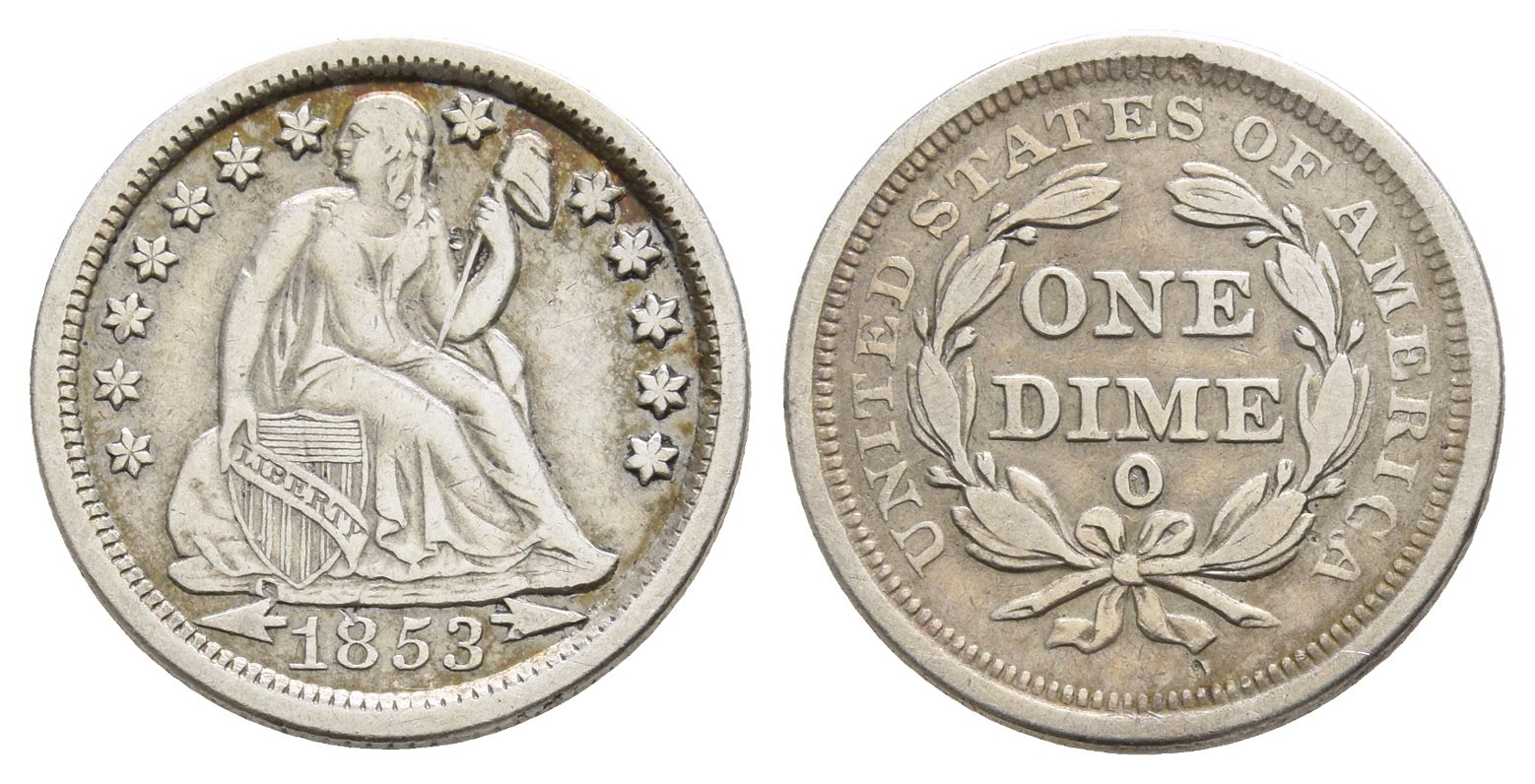
United States of America AR Dime or 10 Cents. Dated 1853. New Orleans mint. Date with arrows.
Seated Liberty facing to left, holding liberty cap on stick and shield, date with arrows in exergue / ONE DIME in two lines within wreath, mintmark below. KM 77. Near Very Fine.(2.46gr, 18mm, 6h.).
Provenance
From the private collection of author and historian Dr DeWitt Bailey; thence by descent to his grandson.
Footnotes
The arrows either side of the date were added to indicate that the standard coin weight had been reduced from the previous issue.
VETTING:
TimeLine Auctions follows a vetting process to ensure the authenticity and legality of all items, reinforcing our commitment to integrity and responsible trading. Each antiquity, antique, and coin lot undergoes thorough examination by a vetting committee of at least ten external specialists, professional trade association members, scientists, and archaeologists: Our Vetting Process
AUCTIONS:
TimeLine is a leading auction house specialising in antiquities, ancient art, collectables, natural history, coins, medals, and books. Our auctions offer museums, collectors, historians, and enthusiasts the opportunity to acquire unique and historically significant pieces.
RELATED LOTS
-
Austria. Holy Roman Empire, Maria Theresia Empress AR Posthumous Taler. Dated 1780. Restrike.
Sold for (Inc. bp): £26
M · THERESIA · D · G · R · IMP · HU · BO · REG ·, veilied and crowned bust of Empress Maria Theresia of Habsburg to right; S · F · below / ARCHID · AVST · DUX · BURG · CO · TYR · 1780 · ☓, coat of arms of Maria Theresia on double-crowned shield divided into four fields representing Hungary, Bohemia, Burgundy, and Burgau (Günzburg); crowned inner shield with coat of arms of Austria; supported by crowned and nimbate double-headed eagle. Edge inscription: IUSTITIA ET CLEMENTIA. KM T1; Yeoman 55; Gigante 2. 27.93gr, 41mm, 12h.
Uncirculated.
Property of a Cambridgeshire, UK, gentleman.
The Maria Theresia Taler was originally struck in Austria between 1740 and 1780. It was the circulating currency of the Holy Roman Empire and its dominions, and it was one of the most important trade coins in Europe and the world. After the death of Maria Theresia in 1780, the coin continued to be minted until today, with the date frozen at 1780. It is estimated that until 2000, 389 million pieces were minted. As of 2024, it is still sold by the Vienna Mint (Numista note). -
United States of America AR Dollar. Dated 1884. Philadelphia mint. Morgan type.
Sold for (Inc. bp): £33
Design by George Thomas Morgan. E • PLURIBUS • UNUM, thirteen stars divided by date below Morgan style Liberty Head / ✶ UNITED STATES OF AMERICA ✶ ONE DOLLAR, IN GOD WE TRUST above eagle clutching laurel and arrows, laurel sprays around. KM 110. 27.86gr, 38mm, 6h.
Very Fine. Mounted as a brooch on obverse.
Ex Stocker collection, Kent, UK, 1955-early 2000s. -
United States of America AR Seated Liberty Half Dollar or 50 Cents. Dated 1861. New Orleans mint. Confederate States issue (die W-103).
Sold for (Inc. bp): £221
Struck by the authority of the Confederate States Treasury Department from March 21, 1861, until the supply of captured Federal silver ran out in April 1861. Thirteen stars around Liberty seated to right, head to left, holding stick with cap and resting her right arm on shield inscribed LIBERTY; date below / UNITED STATES OF AMERICA, eagle facing, wings spread, head to left, holding branch and arrows; mintmark and denomination below. KM A68; WB-103. 12.34gr, 31mm, 6h.
Good Very Fine. Toned. Bisecting die crack in date.
From the private collection of author and historian Dr DeWitt Bailey; thence by descent to his grandson.
The year 1861 was a time of upheaval for the New Orleans Mint. It began under US control, but Louisiana's secession in early 1861 led to a brief period of state-run coinage. With Louisiana joining the Confederacy, production continued until the mint ran out of blanks. This seemingly minor detail, a die crack running from Liberty's nose, holds immense historical significance. Early in the Confederacy's existence, four half dollars were struck using a proposed new reverse die paired with a standard US obverse die. This specific die had the telltale crack. Further production by the Confederacy used the same cracked obverse die alongside a different reverse die. This, along with the later die state of the crack, confirms Confederate minting beyond the initial four coins. Extensive research by Wiley and Bugert identified specific die pairings as definitive proof of Confederate coinage. The Confederacy's official coin production was minimal, limited to a small number of cents (mostly restrikes) that never saw full circulation. Therefore, these half dollars with the die crack stand as exceptional historical artifacts, minted during the Confederacy's infancy in the spring of 1861.