
Loading, please wait...
_900x900.jpg "Two Roman Sandstone Architectural Frieze Sections")
_200x200.jpg "Two Roman Sandstone Architectural Frieze Sections")
.jpg "Two Roman Sandstone Architectural Frieze Sections")
LOT 0120
Two Roman Sandstone Architectural Frieze Sections
CIRCA 1ST CENTURY B.C.-1ST CENTURY A.D.
30 in. (76.2 kg total, 76.5 cm each).
Each rectangular with raised upper lip and a raised decorative frieze with rosettes and a bull's head (bucranium) separated by triple pilasters. [2]
Provenancewith Georges Joseph Demotte (1877-1923) and Andrée Macé (1918-2000), Belgium and New York.
Collection Demotte/Andrée Macé; Jean-Claude Renard Auction, Suresnes, 3 September 2013, no.87.
with Galerie Chenel, Paris, 2021.
This lot has been checked against the Interpol Database of stolen works of art and is accompanied by a search certificate number no.12624-236336.
This lot has been cleared against the Art Loss Register database, and is accompanied by an illustrated lot declaration signed by the Head of the Antiquities Department, Dr Raffaele D'Amato.
For similar frieze visible on the tomb of Caecilia Metella in Rome see Napp, A.E., ‘Bukranion und Guirlande. Beiträge zur Entwicklungsgeschichte der hellenistischen und römischen Dekorationskunst,' Heidelberg University, 1933, p. 2.
FootnotesIn classical Rome bovine skulls decorated the friezes of entablatures. Often, they were positioned in the metopes of Doric entablatures, but also in Ionic and Corinthian friezes, sometimes connected by floral or drapery swags. The architectural term for these skulls is bucranium (pl. bucrania or bucranes), a word derived from the Latin bos, meaning ox or cow, and cranium, the Medieval Latin term for a skull. The skulls allude to the ancient Greek and Roman ceremonies of sacrifice.
CONDITIONTimeLine Auctions follows a vetting process to ensure the authenticity and legality of all items, reinforcing our commitment to integrity and responsible trading. Each antiquity, antique, and coin lot undergoes thorough examination by a vetting committee of at least ten external specialists, professional trade association members, scientists, and archaeologists: Our Vetting Process
AUCTIONS:
TimeLine is a leading auction house specialising in antiquities, ancient art, collectables, natural history, coins, medals, and books. Our auctions offer museums, collectors, historians, and enthusiasts the opportunity to acquire unique and historically significant pieces.
-
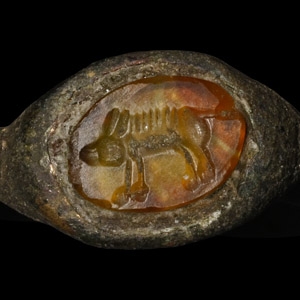
Roman Bronze Ring with Boar Gemstone
3rd-4th century A.D.Sold for (Inc. bp): £91
Comprising a round-section hoop with pelletted shoulders, lentoid-shaped bezel set with carnelian intaglio engraved with a standing boar. 4.77 grams, 25.49 mm overall, 17.28 mm internal diameter (approximate size British N 1/2, USA 6 3/4, Europe 14.35, Japan 13)
Acquired on the UK art market before 2000. Property of an Essex, UK, gentleman. This lot is accompanied by an illustrated lot declaration signed by the Head of the Antiquities Department, Dr Raffaele D'Amato. -
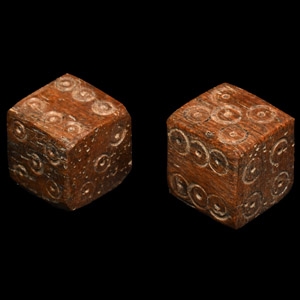
Roman Bone Dice Pair
1st-4th century A.D.Sold for (Inc. bp): £286
Each cuboid with ring-and-dot markings arranged 1:6, 2:5; 3:4. 7.07 grams, 12 mm each
Ex German art market, 2000s. Acquired from an EU collector living in London. From the collection of a Surrey, UK, gentleman. This lot is accompanied by an illustrated lot declaration signed by the Head of the Antiquities Department, Dr Raffaele D'Amato. -
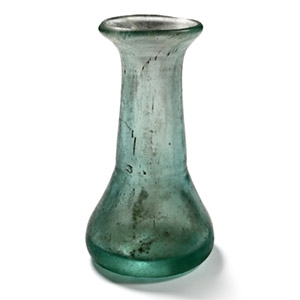
Roman Glass Bottle
2nd-3rd century AD.Sold for (Inc. bp): £117
Translucent pale green vessel with wide foot and dimpled base, tapering stem and flared rim. 130 grams, 95 mm
Ex German art market, 2000s. Acquired from an EU collector living in London. From the collection of a Surrey, UK, gentleman. This lot is accompanied by an illustrated lot declaration signed by the Head of the Antiquities Department, Dr Raffaele D'Amato.
