
Loading, please wait...
_900x900.jpg "Turco-Mongol 'Greek Fire' Ceramic Fire Bomb or Hand Grenade")
_200x200.jpg "Turco-Mongol 'Greek Fire' Ceramic Fire Bomb or Hand Grenade")
.jpg "Turco-Mongol 'Greek Fire' Ceramic Fire Bomb or Hand Grenade")
LOT 1492
Turco-Mongol 'Greek Fire' Ceramic Fire Bomb or Hand Grenade
13TH-15TH CENTURY A.D.
7 1/8 in. (452 grams, 18 cm).
A hollow vessel with cylindrical body, short neck and domed mouth, impressed herringbone decoration to the body; intended to be filled with explosive liquid and a wick, and used as a hand grenade. [No Reserve]
ProvenanceFrom an important specialist collection, London, UK, 1990s onwards.
Accompanied by an academic paper by military specialist Dr Raffaele D'Amato, dated 15 July 2019 and titled 'Eastern Roman Empire - Greek Fire Bomb or Hand Grenade (μεσαίον kακάβιον) 9th-11th century AD'.
This lot is accompanied by an illustrated lot declaration signed by the Head of the Antiquities Department, Dr Raffaele D'Amato.
Cf. Arendt, W. I., Granaten des 13-14. Jahrhunderts, die an der Wolga gefunden sind, Zeitschrift fur Historische Waffen-und Kostumkunde, 11 (1926-8), p.42; cf. Arendt, W., Die Spharisch-konischen Gefäße aus Gebranntem Ton, ibid; cf. Ayalon, D., Gunpowder and Firearms in the Mamluk Kingdom, London, 1956, p.16.
FootnotesApart from the use of siphons or manual flame-throwers called cheirosiphona, special corps of Roman soldiers employed terracotta grenades, in the form of small jars, abundantly evidenced in archaeological excavations. They were called μεσαία kακαβιά or κυτροκακάβια where the former had a bulbous shape and the latter a more cylindrical form.
CONDITIONTimeLine Auctions follows a vetting process to ensure the authenticity and legality of all items, reinforcing our commitment to integrity and responsible trading. Each antiquity, antique, and coin lot undergoes thorough examination by a vetting committee of at least ten external specialists, professional trade association members, scientists, and archaeologists: Our Vetting Process
AUCTIONS:
TimeLine is a leading auction house specialising in antiquities, ancient art, collectables, natural history, coins, medals, and books. Our auctions offer museums, collectors, historians, and enthusiasts the opportunity to acquire unique and historically significant pieces.
LOT 1492
Turco-Mongol 'Greek Fire' Ceramic Fire Bomb or Hand Grenade
Sold for (Inc. bp): £130
-
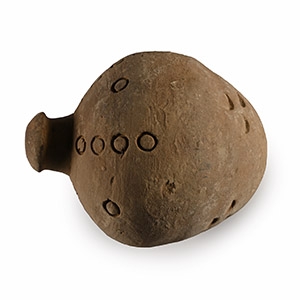
Byzantine 'Greek Fire' Ceramic Fire Bomb or Hand Grenade
9th-11th century A.D.Sold for (Inc. bp): £85
Piriform in profile with domed mouth, vertical bands of annulets to the upper body; intended to be filled with explosive liquid and wick, used as a hand grenade. 396 grams, 10.6 cm
From an important specialist collection, London, UK, 1990s onwards. Accompanied by an academic paper by military specialist Dr Raffaele D'Amato, dated 15 July 2019 and titled 'Eastern Roman Empire - Greek Fire Bomb or Hand Grenade (μεσαίον kακάβιον) 9th-11th century AD'. This lot is accompanied by an illustrated lot declaration signed by the Head of the Antiquities Department, Dr Raffaele D'Amato.
Apart from the use of siphons or manual flame-throwers called cheirosiphona, special corps of Roman soldiers employed terracotta grenades, in the form of small jars, abundantly evidenced in archaeological excavations. They were called μεσαία kακαβιά or κυτροκακάβια where the former had a bulbous shape and the latter a more cylindrical form. -
.jpg)
Achaemenid Akinakes with Horse-Head Hilt and Gold Chain
6th-4th century B.C.Sold for (Inc. bp): £9,100
The upper part of the hilt shaped as a horse-head with an applied sheet-gold mane, wearing a gold bridle of Greek typology adorned with rosettes, mouthpiece formed of wire with garnet beads, and a large garnet cabochon set at the front of the bridle; the upper hilt connected to the straight blade with a restored grip; accompanied by a perspex scabbard with original gold sheet attached; possibly a marriage; mounted on a custom-made display stand. 392 grams, 36.5 cm (473 grams total, 37.6 cm high including stand)
Private collection of a London gentleman, acquired between 1965–2020. This lot has been checked against the Interpol Database of stolen works of art and is accompanied by search certificate number no.12619-235454. This lot has been cleared against the Art Loss Register database, and is accompanied by an illustrated lot declaration signed by the Head of the Antiquities Department, Dr Raffaele D'Amato.
The akinakes was the short dagger of the Scythians and the Achaemenid Persians. Many examples of this characteristic weapon have been found in every corner of the Persian Empire. The hilt was often made of bronze, gold or gilded. It is visible in the hands of the Medes and Persians in the reliefs of Persepolis. These weapons, straight and double-edged, were about 35 cm long. The scabbards could be covered with gold, hung from the belt at the waist and, according to Herodotus, attached to the right thigh with a thong. -
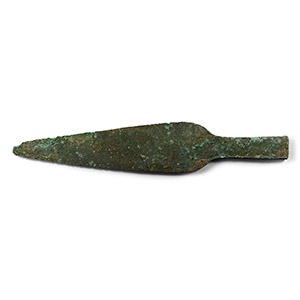
Western Asiatic Integral Hilted Bronze Short Sword
Late 3rd-2nd millennium B.C.Estimate: £200 - 300 (+bp*)
Opening Bid: £110
With a broad, lentoid-section flat blade, rounded tip, sloping sides, well marked shoulders with wide but short tang. 713 grams, 43.5 cm
Acquired 1980-2015. Ex Abelita family collection. This lot is accompanied by an illustrated lot declaration signed by the Head of the Antiquities Department, Dr Raffaele D’Amato. This lot is accompanied by an illustrated lot declaration signed by the Head of the Antiquities Department, Dr Raffaele D'Amato.
The sword finds similarity with a one from the Royal Cemetery of Ur. This is the most primitive form of dagger, consisting of a simple, pointed blade having slightly convex outline shoulders sloping to a short tang which has no rivets, and was probably hafted to wood with bitumen.
