
Loading, please wait...

LOT 1408
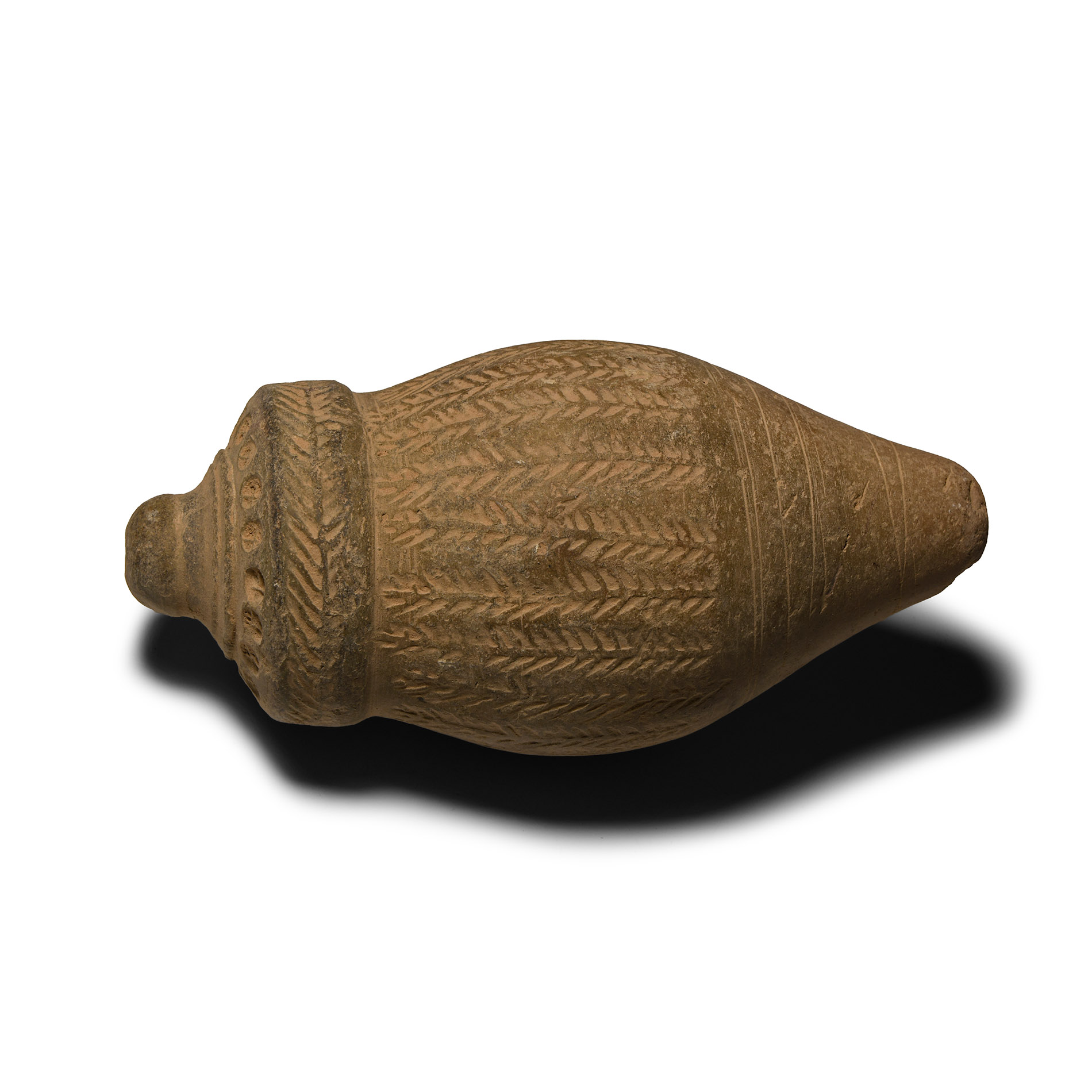
Turco-Mongol 'Greek Fire' Ceramic Fire Bomb or Hand Grenade
13TH-15TH CENTURY A.D.
6 1/2 in. (619 grams, 16.5 cm).
A hollow vessel with cylindrical body, carinated shoulder, short neck and domed mouth, bands of impressed herringbone patterns to the shoulder and waist, piriform lower body; intended to be filled with explosive liquid and a wick, and used as a hand grenade. [No Reserve]
ProvenanceFrom a specialist collection of militaria, London, UK, collected 1990s onwards.
LiteratureCf. Arendt, W. I., Granaten des 13-14. Jahrhunderts, die an der Wolga gefunden sind, Zeitschrift fur Historische Waffen-und Kostumkunde, 11 (1926-8), p.42; cf. Arendt, W., Die Spharisch-konischen Gefäße aus Gebranntem Ton, ibid; cf. Ayalon, D., Gunpowder and Firearms in the Mamluk Kingdom, London, 1956, p.16.
FootnotesThis was a type of ceramic fire grenade, similar to the ones used by the Eastern Romans but of Turco-Mongol type. Apart from the use of manual flame-throwers, special corps of soldiers employed terracotta grenades, in the form of small jars, abundantly evidenced in archaeological excavations.
CONDITIONTimeLine Auctions follows a vetting process to ensure the authenticity and legality of all items, reinforcing our commitment to integrity and responsible trading. Each antiquity, antique, and coin lot undergoes thorough examination by a vetting committee of at least ten external specialists, professional trade association members, scientists, and archaeologists: Our Vetting Process
AUCTIONS:
TimeLine is a leading auction house specialising in antiquities, ancient art, collectables, natural history, coins, medals, and books. Our auctions offer museums, collectors, historians, and enthusiasts the opportunity to acquire unique and historically significant pieces.
LOT 1408
Turco-Mongol 'Greek Fire' Ceramic Fire Bomb or Hand Grenade
Sold for (Inc. bp): £59
-
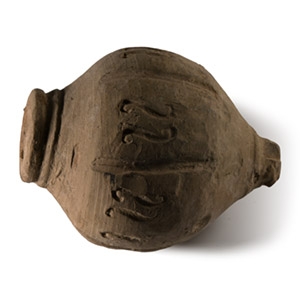
Byzantine 'Greek Fire' Ceramic Fire Bomb or Hand Grenade
9th-11th century A.D.Sold for (Inc. bp): £98
A piriform ceramic missile with segmented shoulder and band of impressed scrolls, domed filler-hole, intended to be filled with explosive liquid and wick, used as a hand grenade. 625 grams, 12.7 cm
From a military inspired collection formed from the 1990s. Accompanied by an academic paper by military specialist Dr Raffaele D'Amato, dated 15 July 2019 and titled 'Eastern Roman Empire - Greek Fire Bomb or Hand Grenade (μεσαίον kακάβιον) 9th-11th century AD'.
Apart from the use of siphons or manual flame-throwers called cheirosiphona, special corps of Roman soldiers employed terracotta grenades, in the form of small jars, abundantly evidenced in archaeological excavations. They were called μεσαία kακαβιά or κυτροκακάβια where the former had a bulbous shape and the latter a more cylindrical form. -
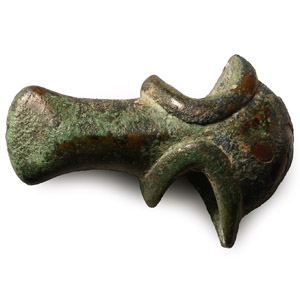
Luristan Bronze Axehead
3rd millennium B.C.Sold for (Inc. bp): £260
With a short blade flaring towards the cutting edge, rounded projection to the butt, rolled ridge around the shaft hole. 192 grams, 75 mm
UK private collection before 2000. Acquired on the UK art market. Property of a London gentleman.
The type corresponds to the Gernez type H.2.Fa, of axes with symmetrical collar, rear hump and rectangular blade. The exact provenance of only three axes of this type outside Luristan are known, mainly in Elam: one was found at Tepe Giyan, a second comes from a pit tomb in Susa and the last, a miniature, belongs to level VI of Tepe Gawra, dated to the last third of the 3rd millennium B.C. All the others are known as originating from Luristan. -
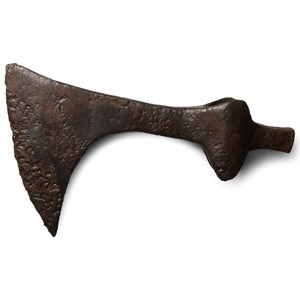
Viking Period Iron Broad Baltic Axe-Hammer
Circa 12th-13th century A.D.Sold for (Inc. bp): £494
Comprising a flat socket with lateral spurs, slender neck developing to a broad blade with curved edge, chin to the lower edge and point to the upper, rear square-section shank with disc hammer-face. 349 grams, 18.5 cm
Private collection, Arundel, West Sussex, UK, 1975-late 1990s.
During the mid 13th century, the axes were favourite weapons among the Baltic people. For example, the Curonian army included lightly armed soldiers who fought with spears, shields, fighting knives and axes. A heavily armed soldier could also carry a sword, a helmet, a shield and a wide-bladed axe.
