
Loading, please wait...


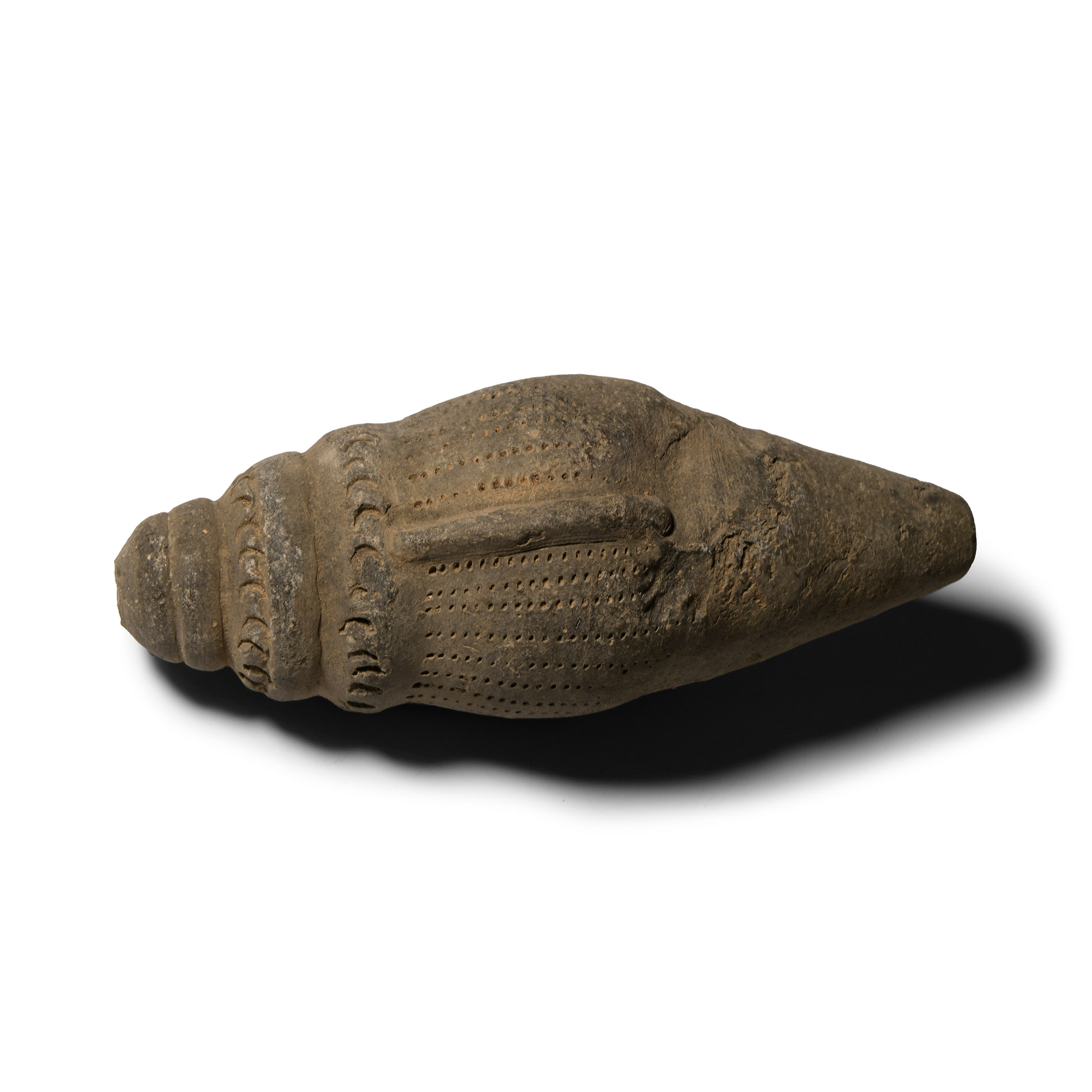
LOT 1354
Turco-Mongol 'Greek Fire' Ceramic Fire Bomb or Hand Grenade
13TH-15TH CENTURY A.D.
5 3/4 in. (357 grams, 14.7 cm).
A hollow vessel with cylindrical body, short neck and domed mouth, four raised lugs to the body, bands of impressed dots in-between, raised neck with impressed crescents; intended to be filled with explosive liquid and a wick, and used as a hand grenade. [No Reserve]
ProvenanceFrom a specialist collection of militaria, London, UK, collected 1990s onwards.
LiteratureCf. Arendt, W. I., Granaten des 13-14. Jahrhunderts, die an der Wolga gefunden sind, Zeitschrift fur Historische Waffen-und Kostumkunde, 11 (1926-8), p.42; cf. Arendt, W., Die Spharisch-konischen Gefäße aus Gebranntem Ton, ibid; cf. Ayalon, D., Gunpowder and Firearms in the Mamluk Kingdom, London, 1956, p.16.
FootnotesThis was a type of ceramic fire grenade, similar to the ones used by the Eastern Romans but of Turco-Mongol type. Apart from the use of manual flame-throwers, special corps of soldiers employed terracotta grenades, in the form of small jars, abundantly evidenced in archaeological excavations.
CONDITIONTimeLine Auctions follows a vetting process to ensure the authenticity and legality of all items, reinforcing our commitment to integrity and responsible trading. Each antiquity, antique, and coin lot undergoes thorough examination by a vetting committee of at least ten external specialists, professional trade association members, scientists, and archaeologists: Our Vetting Process
AUCTIONS:
TimeLine is a leading auction house specialising in antiquities, ancient art, collectables, natural history, coins, medals, and books. Our auctions offer museums, collectors, historians, and enthusiasts the opportunity to acquire unique and historically significant pieces.
LOT 1354
Turco-Mongol 'Greek Fire' Ceramic Fire Bomb or Hand Grenade
Sold for (Inc. bp): £156
-
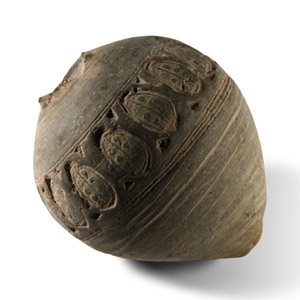
Byzantine 'Greek Fire' Ceramic Fire Bomb or Hand Grenade
9th-11th century A.D.Sold for (Inc. bp): £98
A piriform ceramic missile with band of impressed roundels to the shoulder and filler-hole above, intended to be filled with explosive liquid and wick, used as a hand grenade. 567 grams, 10.5 cm
From a military inspired collection formed from the 1990s. Accompanied by an academic paper by military specialist Dr Raffaele D'Amato, dated 15 July 2019 and titled 'Eastern Roman Empire - Greek Fire Bomb or Hand Grenade (μεσαίον kακάβιον) 9th-11th century AD'.
Apart from the use of siphons or manual flame-throwers called cheirosiphona, special corps of Roman soldiers employed terracotta grenades, in the form of small jars, abundantly evidenced in archaeological excavations. They were called μεσαία kακαβιά or κυτροκακάβια where the former had a bulbous shape and the latter a more cylindrical form. -
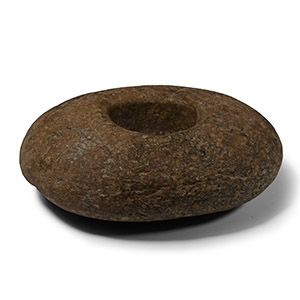
Chinese Stone Axehead
Neolithic Period, 3000-2000 B.C.Estimate: £120 - 170 (+bp*)
Opening Bid: £60
Biconvex in profile and annular in plan with rounded edges to the socket. 1.66 kg, 16.8 cm
Private UK collection. Acquired in the 1980s. Property of a Cambridgeshire gentleman. -
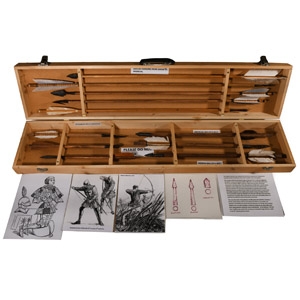
Cased Roman to Medieval Arrow Teaching Aid Collection
1st century A.D.-15th century A.D.Sold for (Inc. bp): £260
Comprising: a Roman ballista bolt with a pyramidal head; a 15th century iron swallowtail arrowhead; three iron medieval crossbow bolts, with pyramidal point, square-section shaft, tubular socket; two medieval ballista bolts with pyramidal point, square-section shaft, tubular socket; two triangular-shaped arrowheads, with pyramidal head; a triangular Eastern Roman bladed arrowhead with a slightly raised mid-rib; a small Anglo-Saxon arrowhead with lozenge form blade and round socket; all mounted on reconstructed modern shafts with their feathered directional lugs, and presented in a wooden display box. 3.83 kg total, 104 x 22 x 9.5 cm including case
From the collection of the famous author, writer and speaker, Gordon Bailey, Essex, UK; formed since 1968.
Crossbow and bows were the protagonist of the 100 Years War between France and England. The crossbow, a bow fixed at its centre to a wooden stock, was a formidable weapon used by the Genoese crossbowmen, mainly in French service; its heavy bolt could easily penetrate a shield or armour breast plate at close range. The longbow, mainly used by the Welsh archers, was able to pierce armours at greater distance. During the reign of Edward III, the long bow distance was estimated to be 400 yards. The capability of the English and Welsh archers enabled the English to secure a victory over the powerful French Cavalry at the battles of Crecy, Poitiers and Agincourt.
