
Loading, please wait...
LOT 1375
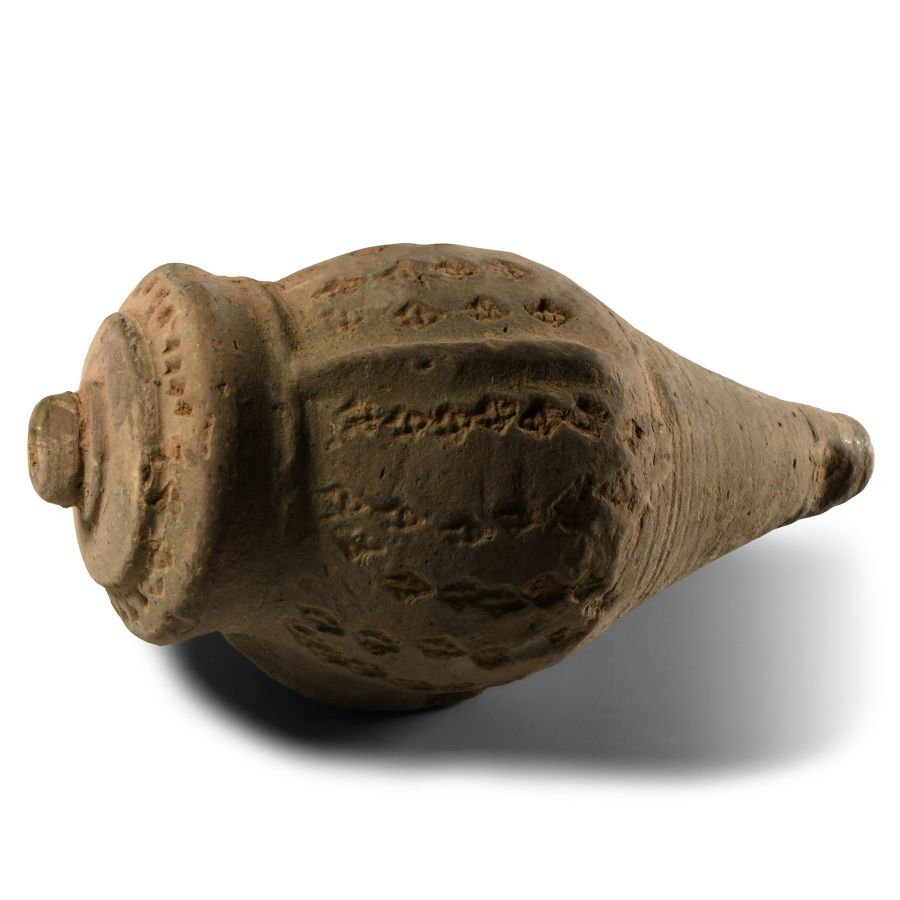
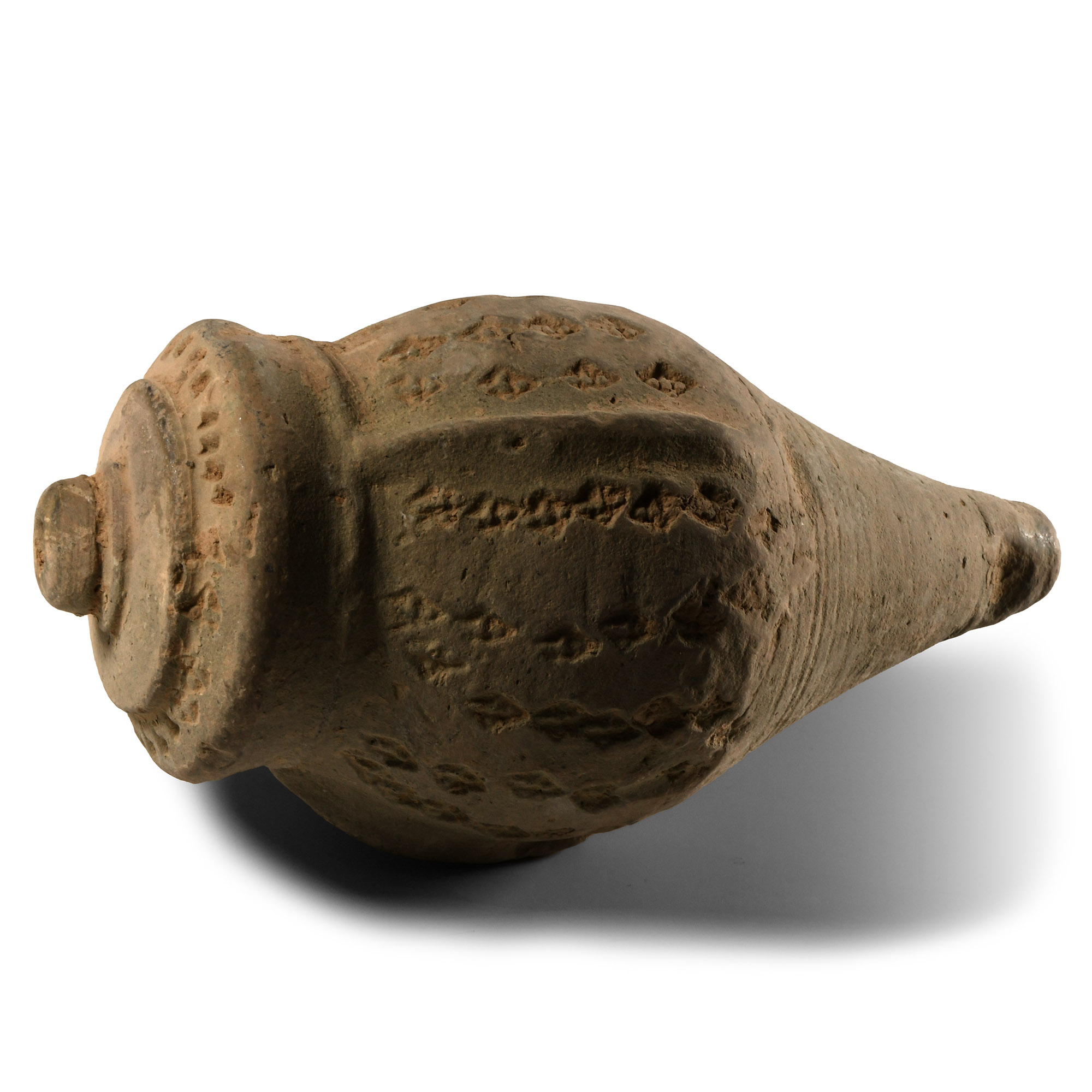
Turco-Mongol 'Greek Fire' Ceramic Fire Bomb or Hand Grenade
14TH CENTURY A.D.
7 7/8 in. (977 grams, 20 cm).
Piriform body with radiating vertical lugs to the shoulder and decorated panels between, tiered neck, domed filler-hole, intended to be filled with explosive liquid and wick, used as a hand grenade. [No Reserve]
ProvenanceFrom a specialist collection of militaria, London, UK, collected 1990s onwards.
LiteratureCf. Arendt, W. I., Granaten des 13-14. Jahrhunderts, die an der Wolga gefunden sind, Zeitschrift fur Historische Waffen-und Kostumkunde, 11 (1926-8), p.42; cf. Arendt, W., Die Spharisch-konischen Gefäße aus Gebranntem Ton, ibid; cf. Ayalon, D., Gunpowder and Firearms in the Mamluk Kingdom, London, 1956, p.16;
FootnotesApart from the use of siphons or manual flame-throwers called cheirosiphona, special corps of Roman soldiers employed terracotta grenades, in the form of small jars, abundantly evidenced in archaeological excavations. They were called μεσαία kακαβιά or κυτροκακάβια where the former had a bulbous shape and the latter a more cylindrical form.
CONDITIONTimeLine Auctions follows a vetting process to ensure the authenticity and legality of all items, reinforcing our commitment to integrity and responsible trading. Each antiquity, antique, and coin lot undergoes thorough examination by a vetting committee of at least ten external specialists, professional trade association members, scientists, and archaeologists: Our Vetting Process
AUCTIONS:
TimeLine is a leading auction house specialising in antiquities, ancient art, collectables, natural history, coins, medals, and books. Our auctions offer museums, collectors, historians, and enthusiasts the opportunity to acquire unique and historically significant pieces.
LOT 1375
Turco-Mongol 'Greek Fire' Ceramic Fire Bomb or Hand Grenade
Sold for (Inc. bp): £98
-
Viking Age Iron Long-Bladed Axehead
9th-11th century A.D.Sold for (Inc. bp): £91
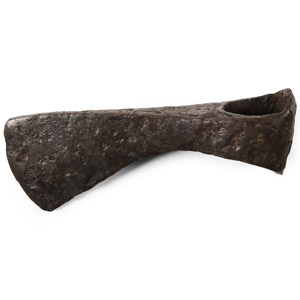
With triangular-section narrow blade widening to a bevelled edge, socket with rounded extension to the rear. 723 grams, 19 cm
From the private collection of a London gentleman, from his grandfather's collection formed before the early 1970s. -
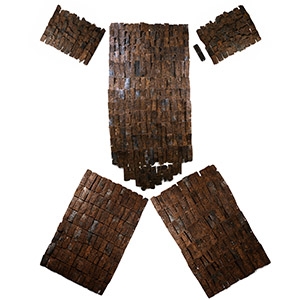
Jin Jurchen Warrior Signed Suit of Iron Plate Armor
Jin Dynasty, early 13th century A.D.Estimate: £8,000 - 10,000 (+bp*)
Opening Bid: £3,200
A complete suite of rectangular iron plates to form a protective coat; the plates provided with a series of holes close to the long edges by which they were laced together into articulating panels; one plate with inscription in Chinese script recording: 'first month of the Datong era / control of the propagation of Armour. Yanhui'. 8.5 kg total, 3-11.1 cm
From the private collection of a London gentleman, from his grandfather's collection formed before the early 1970s. Accompanied by an academic report by Dr Raffaele D’Amato. This lot has been checked against the Interpol Database of stolen works of art and is accompanied by a search certificate number no.12051-216403.
The Datong Era (大同, 1224–1233) is a name used for the reign of Puxian Wannu, a Jurchen warlord who established the Eastern Xia Dynasty in 13th century China. However, the war with the Jurchen states took more than 30 years: having first invaded the Jurchen borders in 1211, the Mongols finally defeated the Jin Empire only in 1234, while the Eastern Xia fell in 1246. -
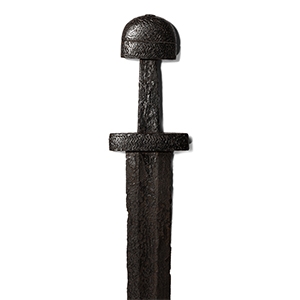
Viking Peterson Type X Sword with Inlaid Hilt
Circa 10th-11th century A.D.Sold for (Inc. bp): £3,900
With pattern-welded double-edged blade, showing well-defined shallow fullers and wide cutting edges, the fullers occupying not less than one third of the entire width and running to a point about 19 cm from the tip; massive, simply decorated hilt; the pommel, as well as the cross-guard, with visible zig-zag patterns; the pommel of solid tea-cosy type, divided into two sections by a well marked groove, the bottom being the larger, the curved top portion of the pommel further divided into three lobes; traces of inlay visible on the pommel and on the cross-guard. 1.25 kg, 94 cm
Acquired on the European art market in the 1990s. From the property of a Suffolk collector.
The blade shows in its central section, and on both cutting edges, the blodiձa style pattern-welding through the central portion of the blade (Oakeshott, 1960, fig.70). The fine pattern-welded blade patterns of Viking swords are the blodiձa (Blood-Eddy) and 'ann' (rows of mown hay) known from Norse poetry.
