
Loading, please wait...
LOT 0970
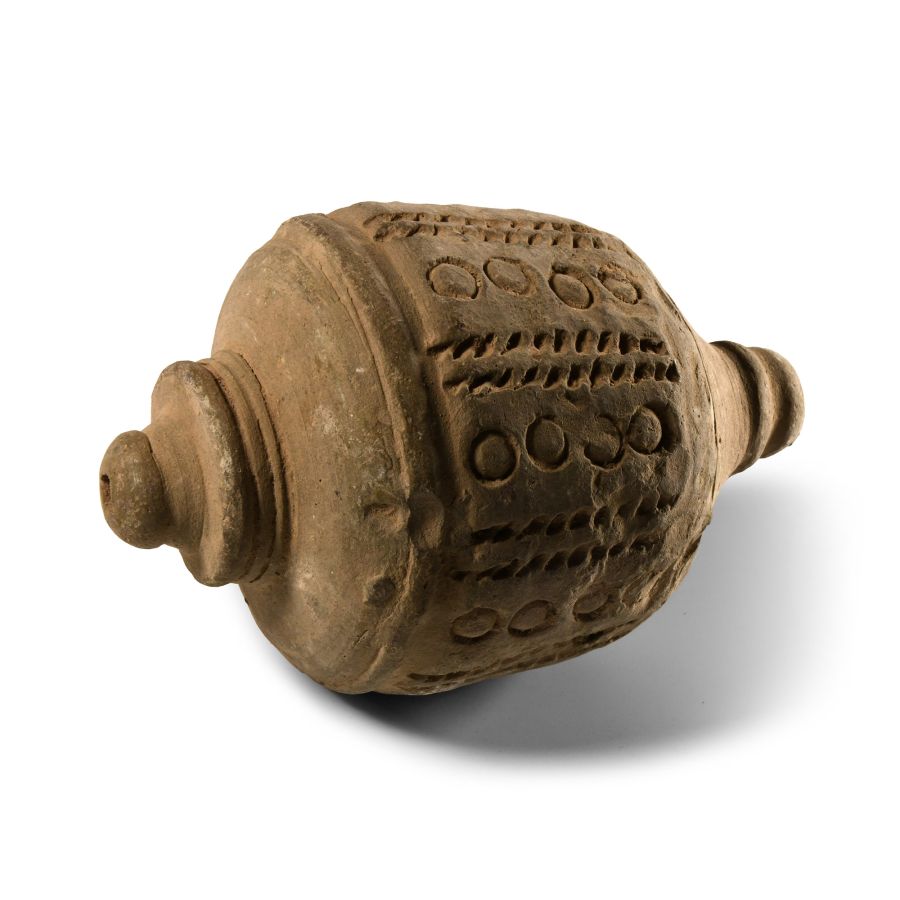
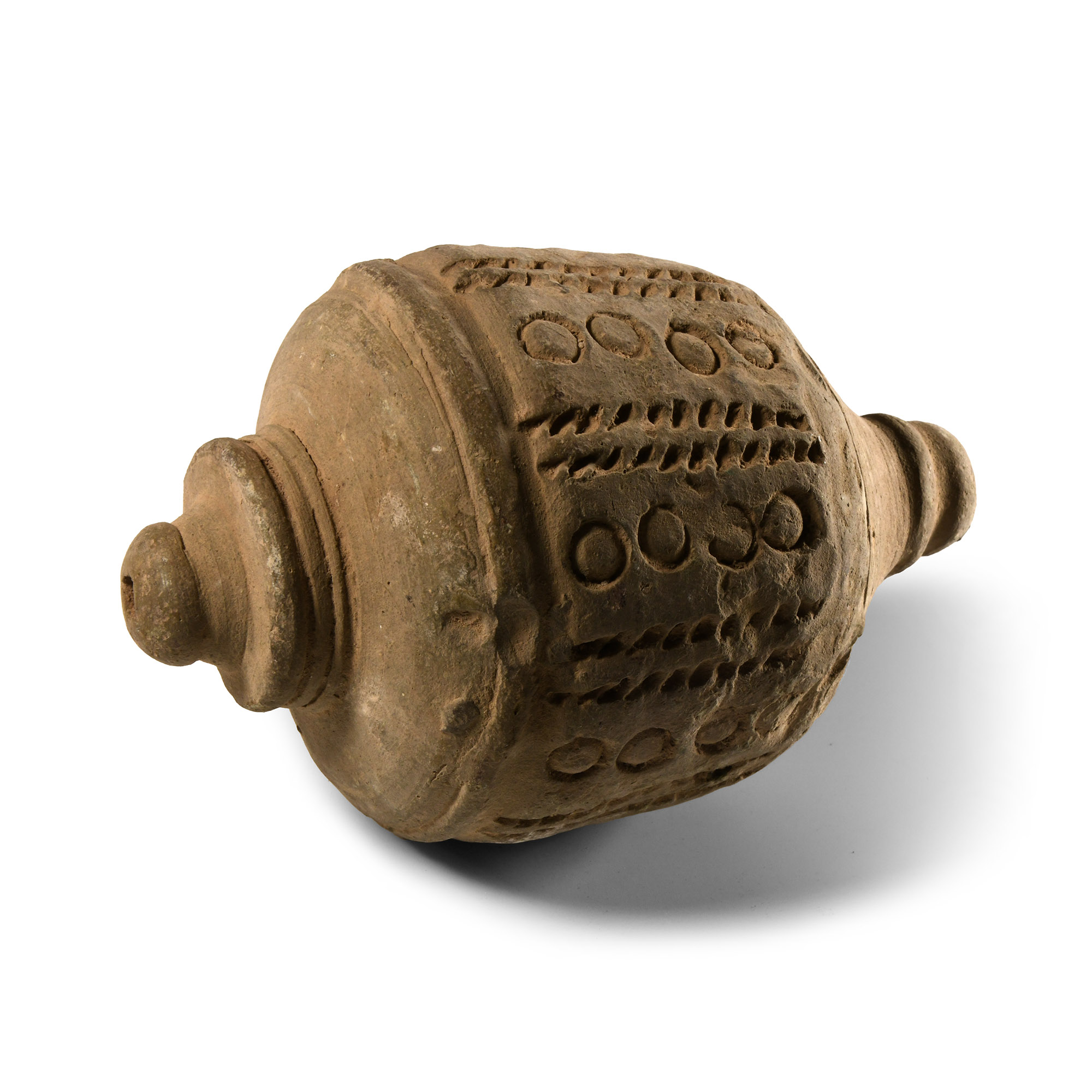
Turco-Mongol 'Greek Fire' Ceramic Fire Bomb or Hand Grenade
14TH CENTURY A.D.
5 7/8 in. (755 grams, 15 cm).
Piriform body with vertical bands of pellets and roundels, knop finial, tiered and domed filler-hole, intended to be filled with explosive liquid and wick, used as a hand grenade. [No Reserve]
ProvenanceFrom a specialist collection of militaria, London, UK, collected 1990s onwards.
LiteratureCf. Arendt, W. I., Granaten des 13-14. Jahrhunderts, die an der Wolga gefunden sind, Zeitschrift fur Historische Waffen-und Kostumkunde, 11 (1926-8), p.42; cf. Arendt, W., Die Spharisch-konischen Gefäße aus Gebranntem Ton, ibid; cf. Ayalon, D., Gunpowder and Firearms in the Mamluk Kingdom, London, 1956, p.16
FootnotesApart from the use of siphons or manual flame-throwers called cheirosiphona, special corps of Roman soldiers employed terracotta grenades, in the form of small jars, abundantly evidenced in archaeological excavations. They were called μεσαία kακαβιά or κυτροκακάβια where the former had a bulbous shape and the latter a more cylindrical form.
CONDITIONTimeLine Auctions follows a vetting process to ensure the authenticity and legality of all items, reinforcing our commitment to integrity and responsible trading. Each antiquity, antique, and coin lot undergoes thorough examination by a vetting committee of at least ten external specialists, professional trade association members, scientists, and archaeologists: Our Vetting Process
AUCTIONS:
TimeLine is a leading auction house specialising in antiquities, ancient art, collectables, natural history, coins, medals, and books. Our auctions offer museums, collectors, historians, and enthusiasts the opportunity to acquire unique and historically significant pieces.
LOT 0970
Turco-Mongol 'Greek Fire' Ceramic Fire Bomb or Hand Grenade
Sold for (Inc. bp): £260
-
Byzantine Inscribed Lead Spindle Whorl
5th-6th century A.D.Sold for (Inc. bp): £39
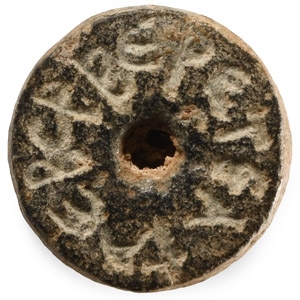
Discoid with central void and portion of the shank embedded; inscribed with Greek characters '+AEB Φ BEPETEAI'. 2.66 grams, 18 mm
Acquired on the London, UK, art market in the 1990s. From a gentleman's private collection.
Similar objects could have been manufactured to look like spindle whorls, while they were in fact used as beads and/or amulets. The current evidence may suggest that these items were burial goods for females. They are sometimes seen incised with Greek letters and symbols that seem to suggest a cryptic onomata barbara formula. In this context, they can be viewed as mystical objects with the function of transmitting a message to the Other World, and the sheer mass of letters intended to convey the idea of an authoritative communication inaccessible to ordinary human being. -
.jpg)
Byzantine Gold Cross Pendant
6th-7th century A.D.Sold for (Inc. bp): £1,170
Formed as a quatrefoil plaque with five large bulbs to the obverse, smaller interstitial bulbs and repoussé collars; bifid loop above. 3.70 grams, 36 mm
UK private collection before 2000. On the UK art market. Property of a London gentleman. -
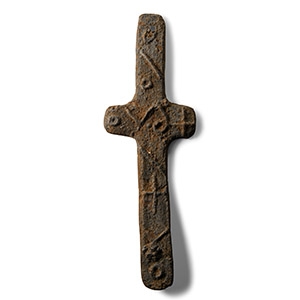
Byzantine Lead Cross
5th-7th century A.D.Estimate: £600 - 800 (‡+bp*)
Opening Bid: £300
Flat-section cruciform mount with stub arms and attachment point at one end; high-relief saltires, hoops and other detailing. 357 grams, 21.5 cm
Acquired in the mid 1980s-1990s. From the family collection of Mr S.A., Switzerland, thence by descent. Private collection since the late 1990s.
