
Loading, please wait...
LOT 2100
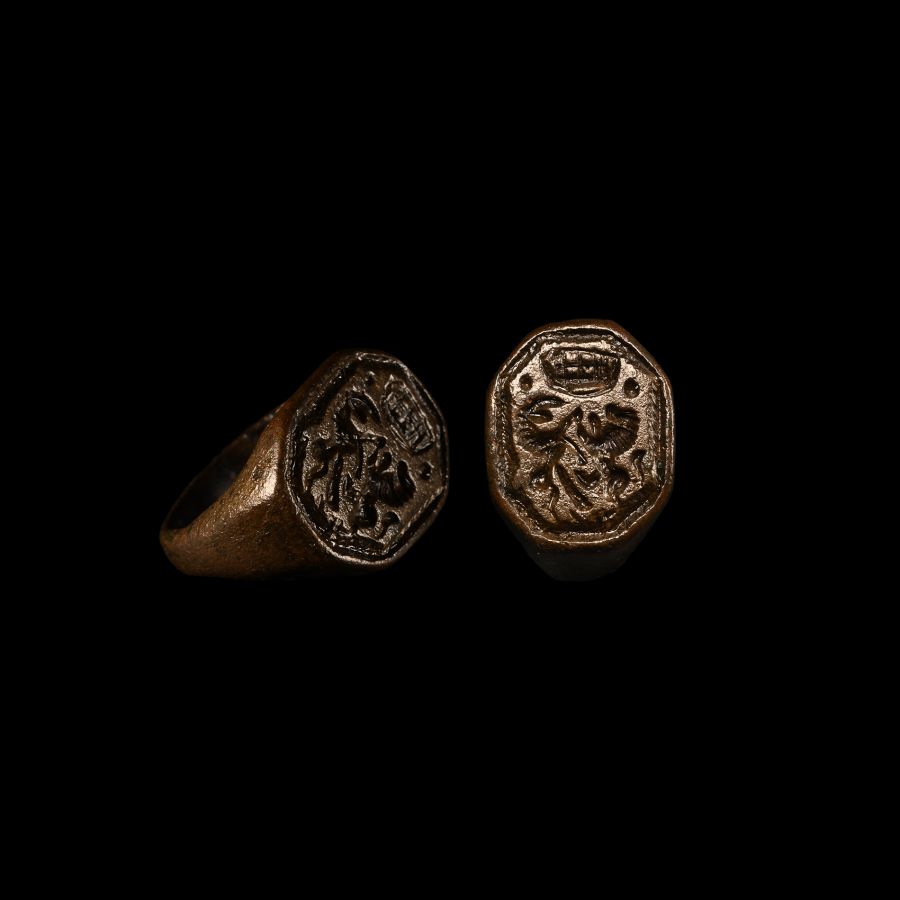
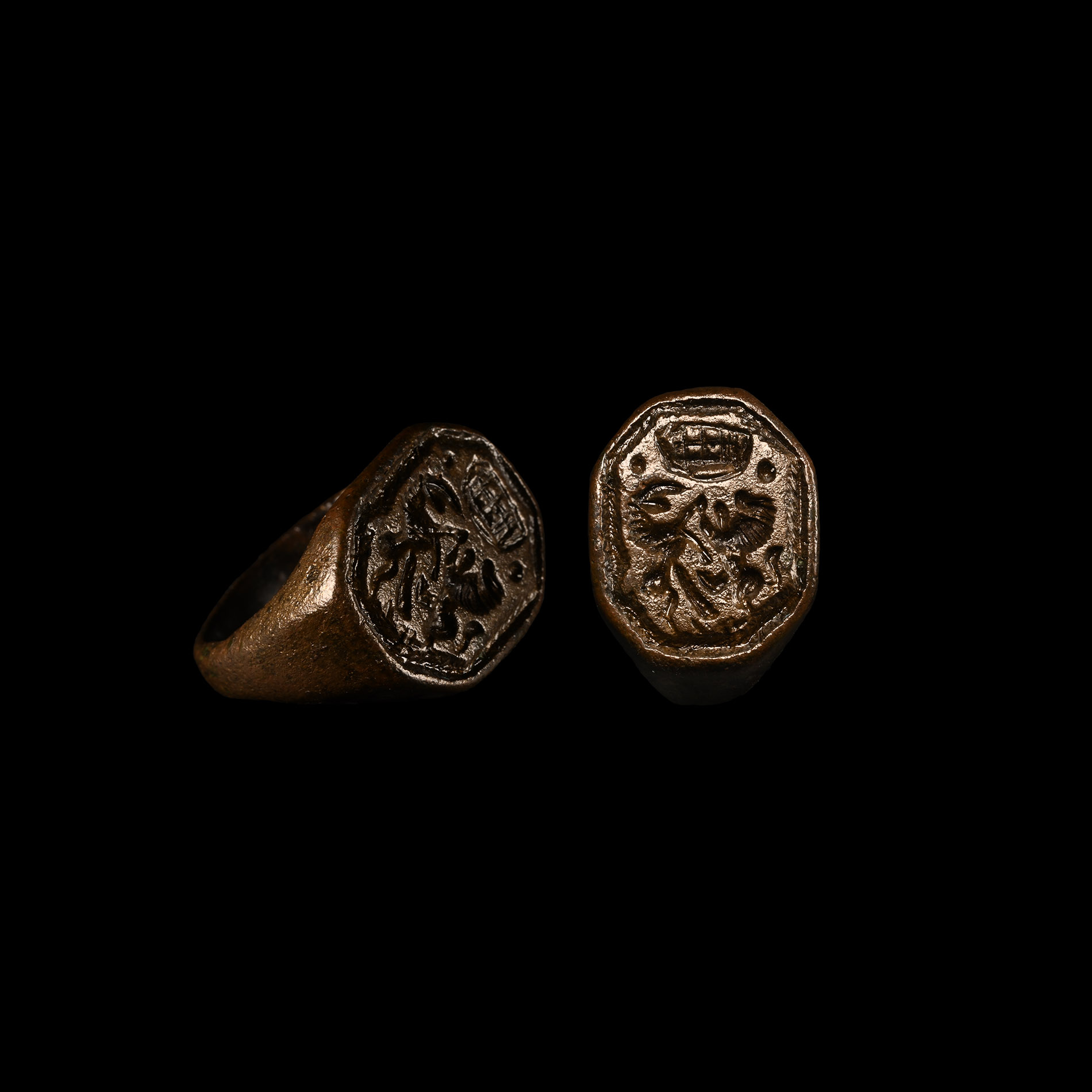
Tudor Period Bronze Armorial Ring with Crowned Lion and Unicorn
16TH-17TH CENTURY A.D.
1 in. (11.41 grams, 24.13 mm overall, 19.50 mm internal diameter (approximate size British S, USA 9, Europe 20, Japan 19)).
The hoop with convex outer face, expanding at the shoulders to an octagonal bezel bearing incuse design. [No Reserve]
ProvenanceLondon art market before 2000.
Property of an Essex gentleman.
TimeLine Auctions follows a vetting process to ensure the authenticity and legality of all items, reinforcing our commitment to integrity and responsible trading. Each antiquity, antique, and coin lot undergoes thorough examination by a vetting committee of at least ten external specialists, professional trade association members, scientists, and archaeologists: Our Vetting Process
AUCTIONS:
TimeLine is a leading auction house specialising in antiquities, ancient art, collectables, natural history, coins, medals, and books. Our auctions offer museums, collectors, historians, and enthusiasts the opportunity to acquire unique and historically significant pieces.
LOT 2100
Tudor Period Bronze Armorial Ring with Crowned Lion and Unicorn
Sold for (Inc. bp): £234
-
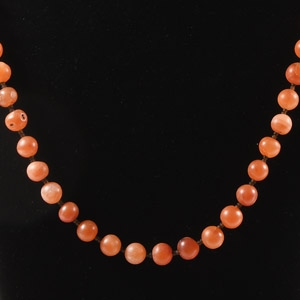
Carnelian Bead Necklace
20th century A.D.Sold for (Inc. bp): £33
Interspersed with small stone spacer beads. 72 grams, 73 cm long
Ex London collection, early 2000s. -
.jpg)
Egyptian Temple of Abu Simbel by J. W. Cox
Dated 1932 A.D.Sold for (Inc. bp): £52
Signed in the bottom right corner of the watercolour; framed and glazed with loops for suspension to the reverse. 1.65 kgs, 40.4 cm
Ex Albert Ward collection, Essex, UK.
J.W.S. Cox (1911-1982) was an American watercolourist renowned for developing the wet-on-wet painting technique. He grew up in New York, where he avidly sketched landscapes from an early age. The artist graduated from Pratt Institute NYC in 1933 and worked various jobs through the Great Depression. In 1936, he studied at the Acadamie Colarossie in Paris, and with Fauvist Othon Friesz for a short time, although later dismissed the Fauvist style as 'sloppy'. He went on to teach watercolour painting to students at Boston University, founding a studio on Bearskin Neck, Rockport, where he developed his 'sponge painting' and palette-knife techniques. He painted with an individualistic style, becoming a member of the Boston Watercolour Society. Cox shunned publicity as he believed it robbed him of painting time and turned down membership to the National Academy because he 'wouldn't play the game'. A Renaissance man, Cox spoke 12 languages with a goal to present himself 'and the soul of nature as truthfully and with as much inspiration, vitality and freshness as is possible, through the medium of watercolour'. He died of a heart attack in Florida in 1982. -
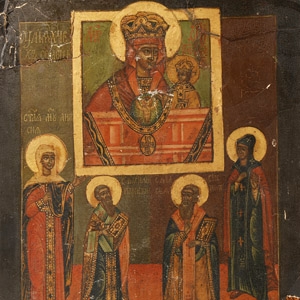
Gilt Painted Wooden Icon Of Virgin and Child
Circa 18th century A.D.Sold for (Inc. bp): £182
Depicted crowned and nimbate in a central panel, the bust of the Virgin encased in a medallion with a cross pendant, with inside the Holy Spirit under shape of dove and with nimbus, four nimbate figures of Saint Anna, Saint Basil the Great, Saint Simeon and another Saint below; text in the fields. 796 grams, 28 cm
The timber shows some old insect flight holes and we are advised that this piece has been recently treated with Permthrin, as a precaution.
Ex French gallery, Paris.
The rare Marian iconographic typology is called ''Mother of God who softens sick hearts', where she carries the Holy Spirit on her breast, represented by a dove emitting rays of light. In particular, it is a variant of the Madonna Odighitria. Both the mother and the child are depicted as the queen and king of the universe: the Virgin wears a crown on her head and holds the Child, who is also blessing with the right hand.
