
Loading, please wait...
LOT 1980
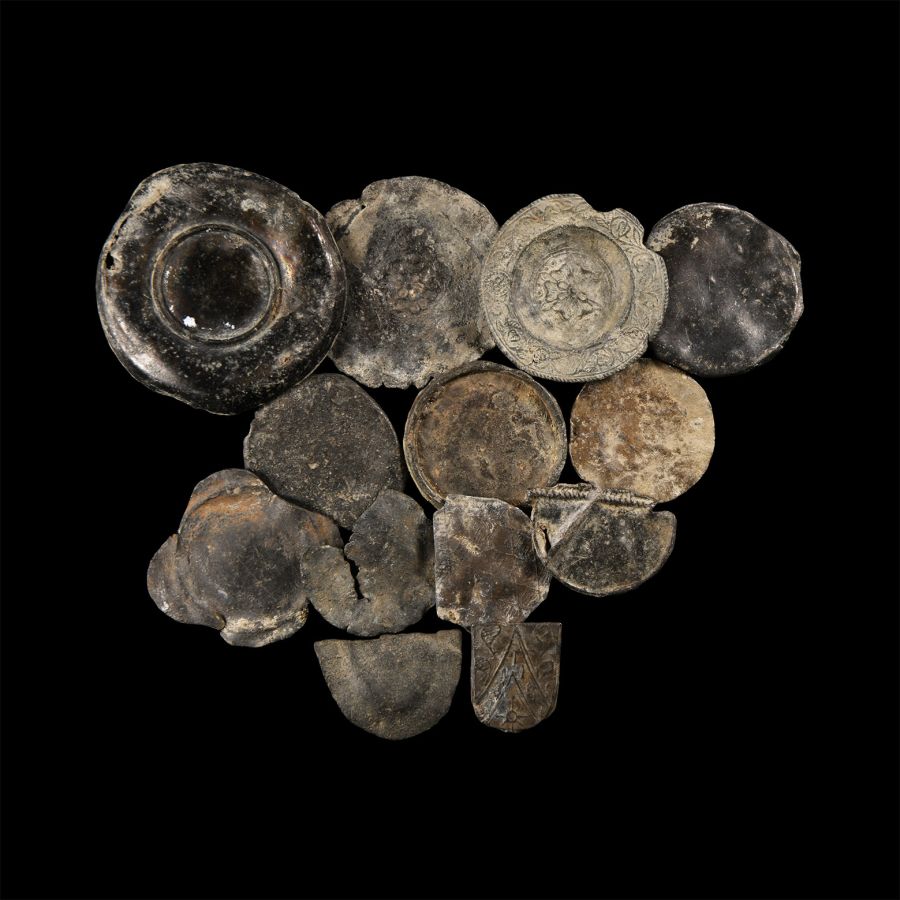
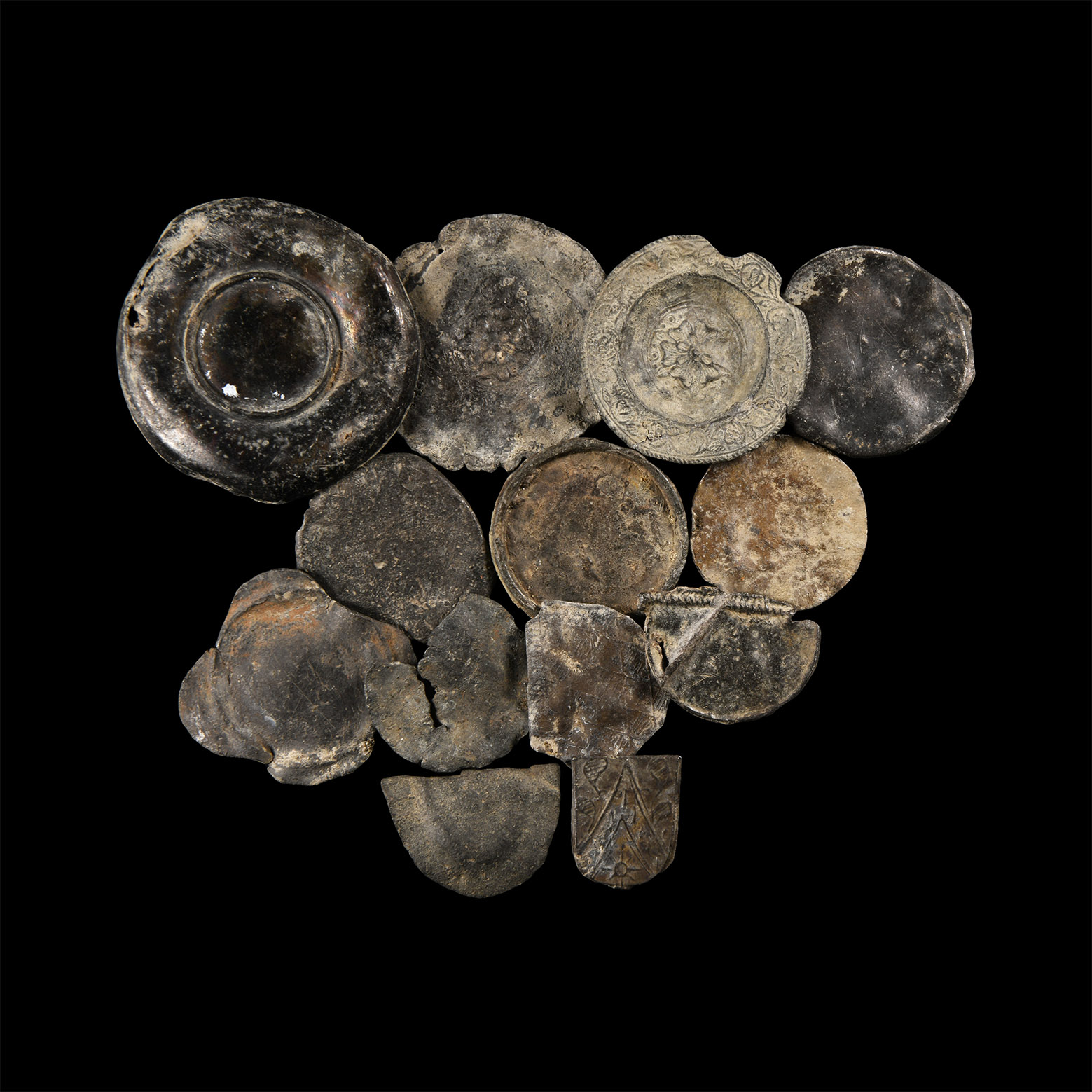
Tudor and Later 'Thames' Lead Toy Dish and Plate Group
16TH-17TH CENTURY A.D.
3/4 - 1 5/8 in. (45 grams total, 18-42 mm).
Including decorated dishes and plates, together with other miscellaneous lead items displaying floral and heraldic motifs. [13, No Reserve]
ProvenanceFound Thames foreshore spoil, 1980s.
CONDITIONTimeLine Auctions follows a vetting process to ensure the authenticity and legality of all items, reinforcing our commitment to integrity and responsible trading. Each antiquity, antique, and coin lot undergoes thorough examination by a vetting committee of at least ten external specialists, professional trade association members, scientists, and archaeologists: Our Vetting Process
AUCTIONS:
TimeLine is a leading auction house specialising in antiquities, ancient art, collectables, natural history, coins, medals, and books. Our auctions offer museums, collectors, historians, and enthusiasts the opportunity to acquire unique and historically significant pieces.
-
.jpg)
Post Medieval Bronze Statuette of a Nude Male
18th-19th century A.D. or earlierEstimate: £300 - 400 (+bp*)
Opening Bid: £150
Modelled in the round, standing with left leg held slightly in front of the right, the right arm bent at the elbow and hand held in a gripping position forming a circular socket to accept an accessory (now absent), semi-naturalistic anatomical detailing to the torso, genitals, head and face; in the style of the Etruscan era; mounted on a custom-made display stand. 321 grams, 16.2cm (421 grams total, 20.5 cm including stand)
Fine condition.
French collection, 1990s-early 2000s. with Vermot & Associés, Paris, 18 July 2020, lot 150 (3,500-5,000 Euros) described as Etruscan. From an important Paris gallery, France. Ex private Parisian collection. -
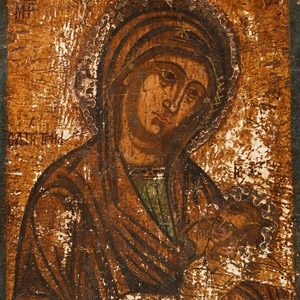
Painted Wooden Icon of Virgin and Child
19th-20th century A.D.Estimate: £200 - 300 (+bp*)
Opening Bid: £65
Mary cradling the infant Christ, Greek text in the field with inscription 'ΜΡ ΘΥ' for 'Mother of God' flanking the Virgin's halo, 'IC XC' for 'Jesus Christ' over the Child's head; to the right a Greek inscription 'ΟΔΙΓΗΤΡΙΑ' (Odighitria); some restoration; a handwritten inscription and a cross to the reverse in Greek, reading 'Eufemia Papadimitriou - born on March, 30, 1932, on Thursday, at the 5.00 p.m.; Vasilios Papadimitriou - born on March, 15, 1934, on Thursday, at the 3.00 p.m.' 614 grams, 29 cm
The timber shows some old insect flight holes and we are advised that this piece has been recently treated with Permthrin, as a precaution.
Ex French gallery, Paris.
The icon belongs to the category of Virgin 'Galaktotrophousa' (Γαλακτοτροφουσα, meaning “the Milk-Giver”) celebrated on third July, and showing Mary breast-feeding Jesus. The ancient typology dates from the 6th century A.D. and resided in St. Sabbas’ lavra (a type of monastic community). -
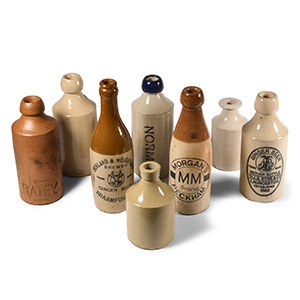
Post Medieval Stoneware Bottle Group
19th century A.D. or earlierSold for (Inc. bp): £14
Including 'J.S. Eyre & Co. Launceston', 'Boreland & Weightman Braamfontein' and other types. 3.8 kg total, 11.5-21.7 cm high
Acquired UK market. Ian Roper collection.
