
Loading, please wait...
_900x900.jpg "Trans-Jordan Polished Terracotta Bowl")
_200x200.jpg "Trans-Jordan Polished Terracotta Bowl")
.jpg "Trans-Jordan Polished Terracotta Bowl")
LOT 1190
Trans-Jordan Polished Terracotta Bowl
EARLY BRONZE AGE, 3RD-2ND MILLENNIUM B.C.
2 1/2 in. (145 grams, 65 mm high).
Hemispherical in profile with small foot, dimple to the underside; rim chipped. [No Reserve]
ProvenanceFrom a family collection pre 1988.
CONDITIONTimeLine Auctions follows a vetting process to ensure the authenticity and legality of all items, reinforcing our commitment to integrity and responsible trading. Each antiquity, antique, and coin lot undergoes thorough examination by a vetting committee of at least ten external specialists, professional trade association members, scientists, and archaeologists: Our Vetting Process
AUCTIONS:
TimeLine is a leading auction house specialising in antiquities, ancient art, collectables, natural history, coins, medals, and books. Our auctions offer museums, collectors, historians, and enthusiasts the opportunity to acquire unique and historically significant pieces.
-
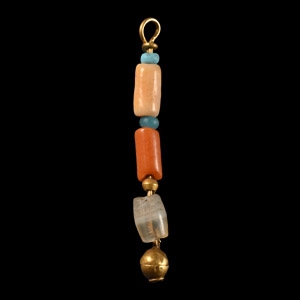
Western Asiatic Gold and Bead Pendant
1st millennium B.C. and laterSold for (Inc. bp): £117
Tubular and other beads in carnelian, glass and other materials on a later gold wire dangle. 1.36 grams, 40 mm
Ex property of a late Japanese collector, 1970s-2000s. -
.jpg)
Western Asiatic Bronze Spindle Whorl on Distaff
2nd millennium B.C.Sold for (Inc. bp): £39
Distaff with spiral slot to the thicker end, separate domed whorl and tapering shank. 60 grams, 32 cm
Collected from 1969-1999. From the collection of the late Mr S.M., London, UK.
Spindle whorls are one of the most durable traces of textile craft in the archaeological record. They can be found in copious quantities and diverse types. Whorls in the shape of discs, cylinders and cones of clay, bone, stone and other more precious materials are widespread in all areas and periods, evidencing the skills of craftswomen engaged in textile production. -
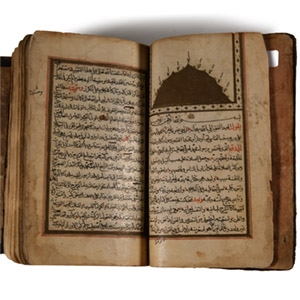
Islamic Leather-Bound Manuscript, The Ascension of Delights by Muhammad al-Mandi Ibn Ahmad Al-Fasi
1162 A.H.Estimate: £4,000 - 6,000 (+bp*)
Opening Bid: £2,000
Rebound hardback with full leather binding, central arabesque foliage panel to both covers, fore-edge flap and envelope flap; title page with liquid gold panel inside a frame with cross and colon detailing (:+:); text pages with concentric red, black and liquid gold frame and typically 17 lines of black text with red titles and highlighting, marginal notation; liquid gold header blocks, occasional dense marginal notation; notation to underside of text-block; spine repaired. 587 grams, 11.5 x 16.7 cm
From an important family collection started in the late 1950s. Property of a West London, UK, gentleman. This lot has been checked against the Interpol Database of stolen works of art and is accompanied by a search certificate number no.12275-220403.
The text is 'Kitab matalle ammasaraat snarh dalayii alkhayrat' (The Book of Ascension of Delights, Explanation of the Evidences of Goodness) compiled by the Sheikh, writer and historian Muhammad al-Mahdi ibn Ahmad Al-Fasi who died in 1109 A.H. (1697 A.D.) written out by the poet Muhammad ibn Ibrahim ibn Saleh ibn Omar Pasha al-Dimashqi in 1162 A.H. (1748 A.D.).
