
Loading, please wait...
_900x900.jpg "'The Somersham' Medieval Inscribed Silver-Gilt Scroll Mount or Badge")
_200x200.jpg "'The Somersham' Medieval Inscribed Silver-Gilt Scroll Mount or Badge")
.jpg "'The Somersham' Medieval Inscribed Silver-Gilt Scroll Mount or Badge")
LOT 0338
'The Somersham' Medieval Inscribed Silver-Gilt Scroll Mount or Badge
13TH-15TH CENTURY A.D.
1 1/4 in. (3.69 grams, 32 mm).
Scroll-shaped mount with canted ends, mounting lugs to reverse; obverse with two incuse panels, each with a line of reserved text: '+MTN V/EIRT R' – not obviously meaningful, though 'VEIRT' is an acceptable Anglo-Norman spelling for mod.Fr. verité, ‘truth’.
ProvenanceFound Somersham, Suffolk, UK, declared as treasure under the Treasure Act with reference no.2022T849 and subsequently disclaimed by the Crown.
Accompanied by a copy of the British Museum's Portable Antiquities Scheme (PAS) report no.SF-B47EF7.
Accompanied by a copy of the Department for Digital, Culture, Media & Sport Treasure Act receipt dated 9 September 2022.
Accompanied by a copy of a letter from the British Museum explaining that the Crown's interest in the object has been disclaimed.
TimeLine Auctions follows a vetting process to ensure the authenticity and legality of all items, reinforcing our commitment to integrity and responsible trading. Each antiquity, antique, and coin lot undergoes thorough examination by a vetting committee of at least ten external specialists, professional trade association members, scientists, and archaeologists: Our Vetting Process
AUCTIONS:
TimeLine is a leading auction house specialising in antiquities, ancient art, collectables, natural history, coins, medals, and books. Our auctions offer museums, collectors, historians, and enthusiasts the opportunity to acquire unique and historically significant pieces.
LOT 0338
'The Somersham' Medieval Inscribed Silver-Gilt Scroll Mount or Badge
Sold for (Inc. bp): £338
-
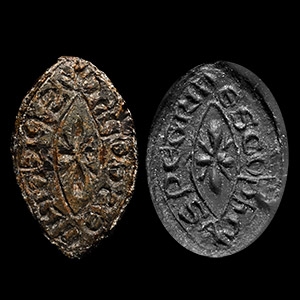
Medieval Lead Seal Matrix for Peter of Scuppeholm
13th century A.D.Sold for (Inc. bp): £20
Vesica-shaped with raised fleur-de-lys on the reverse, inscription '+ S'PETRI DE SCUPHOL' surrounding a double fleur-de-lys. 25.6 grams 36 mm
Ex Paul Moore, 1990s. Accompanied by a laminated Paul Moore identification card.
Scupholme is in South Somercotes, Lincolnshire, England. -
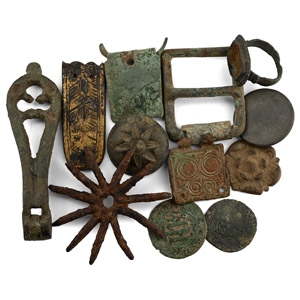
Medieval and Later Bronze Artefact Collection
14th-18th century A.D.Sold for (Inc. bp): £20
Including a spur rowel, finger ring, key bow, buckle loop and other items. 133 grams total, 23-79 mm
From various collections, acquired circa 1950-early 2000s. From the property of a late Lincolnshire, UK, gentleman. -
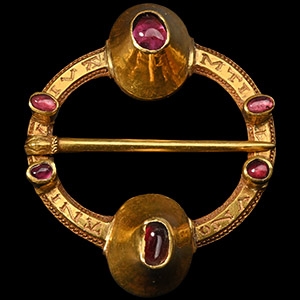
Medieval Gold Ring Brooch with Garnets and 'Let us Live as One Soul’ Posy Inscription
13th-14th century A.D.Sold for (Inc. bp): £7,020
An annular brooch with pelletted edges, six garnet cabochons adorning the brooch, each in a tall closed setting; inscribed on the front 'VIVAMTINVNOANI', the reverse inscribed with 'AMORIVNTVANVNTVI' divided between two palmettes. 8.76 grams, 38 mm
Private English collection, formed between the late 1970s and early 1990s. Private collection, UK. This lot has been checked against the Interpol Database of stolen works of art and is accompanied by search certificate number no.12989-245987.
Both inscriptions can be interpreted differently according to the order of their reading; the front can be read ‘IN JUNO ANI VIVAM TI’, which roughly translates as ‘May I live for you in the fastening’, alternatively ‘VIVAM[vs] IN VNO ANI[mo]’ which roughly translates as ‘Let us live as one soul’. The back reads: 'AMORIVNTVANVNTVI' ‘AMOR[is] IVN[c]T[i] ANVNTIV[s]’ which roughly translates as ‘a message of joint love’. The inscriptions on the brooch serve as metaphors, linking its function of fastening materials to the binding of lovers in medieval romance. Gift-giving was central to courtly love, and the brooch symbolised both affection and protection, reminding the wearer of the giver’s love while also warding off unwanted advances.
