
Loading, please wait...
LOT 0683
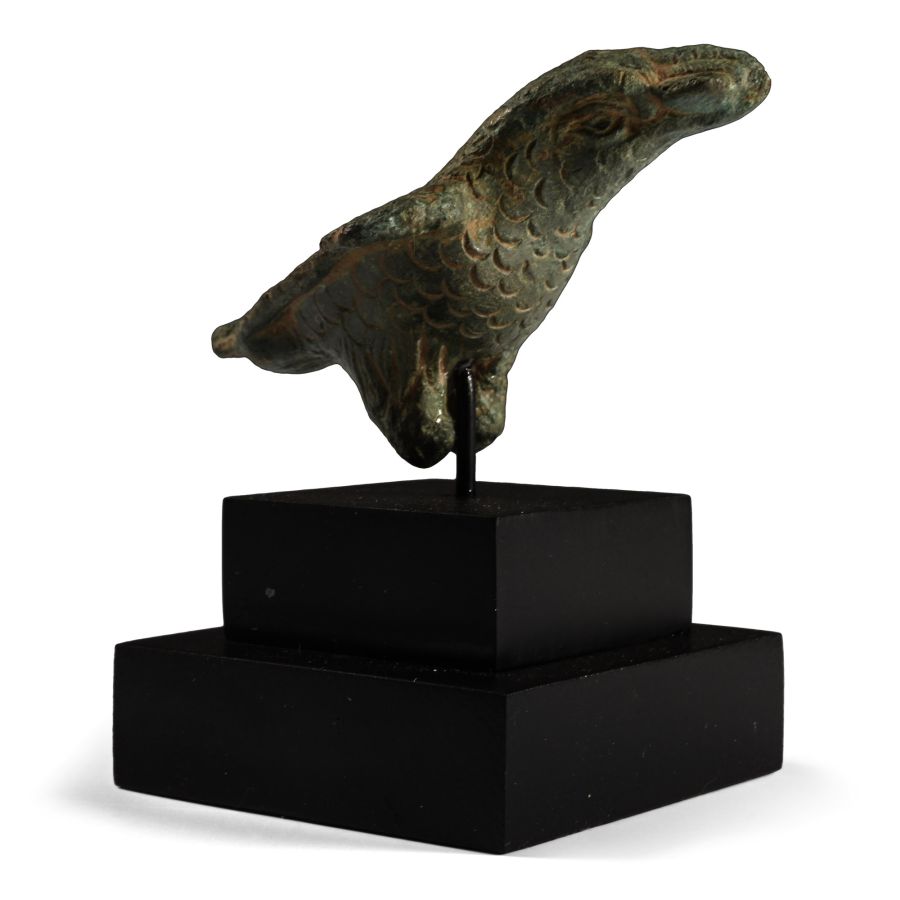
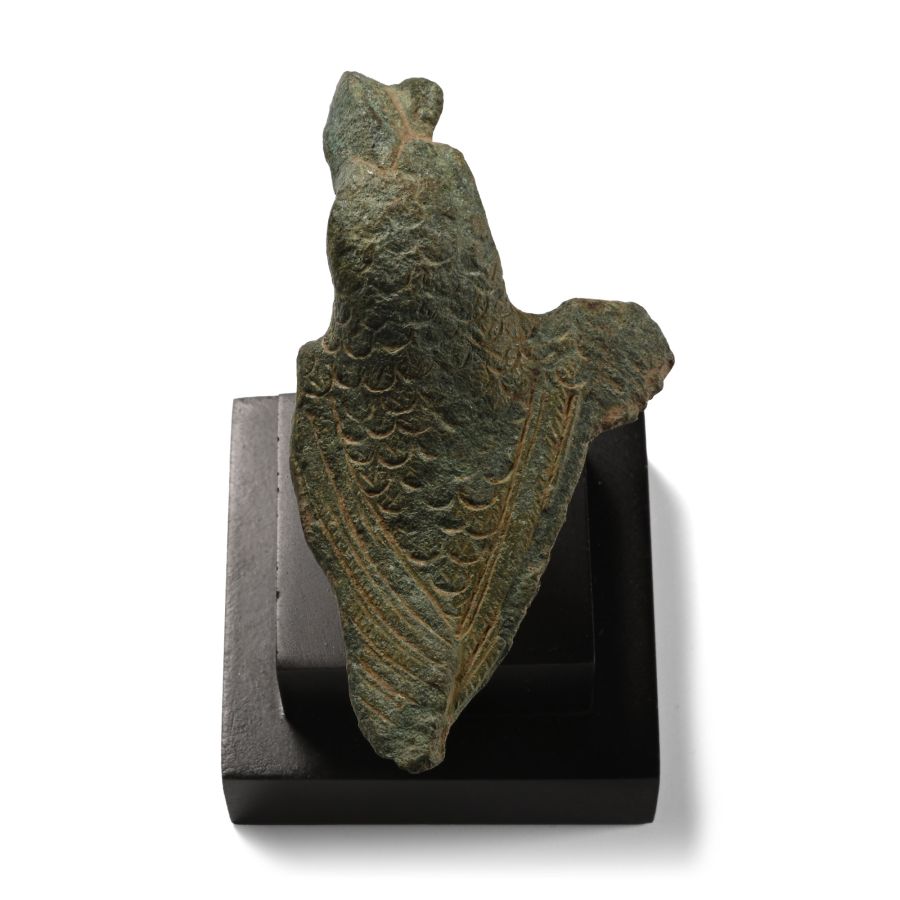
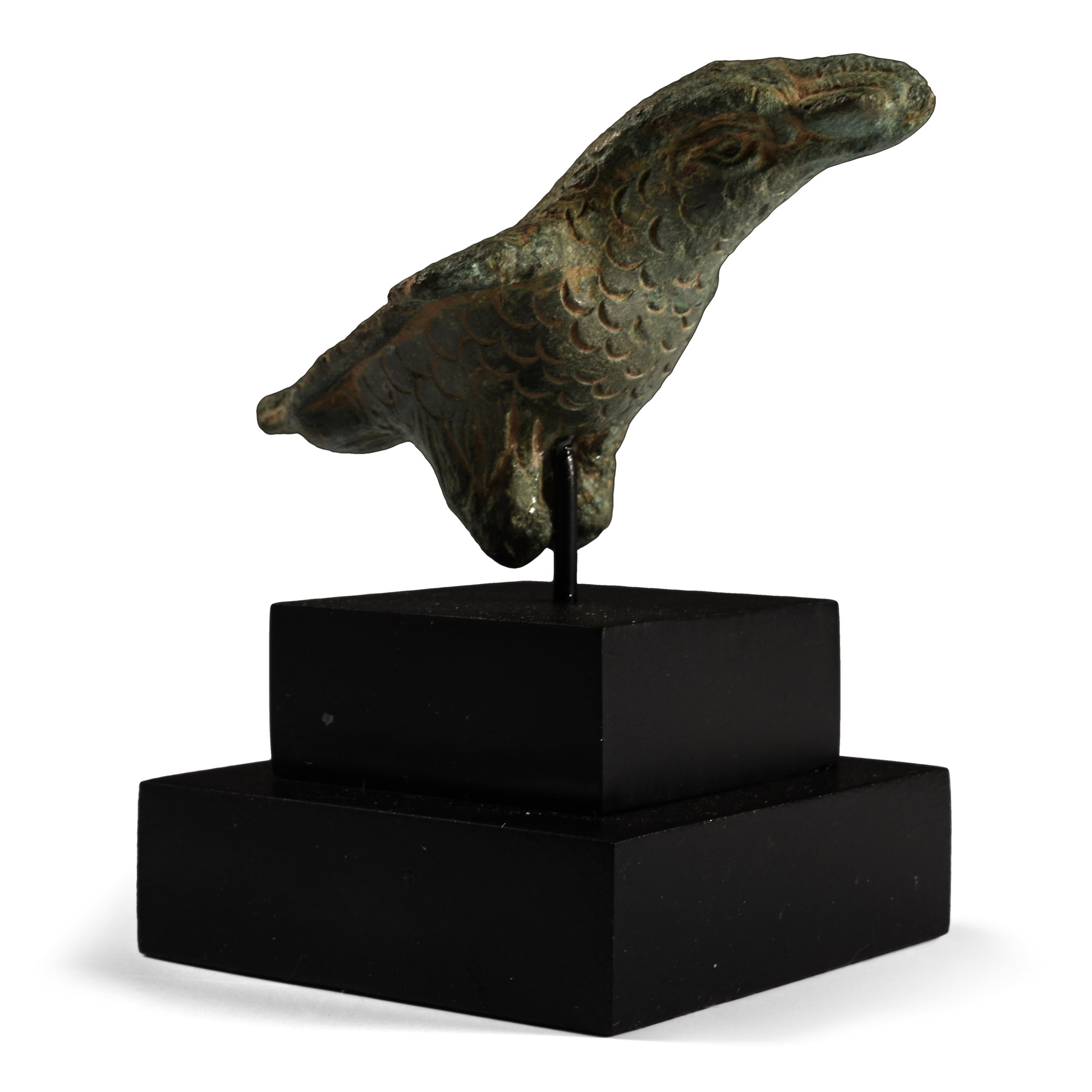
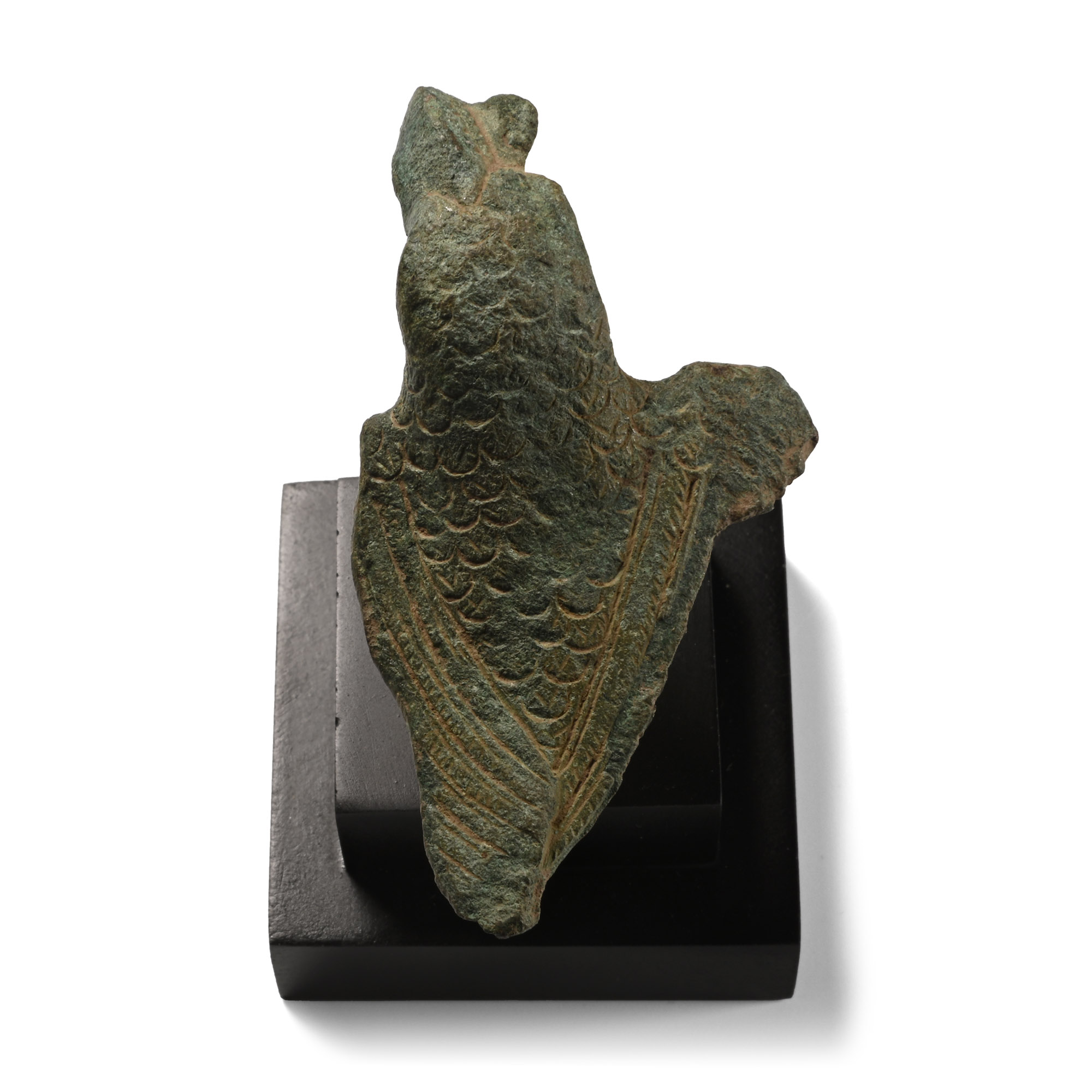
'The Kempsey' Roman Bronze Military Eagle Statuette
CIRCA 43-410 A.D.
3 in. (180 grams total, 76 mm high including stand).
Modelled in the round as a standing eagle with its wings spread, the overlapping wingtips covering the short tail; incised feather detailing to the body and wings, wide head with detailed eyes, remains of a military insignia (a victory wreath or fish?) held in its hooked beak; mounted on a custom-made display stand. [No Reserve]
ProvenanceFound Kempsey, Malvern Hills, Worcestershire, UK.
Accompanied by a copy of the British Museum's Portable Antiquities Scheme (PAS) report no.WAW-19C7C8.
This lot is accompanied by an illustrated lot declaration signed by the Head of the Antiquities Department, Dr Raffaele D'Amato.
See Portable Antiquities Scheme nos. HAMP-5ED544, WAW-7EC54A and DENO-323D62, for similar examples; Rolland, H., Bronzes Antiques de Haute Provence, Paris, 1965, item 268.
FootnotesBoth Ovid and Plutarch place the inception of manipular ensigns with Romulus, where bundles (manipuli) of hay were tied to high poles which served as rallying points for units of the army. Eventually, icons of animals replaced these ensigns: the eagle, wolf, Minotaur, horse, and boar. In 107 B.C., Gaius Marius made sweeping military reforms and the Aquila became the sole standard of the legion, which according to (Pliny NH. 10.5.16) ‘By making the Aquila the standard for all legions improved unity and gave soldiers a symbol that expressed their attachment to an all-encompassing body, to which the soldiers’ loyalty could be directed’. Due to its place at the head of each legion, it became the emblem of the Roman legions, which enforced Roman rule in the provinces, giving the eagle its connotation of dominion.
CONDITIONTimeLine Auctions follows a vetting process to ensure the authenticity and legality of all items, reinforcing our commitment to integrity and responsible trading. Each antiquity, antique, and coin lot undergoes thorough examination by a vetting committee of at least ten external specialists, professional trade association members, scientists, and archaeologists: Our Vetting Process
AUCTIONS:
TimeLine is a leading auction house specialising in antiquities, ancient art, collectables, natural history, coins, medals, and books. Our auctions offer museums, collectors, historians, and enthusiasts the opportunity to acquire unique and historically significant pieces.
-
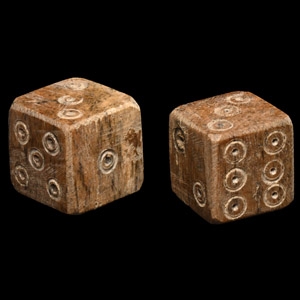
Roman Bone Dice Pair
1st-4th century A.D.Sold for (Inc. bp): £364
Each cuboid with ring-and-dot markings arranged 1:6, 2:5; 3:4. 7.48 grams, 12 mm each
Ex German art market, 2000s. Acquired from an EU collector living in London. From the collection of a Surrey, UK, gentleman. This lot is accompanied by an illustrated lot declaration signed by the Head of the Antiquities Department, Dr Raffaele D'Amato. -
.jpg)
Roman Bronze Jupiter Dolichenus Eagle on the Head of a Stag
2nd century A.D.Sold for (Inc. bp): £1,690
The eagle modelled in the round standing on top of a large head of a stag with curving antlers touching the bird's wings, the eagle with its legs held apart and its long talons spread across the head, the wings slightly raised and the head turned to the right whilst gazing down towards the stag; detailed plumage; accompanied by a custom-made display stand. 544 grams, 97 mm (621 grams total, 15 cm high including stand)
Acquired in 1997 from a Canadian dealership. From a North American gentleman's collection. This lot has been cleared against the Art Loss Register database, and is accompanied by an illustrated lot declaration signed by the Head of the Antiquities Department, Dr Raffaele D'Amato.
The motif of an eagle and a stag or a deer is typically associated with the God Jupiter/Zeus Dolichenus and his wife Juno Dolichena, name derived from his sanctuary in Doliche, Anatolia. Jupiter Dolichenus was a soldier god, usually portrayed wearing full military attire and standing on a bull, while his consort would have been shown standing on a deer or stag. -
.jpg)
Roman Bloodstone Intaglio with Horus, Osiris and Ouroboros
2nd-3rd century A.D.Sold for (Inc. bp): £4,160
Egyptizing intaglio representing the myth of Osiris, with the mummy of the god resting above the snake Ouroboros and surmounted by his son, the falcon god Horus, a star above. 1.31 grams, 17 mm
Giorgio Sangiorgi (1886-1965), Rome, acquired and brought to Switzerland, late 1930s; thence by continuous descent to the current owner. with Christie's Ancient Jewellery, New York, 6 December 2007, no.338. This lot has been checked against the Interpol Database of stolen works of art and is accompanied by a search certificate number no.12582-232140. This lot has been cleared against the Art Loss Register database, and is accompanied by an illustrated lot declaration signed by the Head of the Antiquities Department, Dr Raffaele D'Amato.
The image of Ouroboros (a snake eating its own tail) is usually associated with stars and Egyptian mythology as represented in Roman gnostic intaglios. Ouroboros is continuously re-birthing itself and depicted as a circle, representing eternity and the cyclical nature of things that start once they end. It is also the symbol of duality and dualising power.
