
Loading, please wait...
LOT 1410
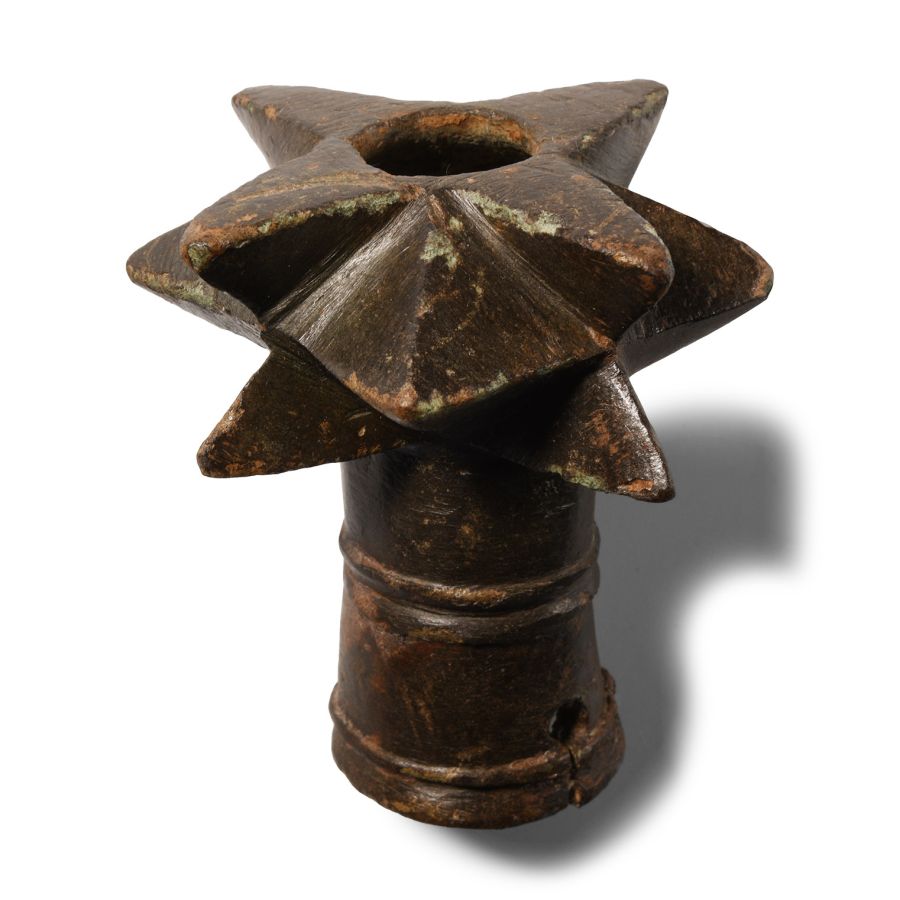
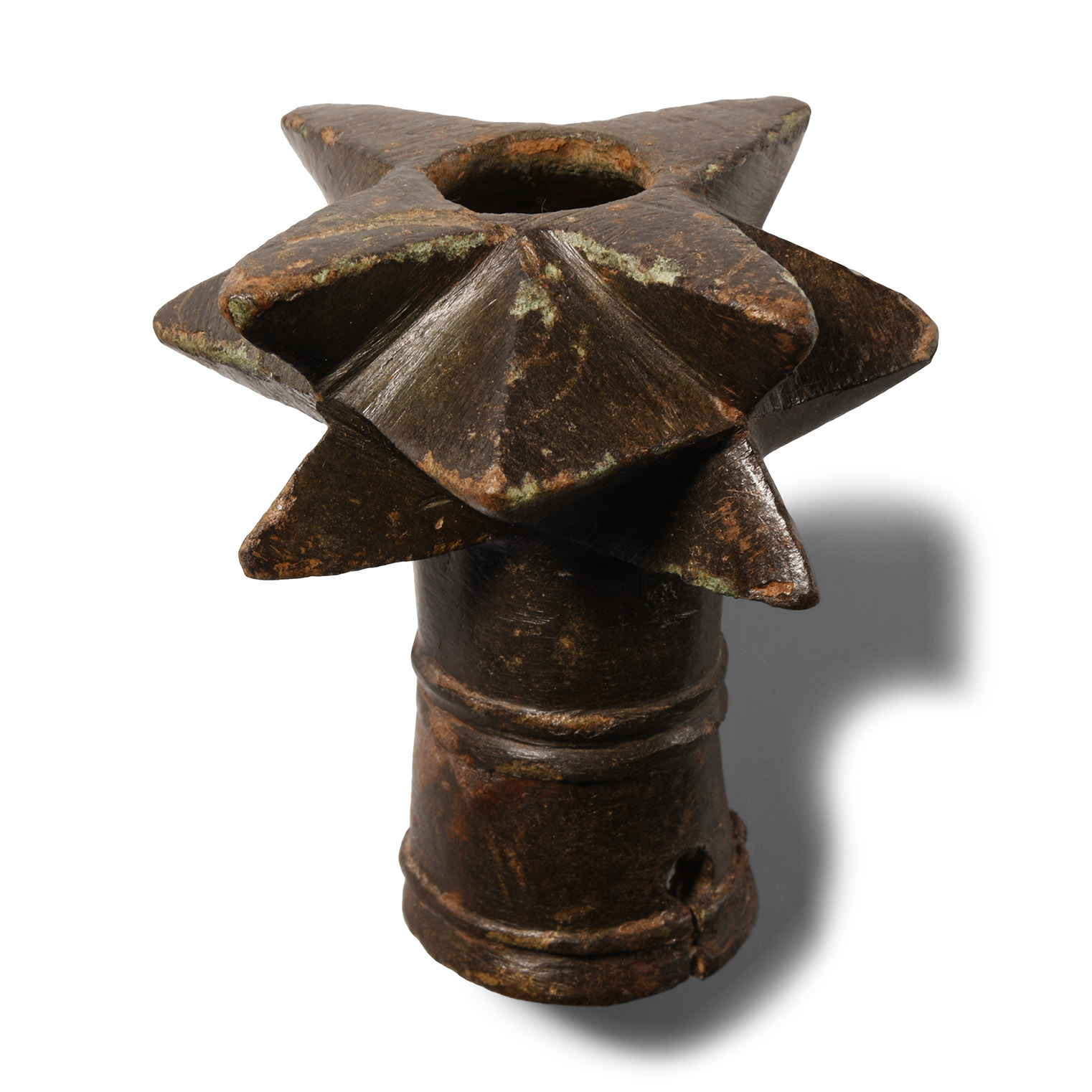
'The Farnham Castle' English Medieval Socketted Macehead
13TH-14TH CENTURY A.D.
3 1/8 in. (312 grams, 80 mm).
With a long tubular socket and raised circumferential ribs, three tiers of radiating spikes; found with remains of wooden haft in situ. [No Reserve]
ProvenanceFound near Farnham Castle, Farnham, Surrey, UK.
From the private collection of a Surrey, UK, gentleman.
Cf. Gilliot, C., Weapons and Armours, Bayeux, 2008, pp.160-161, for similar maceheads.
FootnotesMaces were in use since the Bronze Age. In the Medieval Western Europe, maces are attested in England as throwing weapons at the Battle of Hastings in 1066. At the end of 12th century A.D., the mace head was made of metal and was, under the influence of Byzantium, one of the weapons of the armoured knight. Originally of round section and armed with strong pyramidal spikes, the mace head evolved into a cylindrical shape, sometimes reinforced with spikes, most often with flanges.
CONDITIONTimeLine Auctions follows a vetting process to ensure the authenticity and legality of all items, reinforcing our commitment to integrity and responsible trading. Each antiquity, antique, and coin lot undergoes thorough examination by a vetting committee of at least ten external specialists, professional trade association members, scientists, and archaeologists: Our Vetting Process
AUCTIONS:
TimeLine is a leading auction house specialising in antiquities, ancient art, collectables, natural history, coins, medals, and books. Our auctions offer museums, collectors, historians, and enthusiasts the opportunity to acquire unique and historically significant pieces.
LOT 1410
'The Farnham Castle' English Medieval Socketted Macehead
Sold for (Inc. bp): £2,600
-
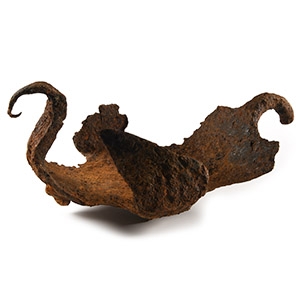
Roman Iron 'Hipposandal' Military Ice Horseshoe
1st-4th century A.D.Sold for (Inc. bp): £390
With lateral curved plates and scrolled bar to the front, rear panel with hooked spur for attachment. 617 grams, 21 cm
From a collection acquired on the UK art market from various auction houses and collections mostly before 2000. From an important Cambridgeshire estate; thence by descent.
Hipposandals (soleae ferreae) were used on horses with injured hooves, a sort of equine orthopaedic shoe used by the mulomedicus, i.e. a Roman military veterinarian. Another important function was that to protect the hooves of the horse from injuries and damages from hard objects. The hipposandal of type 1 was formed from a sub-oval plate which tapered towards the front and rear with projections at the front, back and on either side. The heel was upturned at about 45 degrees and flared outwards. It would have terminated with a downward facing hook, now missing. The base of the sole was flat. -
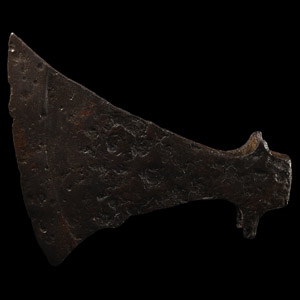
Viking Danish Iron Broad Axehead
Circa 9th-11th century A.D.Sold for (Inc. bp): £1,560
Of asymmetrical profile with reinforced curved cutting edge, triangular-section socket with flanking spurs to upper and lower edges. 370 grams, 18.5 cm
From the private collection of a London gentleman, from his grandfather's collection formed before the early 1970s. -
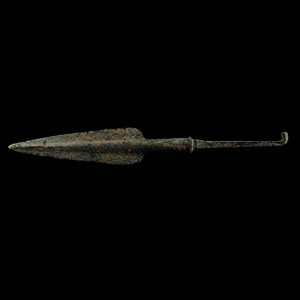
Western Asiatic Tanged Bronze Spearhead
Late 3rd-early 2nd millennium B.C.Estimate: £100 - 140 (+bp*)
Opening Bid: £50
Having foliate blade with central rib and slender shoulders, cylindrical short shaft encasing a rectangular tang with a bent end. 151 grams, 26.5 cm
Acquired 1980-2015. Ex Abelita family collection.
This variant is characterised by a blade of rhomboidal or swollen section, an intermediate part often short widened so as to form a clear stop and a curved bristle at its end, sometimes finished in a button. Most lances are of medium dimensions (23 cm to 36 cm), others are very elongated (more than 50 cm). The best parallels come from Tepe Hissar. Elements of handles found nearby the spearheads in the excavations have made it possible to reconstruct the total length of the weapon (1.40 m).
