
Loading, please wait...
LOT 0187
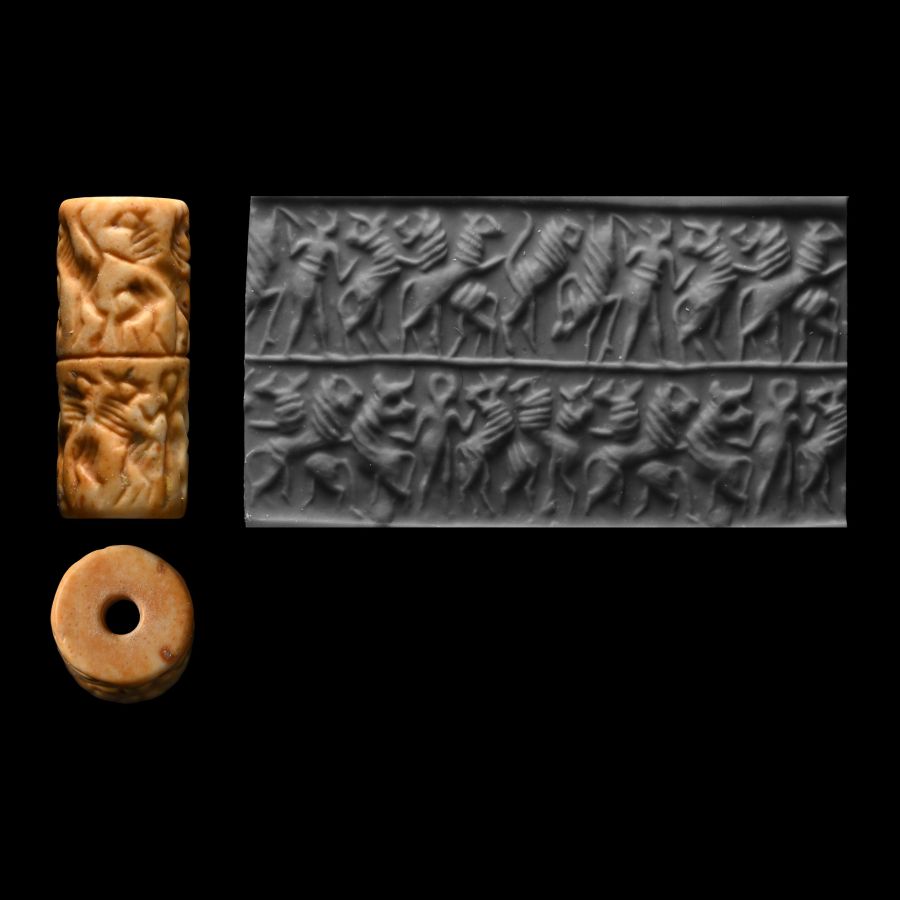
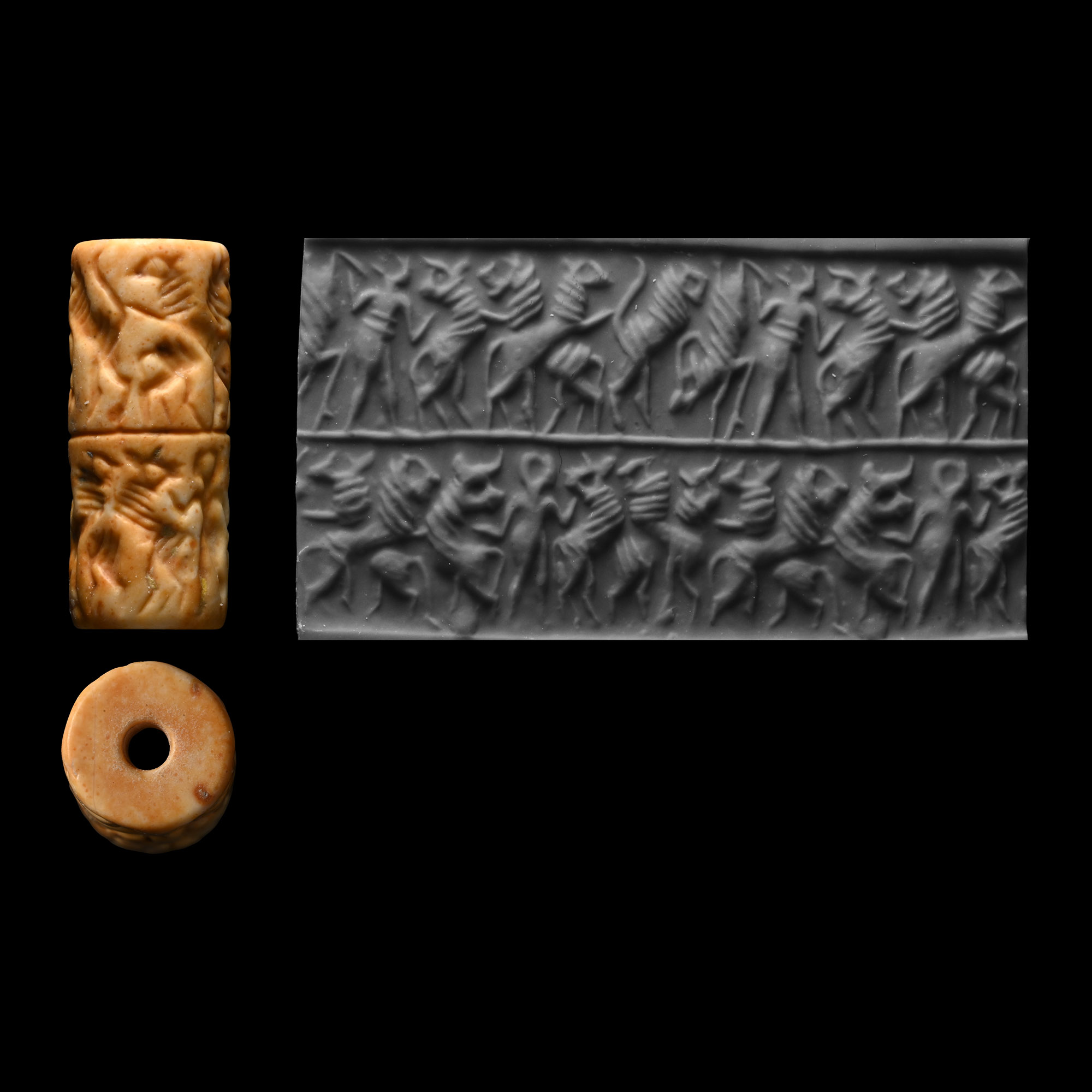
Sumerian Cream Stone Cylinder Seal with Contest Scene
CIRCA 2500 B.C.
1 1/8 in. (8.83 grams, 28 mm).
Divided into two registers, both showing a contest scene with a horned hero grappling with horned beasts; accompanied by a museum quality impression and a copy of an old scholarly note, typed and signed by W.G. Lambert, late Professor of Assyriology, University of Birmingham, 1970-1993, which states: 'Cylinder Seal of Cream Stone, 28.5 x 12 mm. The engraved sides of this seal are divided into two registers by a single horizontal line. In both registers there is a contest scene. In the upper a standing hero with double belt around his waist succours a bovine on the right and an upended gpat on the left, both of which are being attacked by a lion. The body of the lion on the right crosses the body of a second bovine. In the lower register a standing nude hero succours two differentiated bovines, one of each side, which are being attacked each by a lion, but in this case each lion's body crosses that of a third and fourth bovine. This is a seal in the Sumerian tradition, c. 2500 B.C., from the Third Phrase [sic] of the Early Dynastic periods, and may come from Sumer itself, north Mesopotamia or south-east Iran. It is in good state of preservation and a nice example of its kind.' [No Reserve]
ProvenanceUK private collection, acquired 1990-1993.
FootnotesSeals were the working signatures of the ancient Near East. Pressed or rolled into wet clay, they secured jars, bags, doors and tablets, and left a distinct impression that identified the owner, authorised a transaction, and showed whether a container had been opened. Stamp seals (pressed once to leave a single emblem) appear from the 7th–4th millennia BC and continue throughout later periods; cylinder seals (rolled to create a repeating frieze) developed in Mesopotamia in the late 4th millennium BC and are used into the 1st millennium BC. Beyond administration, seals were miniature artworks and amulets. Their images—gods and worshippers, royal hunts, banquets, heroes and mythic beasts—broadcast rank, piety and profession, and were believed to protect the owner. Materials range from soft stones to hard chalcedonies, haematite and lapis, worked with drills and abrasives to achieve crisp intaglio cutting. Many were worn on cords or rings and followed their owners through life, sometimes into the grave. Seals matter because they underpin the earliest systems of record-keeping and trade. Impressions on tablets and bullae are primary documents for ancient law, economy and religion; the seals themselves preserve that imagery in the round. For collectors, well-cut examples with sharp impressions, good polish and honest ancient wear are especially desirable, and pieces with early collection histories are keenly sought.
CONDITIONTimeLine Auctions follows a vetting process to ensure the authenticity and legality of all items, reinforcing our commitment to integrity and responsible trading. Each antiquity, antique, and coin lot undergoes thorough examination by a vetting committee of at least ten external specialists, professional trade association members, scientists, and archaeologists: Our Vetting Process
AUCTIONS:
TimeLine is a leading auction house specialising in antiquities, ancient art, collectables, natural history, coins, medals, and books. Our auctions offer museums, collectors, historians, and enthusiasts the opportunity to acquire unique and historically significant pieces.
-
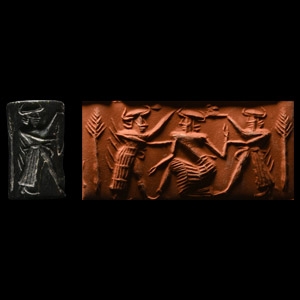
Akkadian Black Stone Cylinder Seal with Combat Scene
Circa 2300-2200 B.C.Sold for (Inc. bp): £749
Showing a combat of gods; accompanied by a museum quality impression and a copy of an old scholarly note, typed and signed by W.G. Lambert, late Professor of Assyriology, University of Birmingham, 1970-1993, which states: 'Cylinder Seal of Black Stone 27 x 16 mm. The design shows a combat of gods: all three wear horns on their heads as a mark of divinity. To each side of the scene is a god in long robe from waist to feet, open at the front with one leg projecting. They stand grappling with a god on one knee between them. He wears a robe of similar length, but not open at the front. Diagonal lines rise from the robes of the two attacking gods, probably marking them as fire gods. A stylised tree serves as a terminal. This is an Akkadian seal, c. 2500-2200 B.C. It is one of the rarer designs to see gods, and such fighting gods are not seen in other periods. But we have no written form of the myth to explain exactly what is happening. the seal is in very good condition and has an interesting design.' 12 grams, 27 mm
From the private collection of a North American lady, formed 1970s-early 1990s, with collection reference no.589/3. Accompanied by a copy of a scholarly note, typed and signed by Professor Wilfrid George Lambert and an old photograph. -
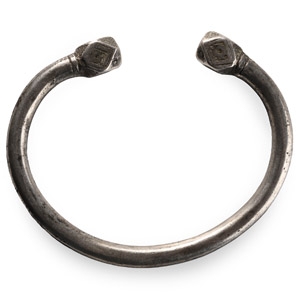
Large Western Asiatic Silver Bracelet
1st millennium A.D.Sold for (Inc. bp): £286
Penannular type with polyhedral terminals, blocks of pointillé detailing and hatching. 141 grams, 10.3 cm
Ex property of a Dutch gentleman; formerly in an old collection formed in the 1970s. -
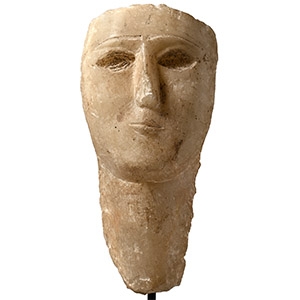
South Arabian Alabaster Head of a Woman
6th-4th century B.C.Sold for (Inc. bp): £1,105
Large female head with angular nose with straight ridge, rounded cheeks and chin, large sockets for inlaid eyes with rounded depressions in the centre of the eyes, grooved eyebrows and outlines of the eyes, the tapering neck long and cylindrical, the back left roughly tooled; mounted on a custom-made display stand. 3.66 kg total, 31.4 cm including stand
UK collection, 1990s. Acquired on the UK art market, before 2000. Private collection, Mr M.V., a London-based businessman.
This finely carved calcite-alabaster head was originally set within a stela and inscribed with the name of the deceased. Six hundred of these funerary stelae were discovered in localities like Mārib, and other examples were later found during the excavations of the Awwam temple cemetery.
