
Loading, please wait...
_900x900.jpg "Stuart Period Iron Door-Hinge Pair with Dragons")
_200x200.jpg "Stuart Period Iron Door-Hinge Pair with Dragons")
.jpg "Stuart Period Iron Door-Hinge Pair with Dragons")
LOT 1768
Stuart Period Iron Door-Hinge Pair with Dragons
EARLY 17TH CENTURY A.D.
15 in. (1.45 kg total, 38 cm each).
Matched pair of openwork iron hinges and plates, each with scrolled hinge barrel, plaque of openwork scrolls with opposed bird-head detailing, coiled tendrils, punched fan-motifs and other decoration. [2,No Reserve]
ProvenanceAcquired Bishop & Miller, UK, 16 April 2016, lot 252.
Property of a Kent collector.
TimeLine Auctions follows a vetting process to ensure the authenticity and legality of all items, reinforcing our commitment to integrity and responsible trading. Each antiquity, antique, and coin lot undergoes thorough examination by a vetting committee of at least ten external specialists, professional trade association members, scientists, and archaeologists: Our Vetting Process
AUCTIONS:
TimeLine is a leading auction house specialising in antiquities, ancient art, collectables, natural history, coins, medals, and books. Our auctions offer museums, collectors, historians, and enthusiasts the opportunity to acquire unique and historically significant pieces.
-
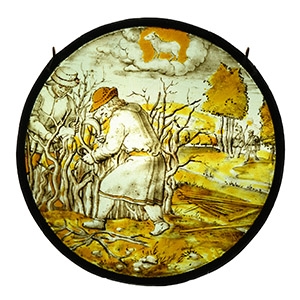
Renaissance Stained Glass Panel of The Month of March
Southern Low Countries, Antwerp, circa 1540 A.D.Sold for (Inc. bp): £3,120
Discoid panel in a lead frame showing two workmen cutting back brushwood with sickles; posts and staves to the rear and two more men in the background landscape, repaired. 296 grams, 24 cm
George Wigley, Monastery Glass, Towcester. Klaus Tiedemann Collection, inv.100. Acquired from the above, 2016. This lot has been checked against the Interpol Database of stolen works of art and is accompanied by a search certificate number no.12075-217451. -
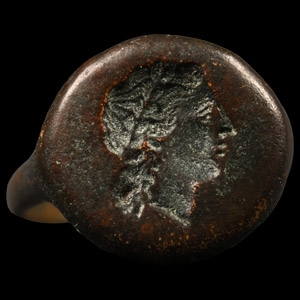
Bronze Signet Ring with Head of Apollo
19th-20th century A.D.Sold for (Inc. bp): £91
Disc bezel with incuse profile bust of Apollo with diadem to the brow; after the antique. 8.19 grams, 24.29 mm overall, 19.80 mm internal diameter (approximate size British U, USA 10, Europe 22.52, Japan 21)
Acquired from Rosebery's Auctions. From the personal collection of a West London, UK, gentleman. -
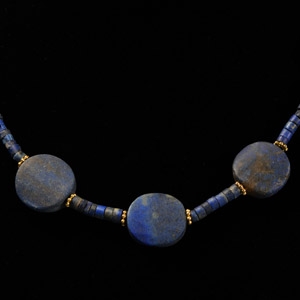
Bactrian Style Lapis Lazuli Bead Necklace
20th century A.D.Sold for (Inc. bp): £33
Comprising small annular beads, yellow-metal beaded collars and coin-shaped beads. 46 grams, 48 cm
From the H.N. collection, Milton Keynes, Berkshire, UK, 1990s.
