
Loading, please wait...
LOT 0202
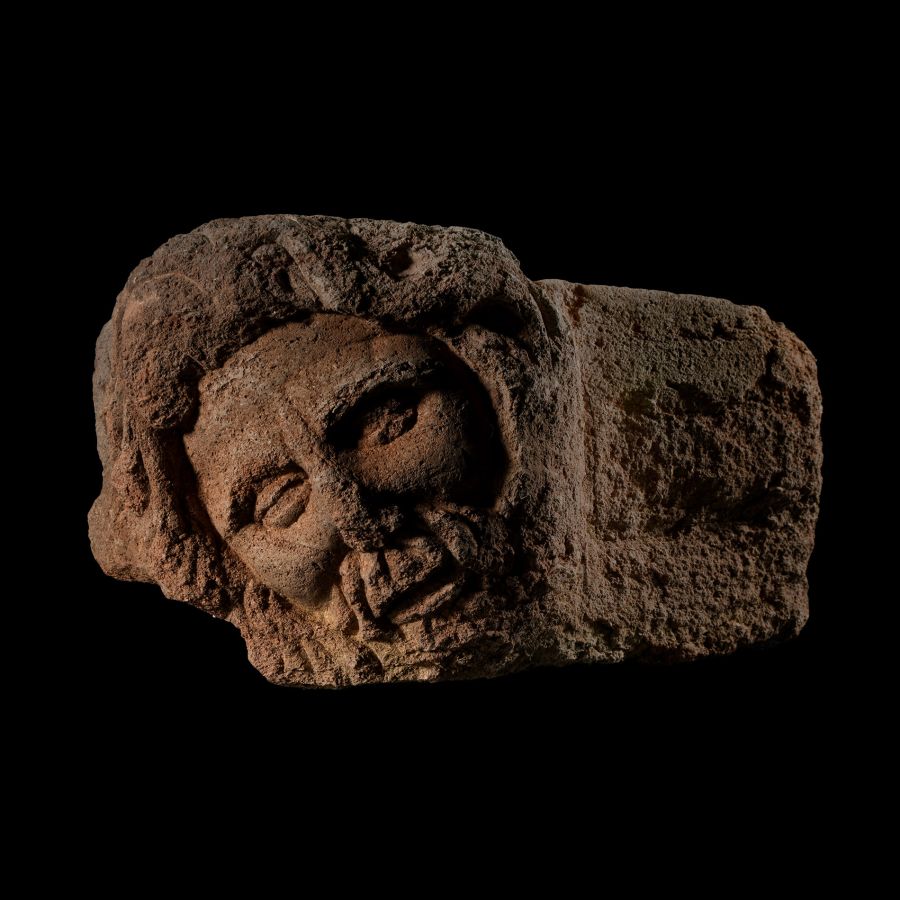
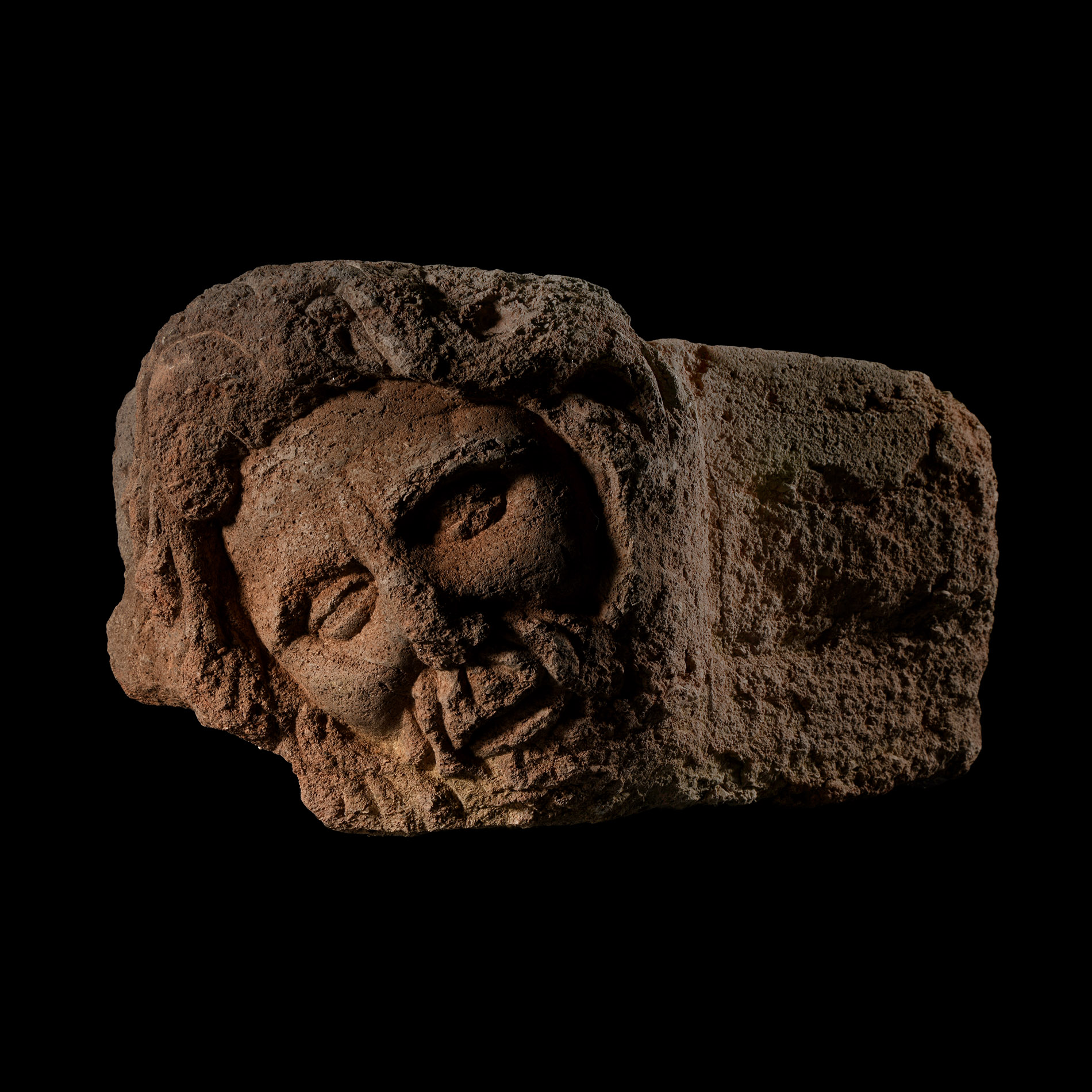
Stone Corbel with Severed Head of a Gallo-Roman
CIRCA 2ND CENTURY A.D.
16 7/8 in. (22.8 kg, 43 cm).
Statue or frieze fragment with male head modelled in the half-round; circular face with large almond-shaped eyes, heavy brow, thick tousled hair framing the face, drooping moustache and short beard; presented at an oblique angle to the lower face of the block; two mounting holes to the underside. [No Reserve]
ProvenanceFound in Norfolk, UK.
Acquired from Michael Booth, 1998.
From an important Cambridgeshire estate; thence by descent.
See Ross, A., Pagan Celtic Britain, London, 1967, pp.90-92; Boulestin, B. & Gambier, D.H., Crânes trophées, crânes d'ancêtres et autres pratiques autour de la tête: problèmes d'interprétation en archéologie. Actes de la table ronde pluridisciplinaire, musée national de Préhistoire, Les Eyzies-de-Tayac (Dordogne, France), 14-16 octobre 2010, BAR International Series 2415, Oxford, 2012.
FootnotesThe angle of the face in respect of the block suggests that the head is both tilted and detached, i.e. that it is a tête coupé or severed head. The practice of headhunting is documented among the natives of both Gaul and Britain (and elsewhere) in the Iron Age. The head is then considered to have special powers to avert evil and promote fertility, cure disease and provide other benefits. This is the case with the carved head - a male mask with copious hair and beard - from the Roman baths at Bath, Somerset (the ancient Aquae Sulis) which was a site of worship long before the arrival of a Roman presence in the area (Ross, p.91). The head takes on the character of a deity and is believed to respond favourably to prayer.
CONDITIONTimeLine Auctions follows a vetting process to ensure the authenticity and legality of all items, reinforcing our commitment to integrity and responsible trading. Each antiquity, antique, and coin lot undergoes thorough examination by a vetting committee of at least ten external specialists, professional trade association members, scientists, and archaeologists: Our Vetting Process
AUCTIONS:
TimeLine is a leading auction house specialising in antiquities, ancient art, collectables, natural history, coins, medals, and books. Our auctions offer museums, collectors, historians, and enthusiasts the opportunity to acquire unique and historically significant pieces.
-
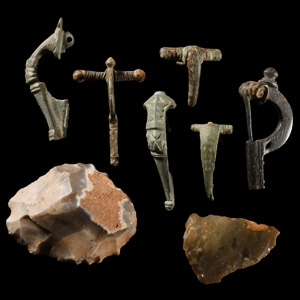
Roman Bronze Brooch and Other Item Group
3rd century A.D. and earlierSold for (Inc. bp): £85
Mixed group including P-shaped bow brooches, Langton Down type brooch, flint scraper with old label 'Clactonian/Bainfield/Swanscombe/1916' and other items. 143 grams total, 29-60 mm
Property of a Gloucestershire, UK, collector. Property of an East Sussex, UK, gentleman. -
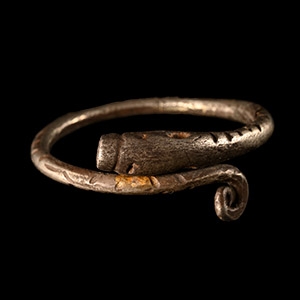
Roman Silver Snake Ring
1st-2nd century A.D.Sold for (Inc. bp): £111
Formed as a coiled snake with curved tail, hatched lines to the body and stylised facial features. 3.28 grams, 23.25mm overall, 19.74mm internal diameter (approximate size British T, USA 9 1/2, Europe 21.26, Japan 20)
Private collection, UK; formed in the 1980s. Property of a Shropshire private collector. -
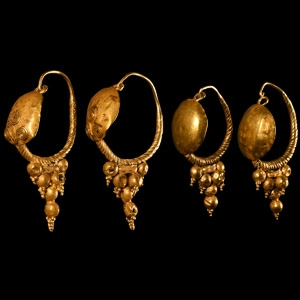
Roman Gold Earring Pairs
2nd-3rd century A.D. or earlierEstimate: £1,500 - 2,000 (‡+bp*)
Opening Bid: £750
Two pairs of earrings with decoratively twisted hoops, domed plaques and pyramid bulbs embellished with granule clusters; one pair with gold wire spirals to the plaques. 16.97 grams total, 42-50 mm
Acquired between 1950-1970s. Ex Swiss private collection.
