
Loading, please wait...
LOT 0389
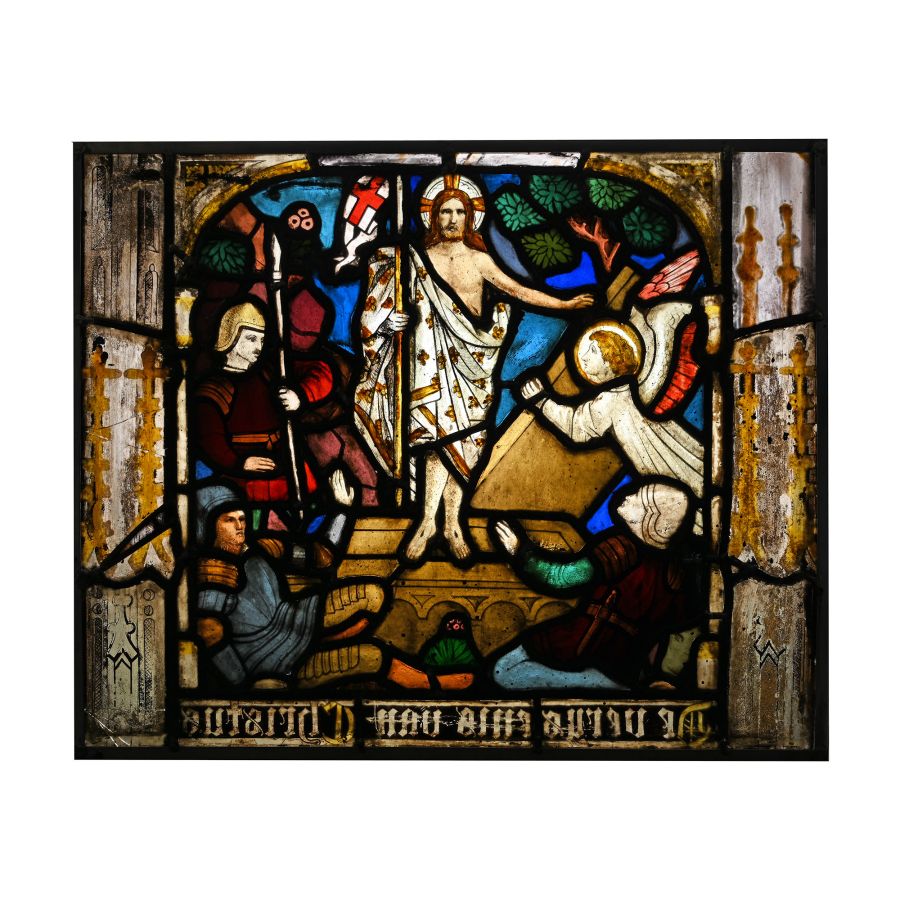
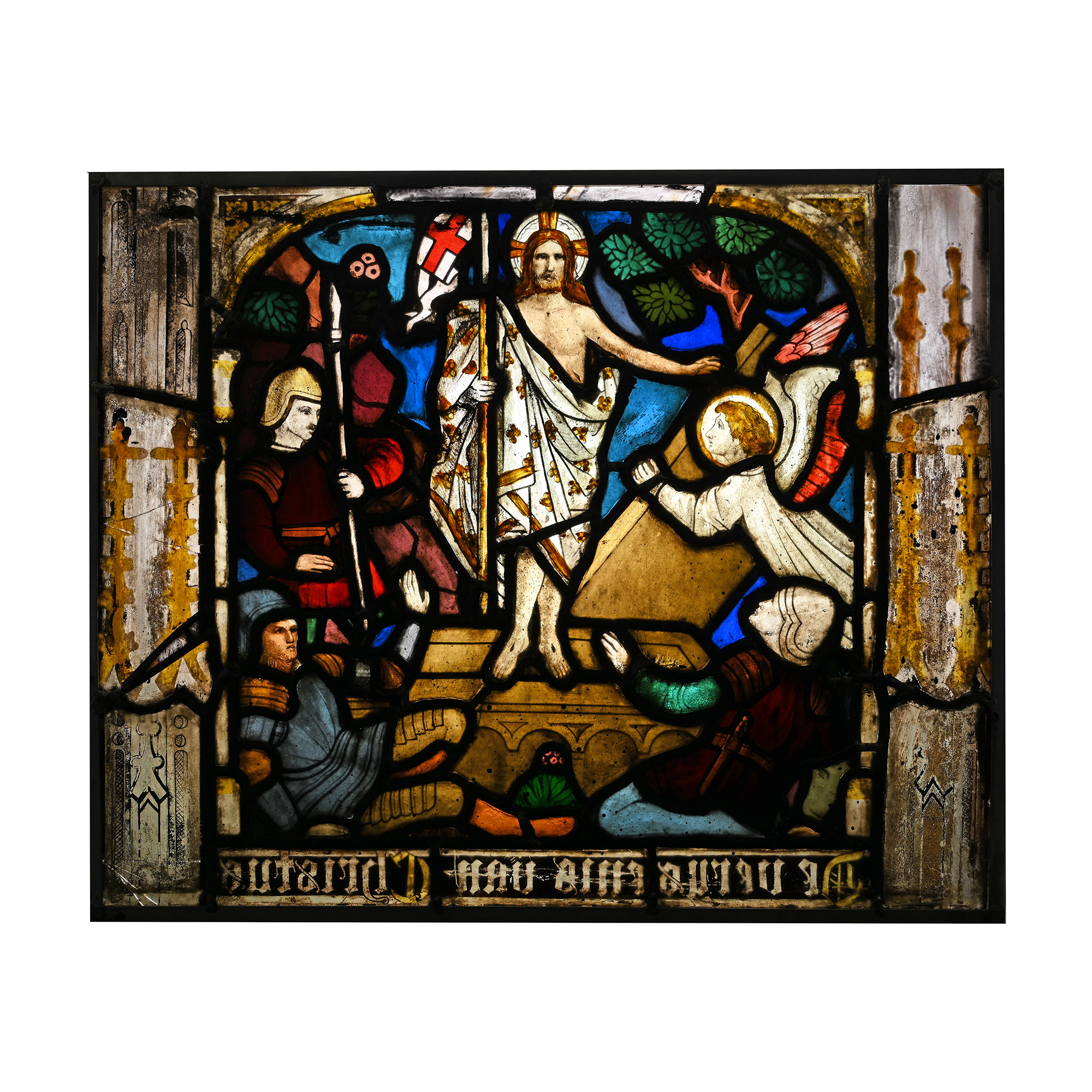
Stained Glass Panel with the Resurrection
FLEMISH, 19TH CENTURY A.D. OR EARLIER
25 1/2 x 21 in. (4.5 kg, 65 x 53.5 cm).
In late 15th century style, showing triumphant Jesus on the foreground, holding a flag and dressed in a brocade cloak, stigmata showing on his hands and feet; two guards on his side looking stunned, one wearing a full plate armour with a sallet and the other a leather corselet with a bascinet, third guard at the bottom of the panel looking terrified; an angel dressed in white robe, extending his arms towards Jesus; the opened tomb on the background and medieval Flemish inscription at the bottom reading 'DE VERISENIS VAN CHRISTUS’ (the Resurrection of Christ) in uncial letters; some restoration. [No Reserve]
ProvenanceFrom a war-damaged church in Belgium.
Ex property of a late Northumberland collector.
From a private collection, Derbyshire, UK.
This lot has been cleared against the Art Loss Register database, and is accompanied by an illustrated lot declaration signed by the Head of the Antiquities Department, Dr Raffaele D'Amato.
Cf. similar scene in ‘Resurrection of Christ’, historiated initial R from a Gradual, ms. Ludwig VI 3 (83.MH.86), f.16r, late 15th or early 16th century, The J. Paul Getty Museum, Los Angeles.
FootnotesThe scene represents the Resurrection of Christ according to the Gospel of Matthew (28,2-4), as revealed by the presence of an angel moving away the stone, and of the soldiers. According to the Christian tradition, the bodily resurrection was the restoration to life of a body transformed and nourished by the spirit, as described by Paul and the Evangelists, which led to the affirmation of Christianity. In Christian theology, the Resurrection of Jesus is ‘the fundamental mystery of faith’, as recalled by Easter, together with the remaining Christological mystery (Incarnation, Passion and Death), and together with the Logia and the works of the ministry of Jesus. For Christians, the resurrection of Jesus is a guarantee that all the dead Christians will come back to life at the time of the parousia (second coming) of Christ.
CONDITIONTimeLine Auctions follows a vetting process to ensure the authenticity and legality of all items, reinforcing our commitment to integrity and responsible trading. Each antiquity, antique, and coin lot undergoes thorough examination by a vetting committee of at least ten external specialists, professional trade association members, scientists, and archaeologists: Our Vetting Process
AUCTIONS:
TimeLine is a leading auction house specialising in antiquities, ancient art, collectables, natural history, coins, medals, and books. Our auctions offer museums, collectors, historians, and enthusiasts the opportunity to acquire unique and historically significant pieces.
-
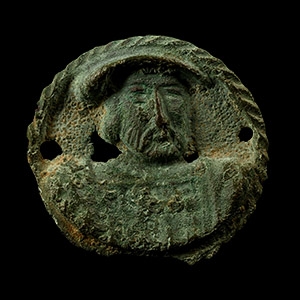
Tudor Henry VIII Tin Supporters Purse Badge
1509-1547 A.D.Sold for (Inc. bp): £221
Bearing the bust of a bearded man dressed in elaborate Tudor clothing and wearing a wide-brimmed hat, Tudor rose on the breast band. 13.3 grams, 37 mm
Found New Sheriff Hutton Industrial Estate, Yorkshire, UK, in July 2006. From the private collection of Robin Sykes, Yorkshire, UK, formed since the late 1990s. Accompanied by an illustrated record card by Jim Halliday. This lot is accompanied by an illustrated lot declaration signed by the Head of the Antiquities Department, Dr Raffaele D'Amato.
This type of badge would have been attached to the lid of a purse; other examples were worn as brooches and pierced for attachment when the pin had broken off. -
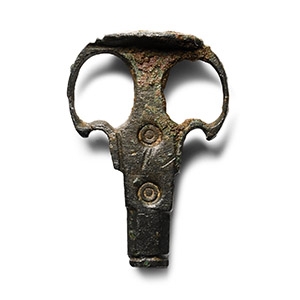
Tudor Bronze Winder Key
16th century A.D. or laterSold for (Inc. bp): £39
With tubular shank and flared lateral arms, ellipsoid panel above. 3.72 grams, 24 mm
Found near Skirpenbeck, Yorkshire, UK, in 1997. From an old Yorkshire, UK, collection. Accompanied by a copy of the British Museum's Portable Antiquities Scheme (PAS) report no.FAKL-404206. This lot is accompanied by an illustrated lot declaration signed by the Head of the Antiquities Department, Dr Raffaele D'Amato.
The item is described by the PAS report as 'probably a watch winding key' although these are very rare until the late 17th century since mechanical timepieces were not portable until then. An alternative use for the item would be for the tuning of a musical instrument: hollow keys for this purpose have been in use since at least the 7th century. -
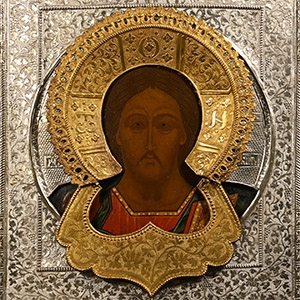
Russian Icon with Bust of Christ Pantokrator
17th century A.D.Estimate: £2,200 - 3,200 (+bp*)
Opening Bid: £1,100
Rectangular wooden board with mounting bars to reverse, silver-coloured metal riza with reserved epigraphic panels and circular void to reveal painted icon beneath; separate two-piece gilt revetment, the upper with pierced edge and reserved capitals, the scooped lower panel bearing reserved tendril ornament. 1.53 kg. 30.5 x 26 cm
Acquired on the UK art market. Private collection, London, UK. Accompanied by an academic report by Dr Raffaele D'Amato. This lot has been checked against the Interpol Database of stolen works of art and is accompanied by a search certificate number no.12553-231940. This lot has been cleared against the Art Loss Register database, and is accompanied by an illustrated lot declaration signed by the Head of the Antiquities Department, Dr Raffaele D’Amato. This lot has been cleared against the Art Loss Register database, and is accompanied by an illustrated lot declaration signed by the Head of the Antiquities Department, Dr Raffaele D'Amato.
