
Loading, please wait...
LOT 0403
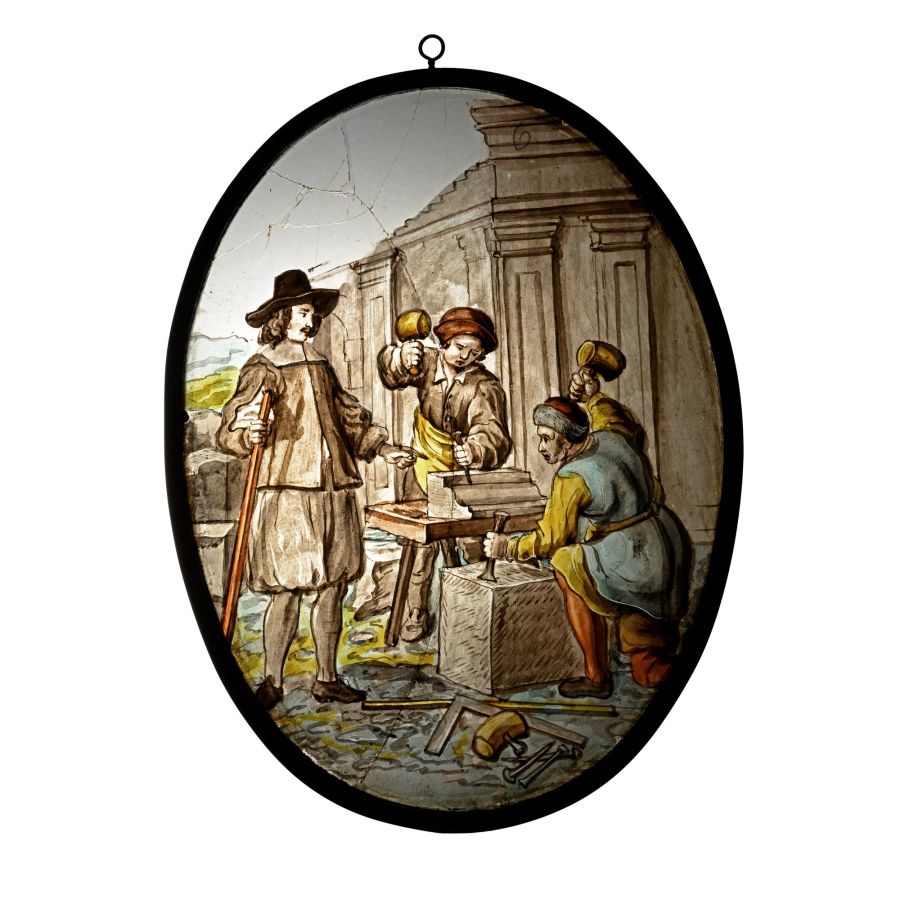
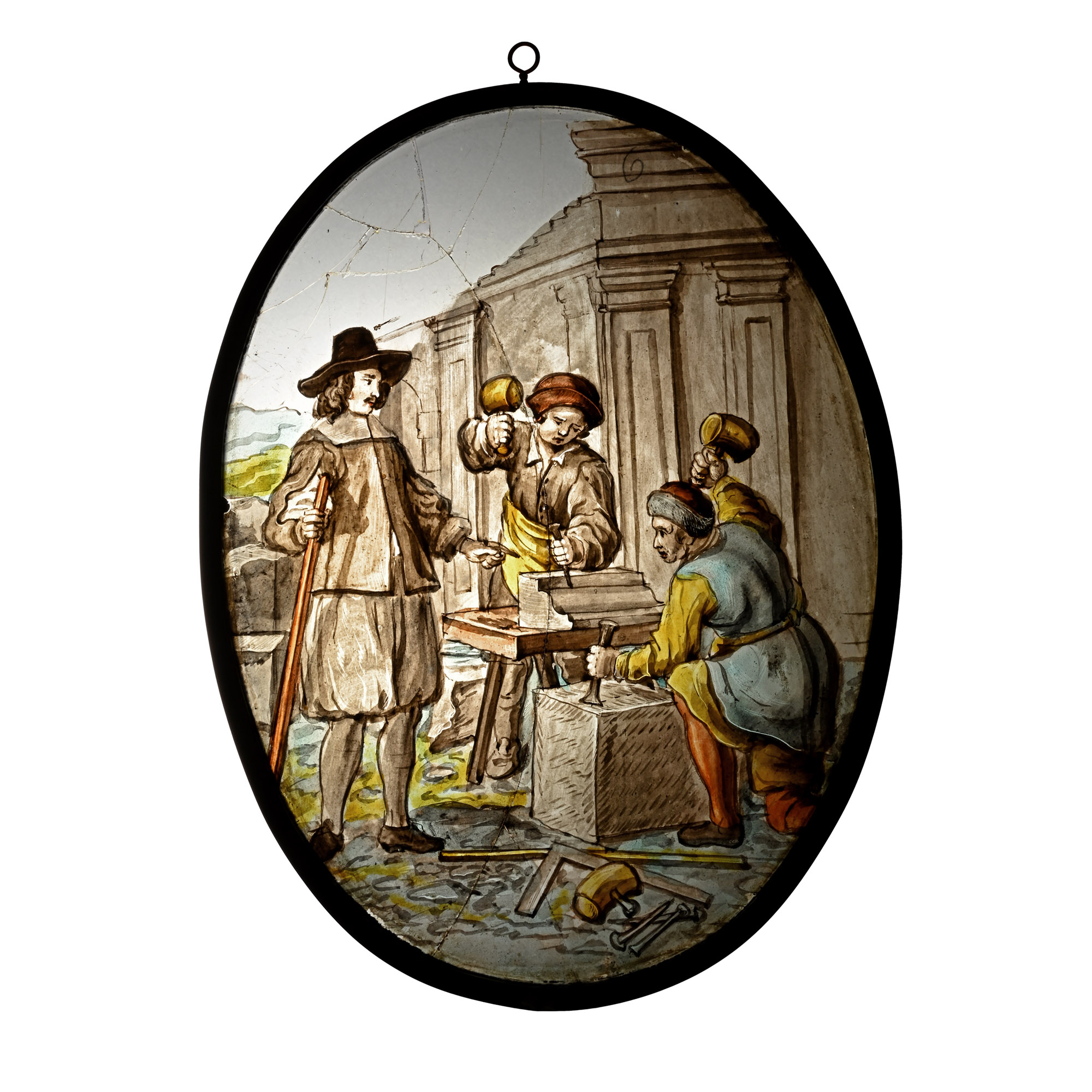
Stained Glass Panel of an Architect Inspecting the Work of Masons
LOW COUNTRIES, CIRCA 1640 A.D.
10 1/2 in. (271 grams, 26.7 cm).
Ellipsoid panel with polychrome scene depicting a standing figure in doublet with broad collar, plain hose and wide-brimmed felt hat, holding a surveying staff and pointing towards a stone in preparation; mason to the rear wearing a soft felt cap with turned brim and with an apron on his waist, using a mallet and chisel to finish a stone block on a bench; second mason kneeling working on a fresh dressed stone with a mallet and bolster; chisels, square and other tools in the foreground, all set in a landscape with building under construction; cracked and repaired, in a lead came with loop to the upper edge. [No Reserve]
ProvenanceCollection of Henry L Hotellier (1908-1993), and by descent until 2021.
Encheres Cote d'Opal DeBacker Richmond, 22 May 2021, no.263 [Part].
TimeLine Auctions follows a vetting process to ensure the authenticity and legality of all items, reinforcing our commitment to integrity and responsible trading. Each antiquity, antique, and coin lot undergoes thorough examination by a vetting committee of at least ten external specialists, professional trade association members, scientists, and archaeologists: Our Vetting Process
AUCTIONS:
TimeLine is a leading auction house specialising in antiquities, ancient art, collectables, natural history, coins, medals, and books. Our auctions offer museums, collectors, historians, and enthusiasts the opportunity to acquire unique and historically significant pieces.
LOT 0403
Stained Glass Panel of an Architect Inspecting the Work of Masons
Sold for (Inc. bp): £208
-
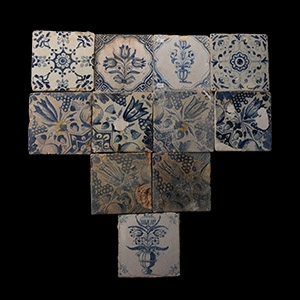
Post Medieval Dutch Glazed Ceramic Tile Group
Circa 17th-18th century A.D.Sold for (Inc. bp): £85
Comprising blue and white glazed floral and geometric schemes. 4.76 kg total, 13 x 13 - 13.5 x 13.5 cm
Acquired 1990s-early 2000s. East Anglian private collection. -
.jpg)
Post Medieval Glazed Ceramic Tile Group
17th-18th century A.D.Sold for (Inc. bp): £26
Comprising two designs in relief including three horses in an enclosure and two animals, likely cats, fighting; coloured glazes. 1.3 kg total, 10 x 9 - 10.5 x 9.5 cm
Acquired 1990s-early 2000s. East Anglian private collection.
The tile production increases in the second half of the sixteenth century and during the following centuries. The fragments discovered from various localities (pot-tiles, rectangular, triangular and trapezoidal panels, open-work crest tiles) were all produced in regional workshops, from the end of the 15th century or at the beginning of the 16th century. They all had diverse decorative motifs, mainly animals and geometrical or vegetal combinations, almost all of them singular finds for this study area. -
.jpg)
Carnelian Calligraphic Gemstone Collection
Circa 18th-19th century A.D.Sold for (Inc. bp): £39
Comprising: one square with nasta'liq inscription; one similar, octagonal with date; two ellipsoid with compressed text; one discoid with large lettering. 6.99 grams total, 12-15 mm
Acquired 1970s-1996. Property of a North American collector. London collection, 2016.
