
Loading, please wait...
LOT 1411
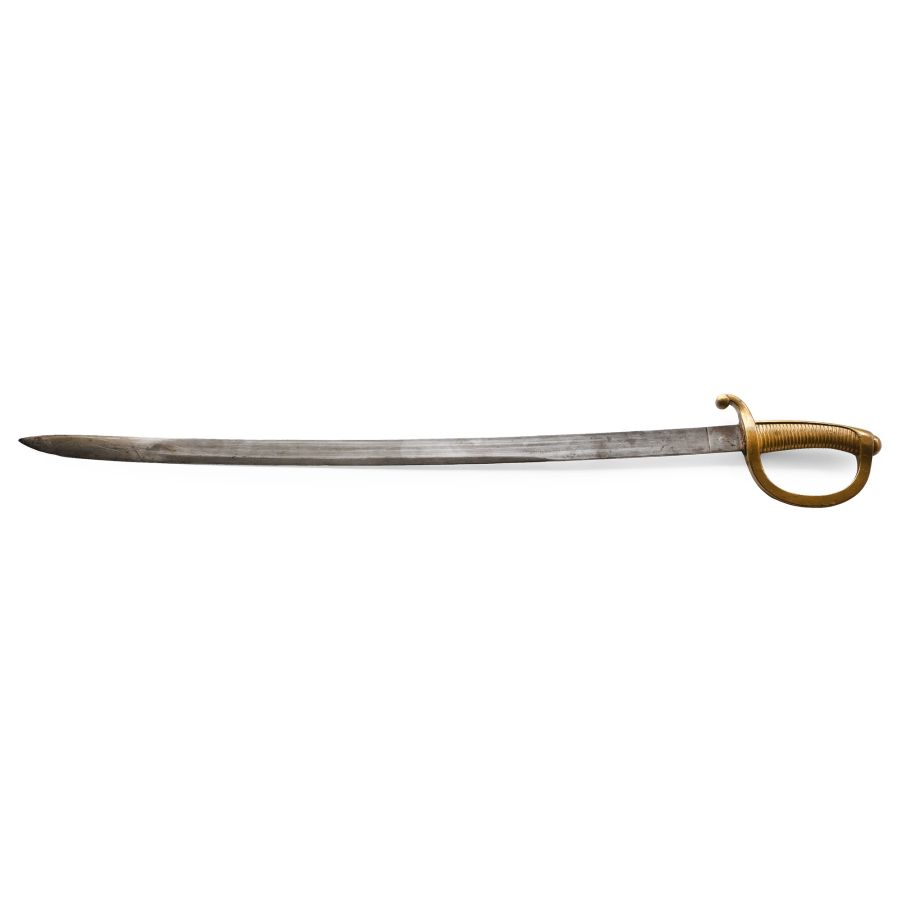
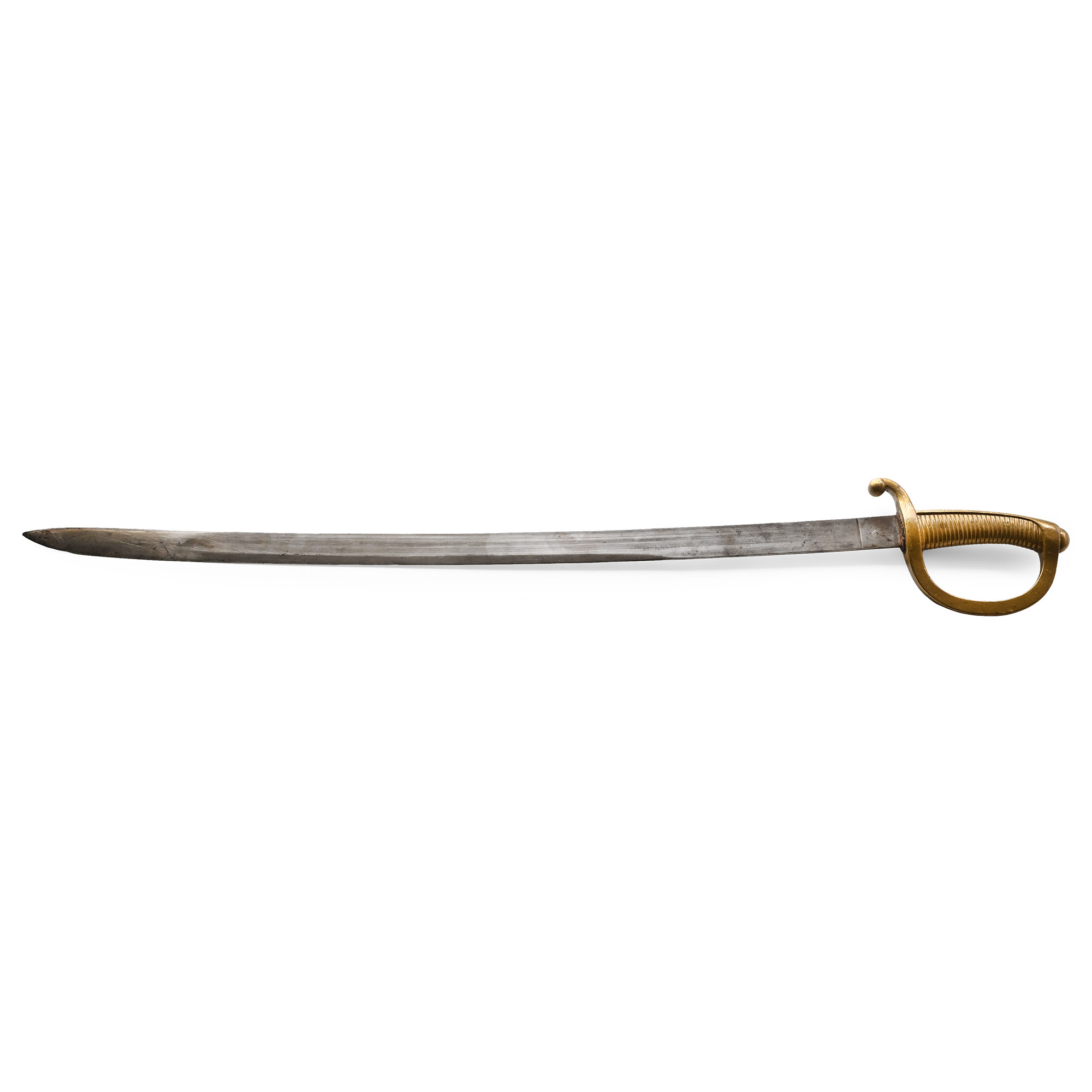
Spanish Military Briquet Sabre
DATED 1902 A.D.
82 7/8 in. (1.04 kg, 83.5 cm).
Comprising: slightly swept single-edge blade with scooped point and ricasso; brass hilt with finger-guard, lobed quillon, ribbed grip; blade stamped 'Arta. Faba. de Toldo 1902'. [No Reserve]
ProvenanceFrom a private Tyneside collection, formed since the early 2000s.
CONDITIONTimeLine Auctions follows a vetting process to ensure the authenticity and legality of all items, reinforcing our commitment to integrity and responsible trading. Each antiquity, antique, and coin lot undergoes thorough examination by a vetting committee of at least ten external specialists, professional trade association members, scientists, and archaeologists: Our Vetting Process
AUCTIONS:
TimeLine is a leading auction house specialising in antiquities, ancient art, collectables, natural history, coins, medals, and books. Our auctions offer museums, collectors, historians, and enthusiasts the opportunity to acquire unique and historically significant pieces.
-
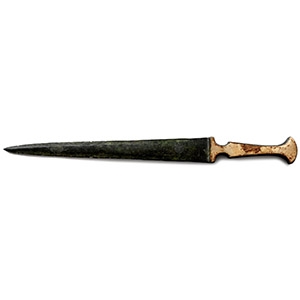
Luristan Bronze Short Sword with Inlaid Handle
1000 B.C.Sold for (Inc. bp): £1,430
With triangular tapering blade, flanged hilt to accept inlays, bone on the handle, two angular indentations on each side of the guard. 515 grams, 50 cm
with Bonhams, London, 4 July 1996, no.324. Private collection, Suffolk.
This dirk is of Medvedskaya type I, a common weapon among dirks and daggers produced in Luristan. According to Moorey, such kind of daggers were produced in Western Persia at least since the 13th century B.C. and remained in use at least until the 9th century B.C. The two practically identical examples published by Khorasani are preserved in the National Museum of Teheran. -
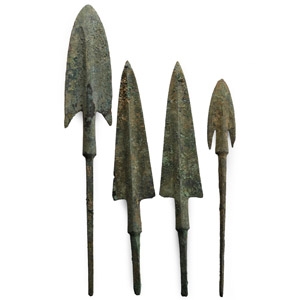
Luristan Bronze Arrowhead Collection
2nd-1st millennium B.C.Sold for (Inc. bp): £117
Mainly triangular-headed barbed and tanged types with midrib. 139 grams total, 13.5-18.2 cm
Ex London, UK, collection, 1990s. -
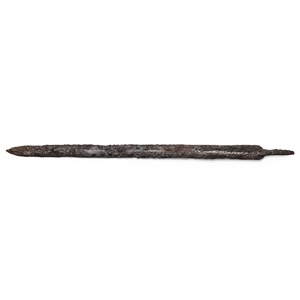
Merovingian Iron Pattern-Welded Sword
Circa 6th century A.D.Estimate: £2,000 - 3,000 (+bp*)
Opening Bid: £400
A double-edged spatha with a lentoid parallel-sided blade and pointed tip; evidence of battle nicks on both cutting edges; long tang and traces of wooden scabbard on the blade; signs of damask pattern running along the length of the blade, especially on the upper part; cleaned and conserved. 694 grams, 86.5 cm
From the private collection of a London gentleman, from his grandfather's collection formed before the early 1970s. Accompanied by an academic report by Dr Raffaele D’Amato. This lot has been checked against the Interpol Database of stolen works of art and is accompanied by search certificate number no.12919-245174.
Usually the term ‘damascened’ is only used for blades, describing the way in which their individual rods are forged to create a desired pattern effect that remained visible on the surfaces of the finished product (technique B.II.1.2.). The shape and regularity of the pattern was essentially dependent on the number and nature of the individual rods and on the skills of the blacksmith. The scholars differentiate on this basis more or less careful and complicated variants (e.g. striped, diamond, herringbone, angular, rosette, mosaic, etc.), in which the individual rods from different iron lamellae, which are parallel or twisted (torsion pattern-welding), were built up often in connection with each other (technique B.II.1.2.1-2). Combining striped rods that were partially straight and partially twisted - clockwise or counter-clockwise - allowed the formation of a very decorative blade.
