
Loading, please wait...

LOT 0393
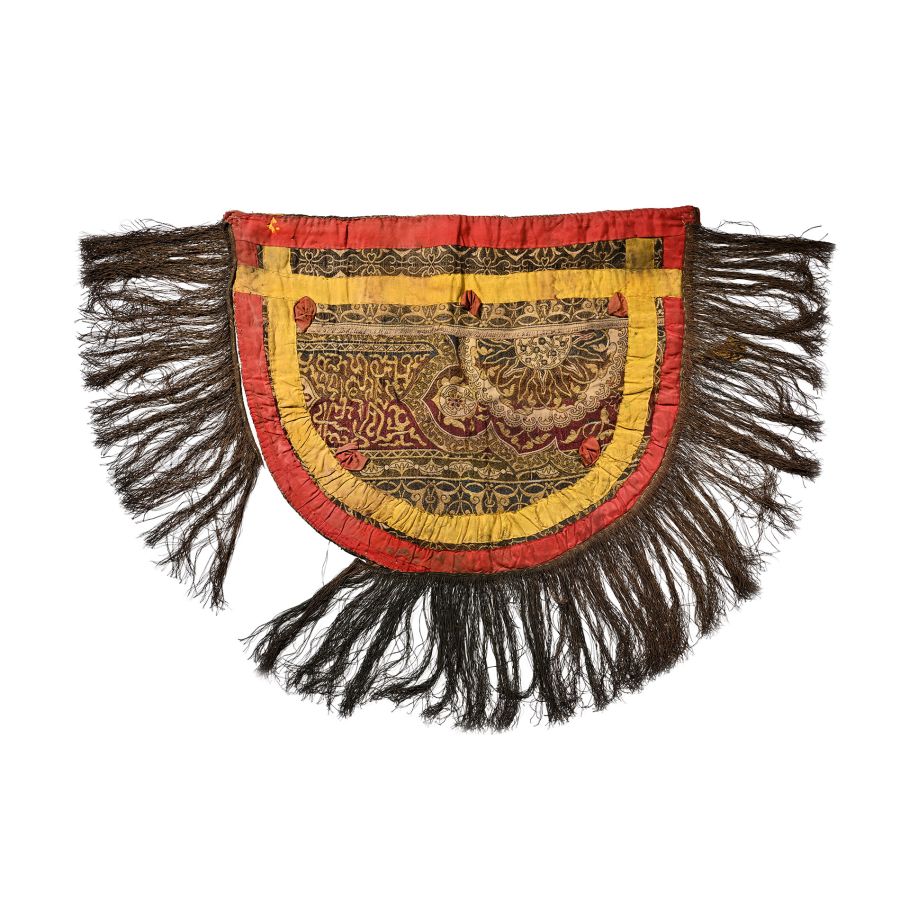
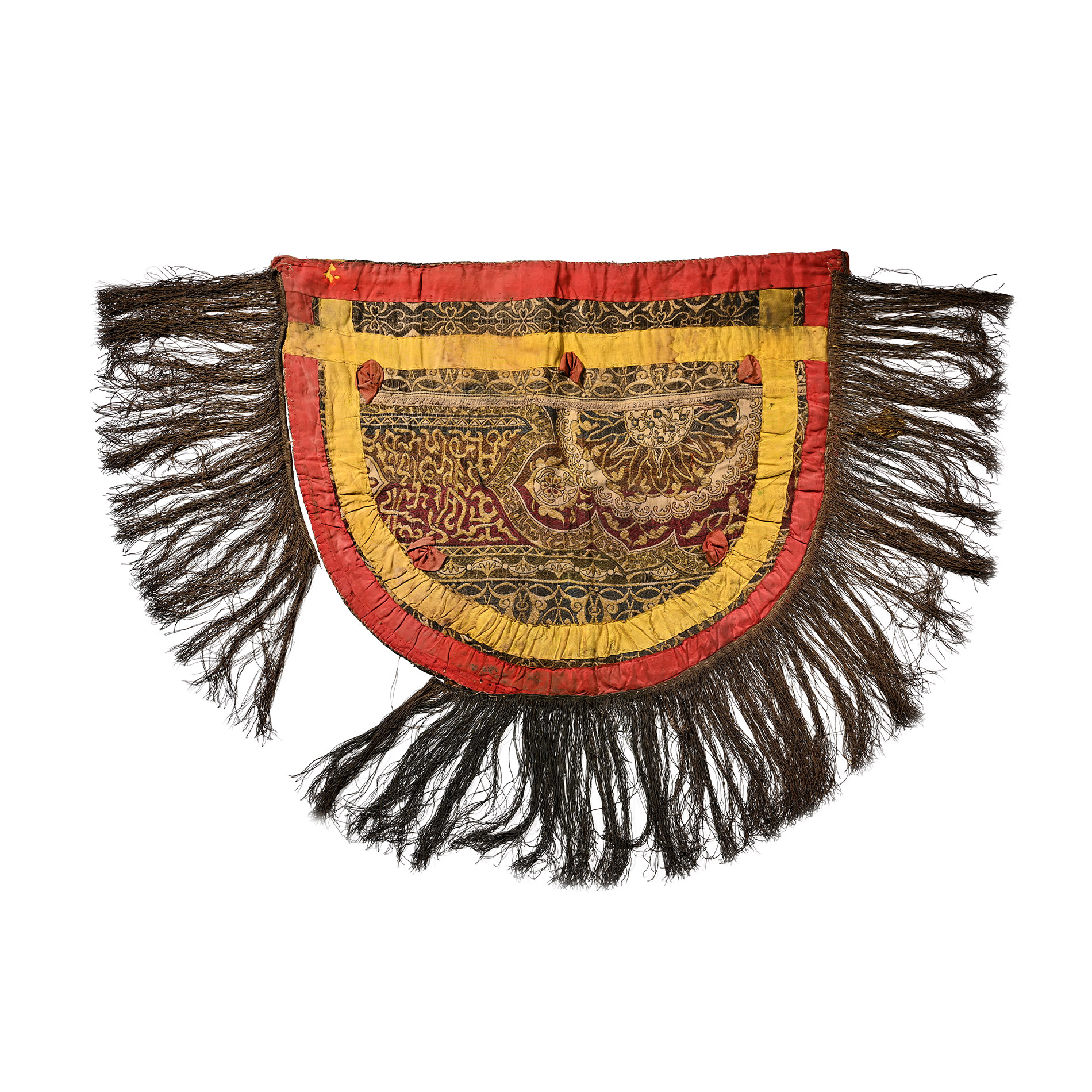
Spanish Military Banner Made from a Fragment of Nasrid Granada Embroidery
15TH-19TH CENTURY A.D.
29 1/8 in. (960 grams, 74 cm wide).
D-shaped banner comprising an old woven panel with embroidered arabesque sections in red, blue, white and yellow on a newer coarse textile backing; applied strips of red and yellow fabric, red fabric rosettes, heavy fringes to the edges; securing loops to the outer edges. [No Reserve]
ProvenancePrivate collection, London.
This lot has been checked against the Interpol Database of stolen works of art and is accompanied by a search certificate no.12300-221678.
The Nasrid Dynasty was an Arab Emirate which ruled the territory of Granada from 1232 to 1492 A.D. At its demise, it was the last Muslim dynasty remaining in the Iberian Peninsula.
CONDITIONTimeLine Auctions follows a vetting process to ensure the authenticity and legality of all items, reinforcing our commitment to integrity and responsible trading. Each antiquity, antique, and coin lot undergoes thorough examination by a vetting committee of at least ten external specialists, professional trade association members, scientists, and archaeologists: Our Vetting Process
AUCTIONS:
TimeLine is a leading auction house specialising in antiquities, ancient art, collectables, natural history, coins, medals, and books. Our auctions offer museums, collectors, historians, and enthusiasts the opportunity to acquire unique and historically significant pieces.
LOT 0393
Spanish Military Banner Made from a Fragment of Nasrid Granada Embroidery
Sold for (Inc. bp): £1,170
-
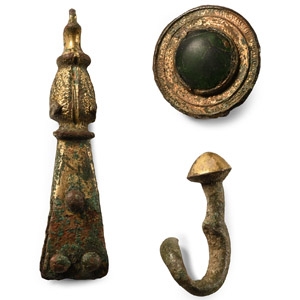
Anglo-Norman and Medieval Gilt Bronze Artefact Collection
6th-15th century A.D.Sold for (Inc. bp): £85
Comprising: a 6th century Dark Age round gilded brooch; a 15th century medieval bronze swivel hook with domed shaped gilded top; and a 11th-12th century copper-alloy chape with plain top half, the lower part ending in a wolf’s head covered with small indentations and raised ears, with a small suspension loop on the snout. 35 grams total, 27-65 mm
From the collection of the famous author, writer and speaker, Gordon Bailey, Essex, UK; formed since 1968.
Most of the strap ends recovered in Britain date from the 12th century onwards, this being the period when they were widely used by both men and women. The strap end was made from various metals including bronze, copper (normally gilded, silvered or tinned) pewter, tin, silver, gold and iron. Our specimen, probably dated to 11th-12th century A.D., continue the style of the Anglo-Viking beast mounts of the previous centuries. -
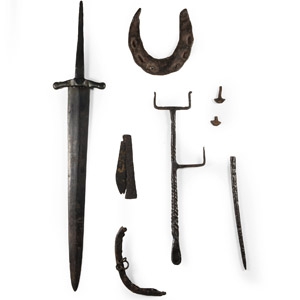
Medieval and Later Iron Artefact Collection
11th-20th century A.D.Sold for (Inc. bp): £286
Comprising: a rare 10th-12h century Anglo-Norman horseshoe; a 15th century iron folded knife; a fragment of a possible stirrup element; the fragment of an iron musket pricker (?); an unidentified iron tool; accompanied by a reproduction medieval dagger. 586 grams total, 1.5-41.5 cm
From the collection of the famous author, writer and speaker, Gordon Bailey, Essex, UK; formed since 1968.
The early type of horseshoe known as 'wavy rim' from the undulating sides was well used in the Anglo-Saxon period. At the time of the Normans it was implemented, and the Domesday Book refers to the presence of many blacksmiths in England. The type was in use until the 13th century A.D. -
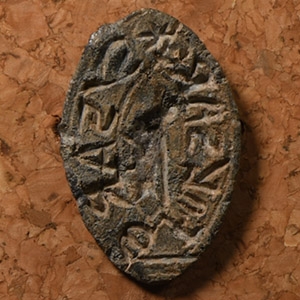
Framed Medieval Lead Seal Matrix of Sare Daughter of Sare
13th century A.D.Sold for (Inc. bp): £59
Vesica-shaped and fitted with attachment loop, legend in Latin script around a stylised bird, reading 'S. SARE FIL.SARE' i.e. 'SEAL OF SARE DAUGHTER OF SARE', a stylised flower to the reverse. 136 grams, 17 x 13 cm
From the collection of the famous author, writer and speaker, Gordon Bailey, Essex, UK; formed since 1968.
The lady of a wealthy family of merchants would have had her own small seal used for sealing her private letters, and the design of the matrix would have reflected this. On the vesica seals the legend around the border usually started at 12 o'clock position with a cross or a star (like here) and the word sigillum (seal) often indicated only by the letter S. Then, normally, the name of the owner and the one of the parent, after the letter F. (FILIUS or FILIA = son or daughter).
