
Loading, please wait...
_900x900.jpg "South German Burgonet Helm")
_200x200.jpg "South German Burgonet Helm")
_900x900.jpg "South German Burgonet Helm")
_200x200.jpg "South German Burgonet Helm")
.jpg "South German Burgonet Helm")
.jpg "South German Burgonet Helm")
LOT 0271
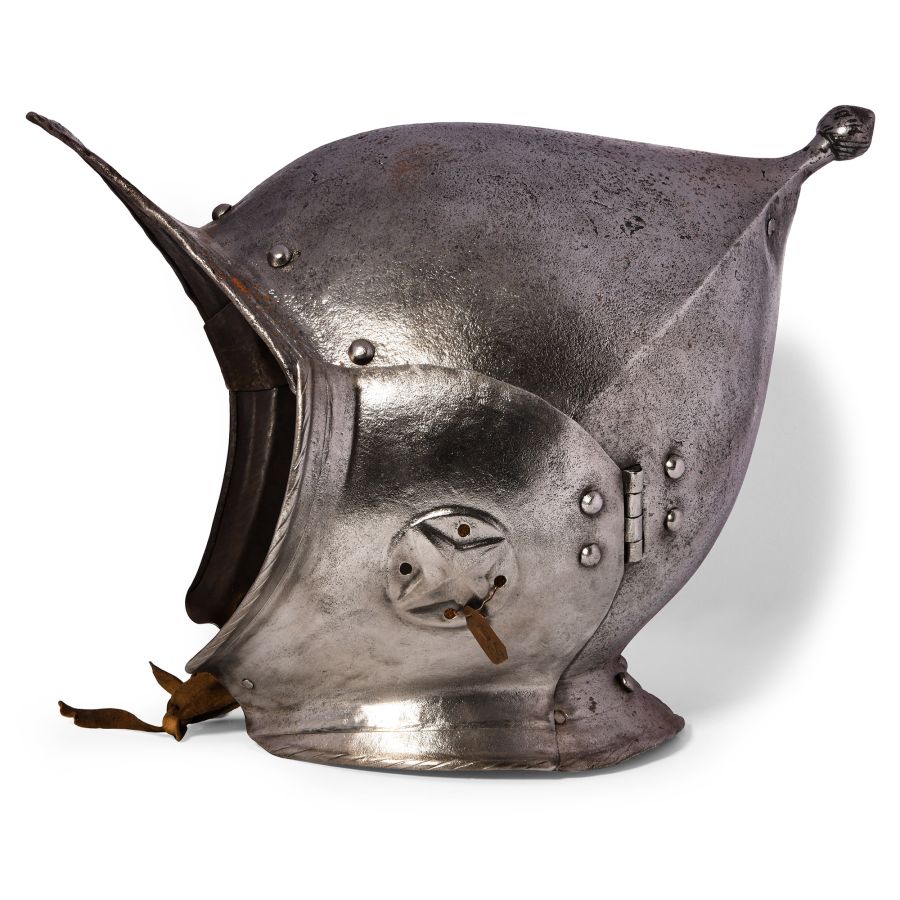
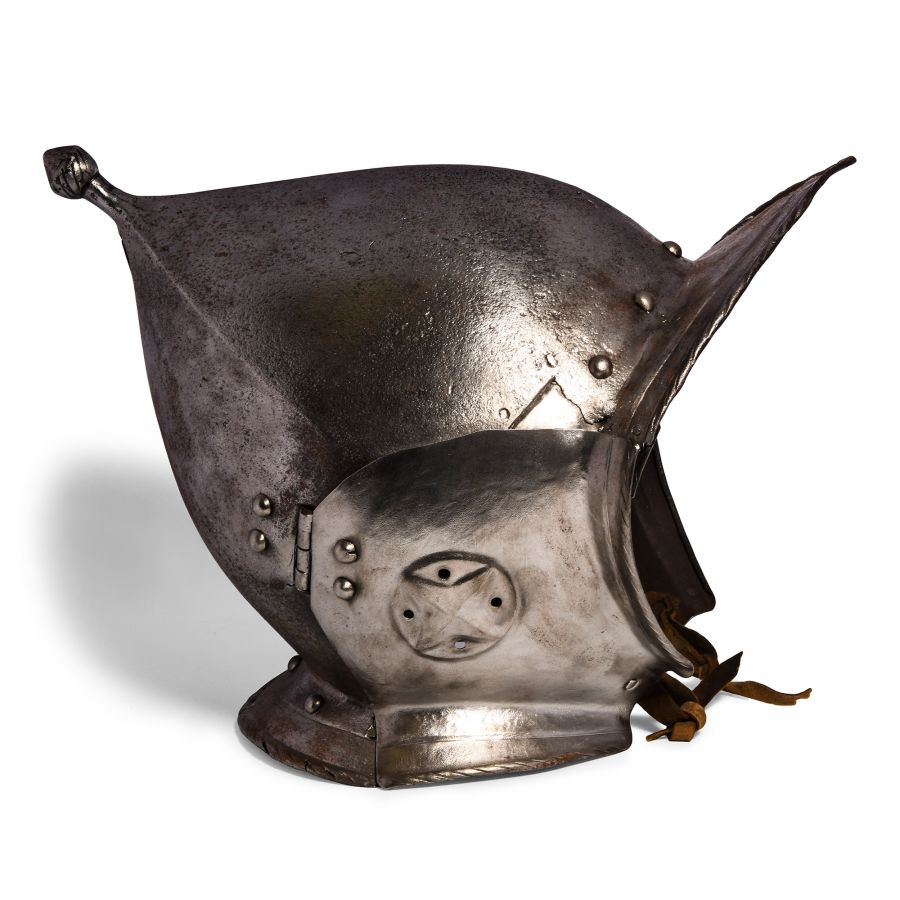
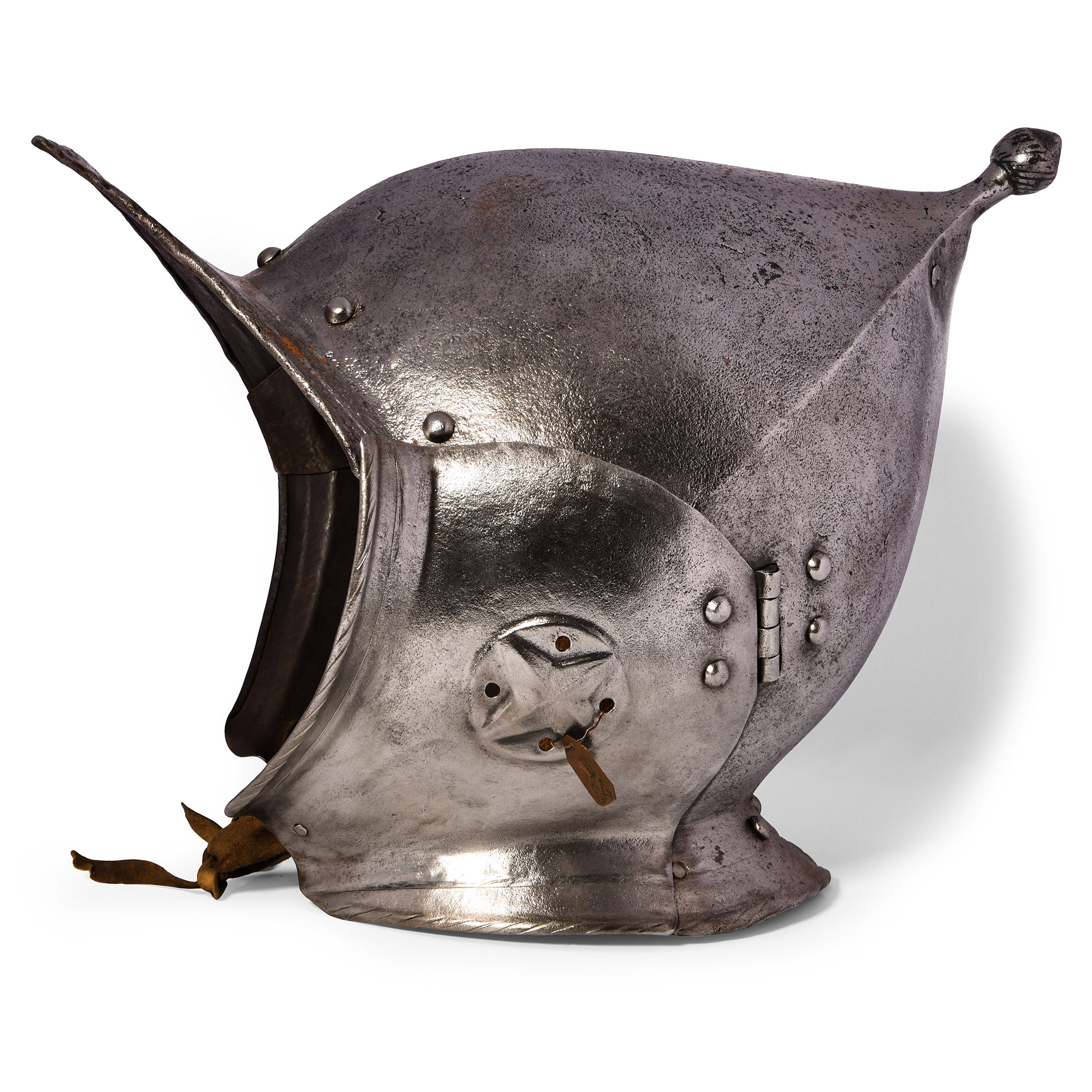
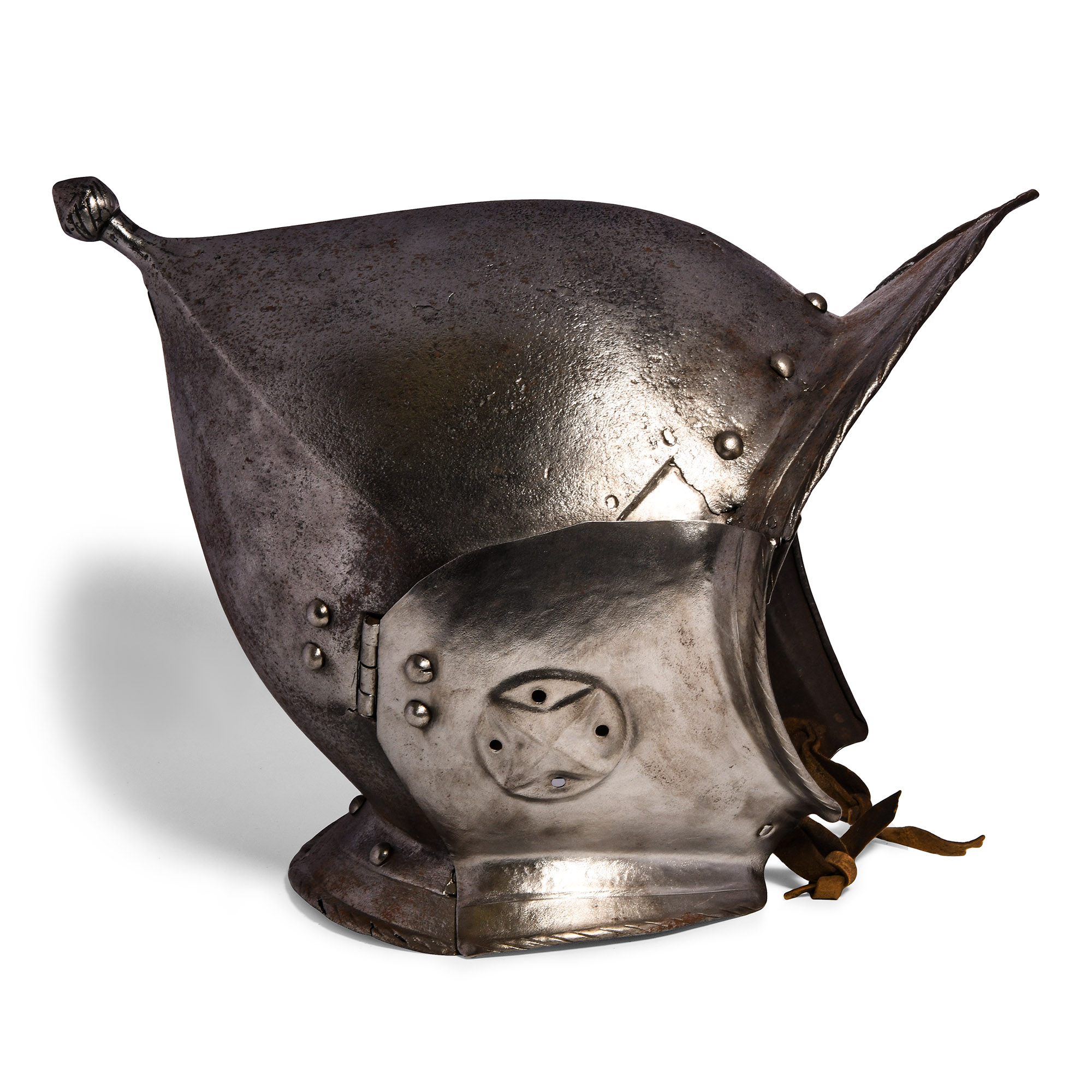
South German Burgonet Helm
CIRCA 1560-1570 A.D.
9 1/2 in. (1.54 kg, 24 cm high).
The one-piece skull rising to a prominent baluster-shaped finial, facetted upper half, the lower writhen projecting forward to flat obtusely pointed integral peak and backwards to a similar but shorter integral neck-guard, hinged cheek-pieces embossed with a star with four points, an auditory hole between each arm; fitted internally with a quilted canvas lining; with possible punched 'eagle' maker mark to visor projection.
Provenancewith Thomas Del Mar Ltd, 6th December 2017, lot 199.
The Kusmirek Collection, UK.
Accompanied by an academic report by Dr Raffaele D'Amato.
Accompanied by a copy of the relevant Thomas Del Mar Ltd catalogue pages and purchase invoice.
This lot has been checked against the Interpol Database of stolen works of art and is accompanied by search certificate number no.11770-203982.
See Gessler E.A., Führer durch die Waffensammlung, ein Abriss der Schweizerischen Waffenkunde, Zurich, 1928, pls. 23 and 24.
FootnotesMost original burgonets feature some form of decoration. Rolled and roped edges and pierced cheek-pieces are common, and the finest burgonets were engraved, inlaid and/or selectively coloured and polished. Some were covered in fine cloth in the tradition of sallets. The name seems to be a corrupted form of bourguignotte, the contemporary French term for this helmet type.
CONDITIONTimeLine Auctions follows a vetting process to ensure the authenticity and legality of all items, reinforcing our commitment to integrity and responsible trading. Each antiquity, antique, and coin lot undergoes thorough examination by a vetting committee of at least ten external specialists, professional trade association members, scientists, and archaeologists: Our Vetting Process
AUCTIONS:
TimeLine is a leading auction house specialising in antiquities, ancient art, collectables, natural history, coins, medals, and books. Our auctions offer museums, collectors, historians, and enthusiasts the opportunity to acquire unique and historically significant pieces.
LOT 0271
South German Burgonet Helm
Estimate £2,000 - 3,000€2,320 - 3,480 (for guidance only)$2,700 - 4,050 (for guidance only)
-
Luristan Bronze Arrowhead Group
2nd-1st millennium B.C.Sold for (Inc. bp): £187
Mainly comprising tanged examples of barbed, conical and leaf-shaped types with midribs. 162 grams total, 39-88 mm
Acquired 1990s. From the collection of a late Japanese weaponry collector. -
Post Medieval Fencing Foil Pair
Circa 1900 A.D.Sold for (Inc. bp): £33
Each with a long and narrow blade, the longer of square section, the shorter rectangular, each fitted with traditional slender, straight hilt, guard and finger-ring. 657 grams total, 85-106 cm
Acquired from Czerny's Auctions, Italy, 2016, lot 280. The Kusmirek Collection, UK. Accompanied by a copy of Czerny's invoice and listing. -
.jpg)
Western Asiatic Bronze Dagger with Stone Pommel
3rd millenium B.C.Sold for (Inc. bp): £910
Comprising a leaf-shaped blade with broad midrib to both faces, square-section tang and pommel with discoid bronze top displaying a stylised floral or geometric motif with parallel pairs of lines radiating from the centre and a pellet in each segment. 693 grams, 42 cm
Ex old English collection. Acquired from Timeline Originals, UK, 2015. The Kusmirek Collection, UK.
This type of daggers include lanceolate blades with a pronounced piercing and cutting function, often reinforced with a convex stiffening rib or fullers that follow the contour of the blade (Gorelik, 2003, pls. IV, 15-21, 23-25). It is commonly believed that the fullers were designed to drain blood, but this is a misconception; their purpose is to increase the strength of the blade and reduce its weight.
