
Loading, please wait...
_900x900.jpg "South East Asian Bronze Kohl Pot")
_200x200.jpg "South East Asian Bronze Kohl Pot")
.jpg "South East Asian Bronze Kohl Pot")
LOT 2168
South East Asian Bronze Kohl Pot
18TH-19TH CENTURY A.D.
4 3/4 in. (297 grams, 12 cm high).
The squat body supported on four legs, cylindrical neck with collars and flange rim with incised linear decoration. [No Reserve]
ProvenanceFrom the collection of H.N., Milton Keynes, 1980s-1990s.
CONDITIONTimeLine Auctions follows a vetting process to ensure the authenticity and legality of all items, reinforcing our commitment to integrity and responsible trading. Each antiquity, antique, and coin lot undergoes thorough examination by a vetting committee of at least ten external specialists, professional trade association members, scientists, and archaeologists: Our Vetting Process
AUCTIONS:
TimeLine is a leading auction house specialising in antiquities, ancient art, collectables, natural history, coins, medals, and books. Our auctions offer museums, collectors, historians, and enthusiasts the opportunity to acquire unique and historically significant pieces.
-
.jpg)
Chinese Glass Snuff Bottle, Signed Zhou Leyuan
Dated 1924 A.D.Sold for (Inc. bp): £520
Painted interior with flowers and fruits to one face and a landscape scene depicting cattle to the other; inscriptions to both faces; pink cabochon to lid. 97.9 grams, 95 mm high
Property of a lady, from her grandfather's collection, 1960s-1970s; thence by decent. -
.jpg)
Chinese Tang Terracotta Courtly Lady
Tang Dynasty, 618-907 A.D.Estimate: £2,000 - 3,000 (+bp*)
Opening Bid: £1,111
Modelled standing facing in a floor-length courtly dress featuring a hand fan and floral print, hands held within voluminous sleeves at her chest, presenting a small lidded box; remains of polychrome pigmentation. 2.6 kg, 40 cm high
Acquired 1990s. West Country, UK, collection. Accompanied by an original thermoluminescence analysis report no.CJ142522022 from Laboratory Kotalla. This lot has been checked against the Interpol Database of stolen works of art and is accompanied by search certificate no.11370-192729. -
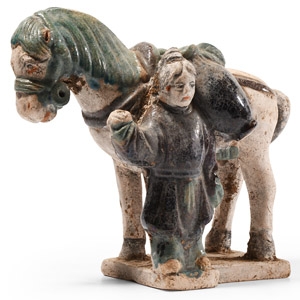
Chinese Qing Glazed Ceramic Pony and Attendant
Qing Dynasty, 1644-1911 A.D.Estimate: £150 - 200 (+bp*)
Opening Bid: £75
Modelled in the round standing on a rectangular base, the animal saddled with baskets or water pitchers, a female attendant standing at the animal's side; remains of polychrome pigmentation. 916 grams, 19 cm wide
Ex Cotswold, UK, collection, 1970-1990.
