
Loading, please wait...
_900x900.jpg "Smith and Wesson Old Model No 2 Revolver")
_200x200.jpg "Smith and Wesson Old Model No 2 Revolver")
.jpg "Smith and Wesson Old Model No 2 Revolver")
LOT 0300
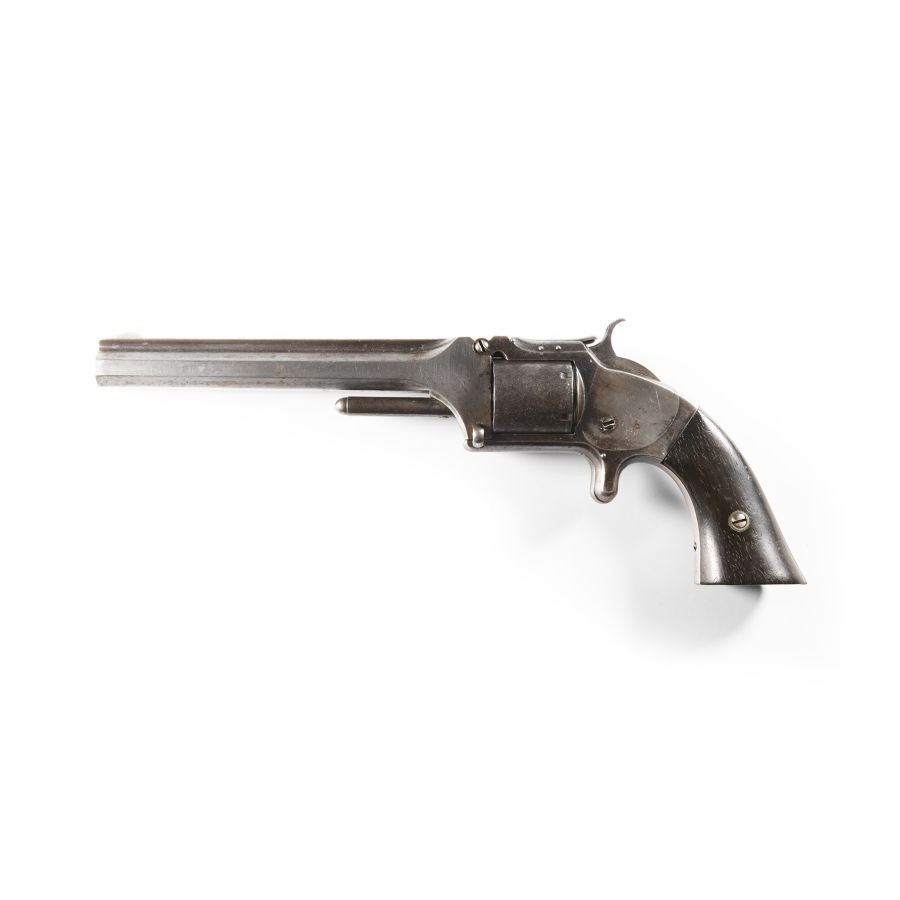
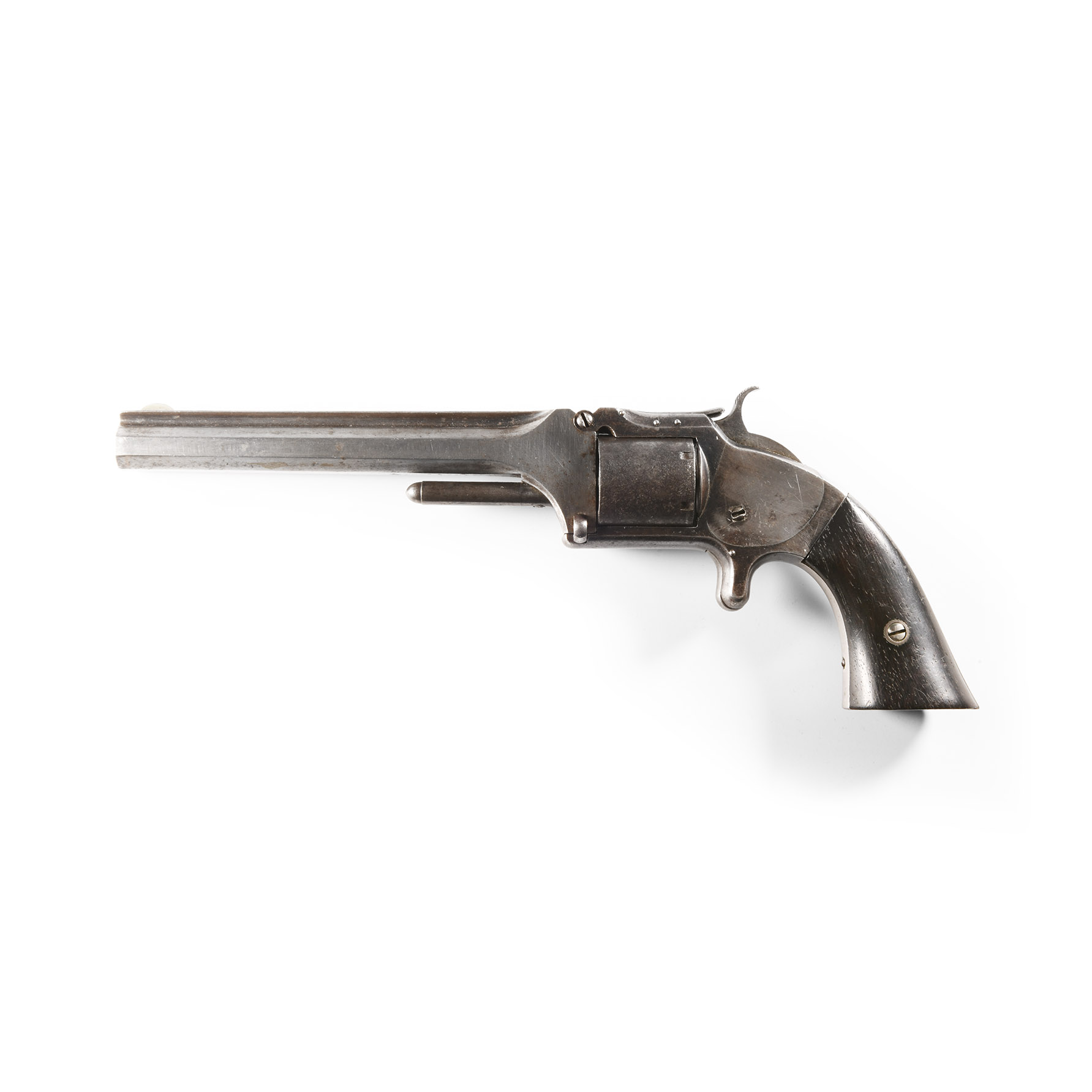
Smith and Wesson Old Model No 2 Revolver
1861-1874 A.D.
10 5/8 in. (690 grams, 27 cm).
Also known as 'Model No 2 Army' with hinged frame, six shot .32 calibre rimfire cylinder with 'PATENTED APRIL 3 1855 JULY 5 1859 & DEC 18 1860' and 15cm (6") octagonal barrel marked 'SMITH & WESSON SPRINGFIELD MASS' to top with fixed extractor pin and spur trigger; serial number 47946 to butt strap with plain wood grip scales; action working.
ProvenanceAcquired from Bolk Antique Arms, Netherlands, 2016.
The Kusmirek Collection, UK.
Accompanied by an original Bolk invoice.
See Flayderman, N., Guide to Antique American Firearms, 9th edition, 2007, pp.220-221, for details.
FootnotesSold as an exempt item under Section 58 (2) of the Firearms Act, 1968, to be held as a curiosity or ornament. No license required but buyer must be over 18 years of age. Overseas bidders should note that, due to UK regulations governing export of all firearms, overseas buyers will need to make arrangements for shipping this lot out of the UK directly, by air freight, with a specialist company or agent.
CONDITIONTimeLine Auctions follows a vetting process to ensure the authenticity and legality of all items, reinforcing our commitment to integrity and responsible trading. Each antiquity, antique, and coin lot undergoes thorough examination by a vetting committee of at least ten external specialists, professional trade association members, scientists, and archaeologists: Our Vetting Process
AUCTIONS:
TimeLine is a leading auction house specialising in antiquities, ancient art, collectables, natural history, coins, medals, and books. Our auctions offer museums, collectors, historians, and enthusiasts the opportunity to acquire unique and historically significant pieces.
-
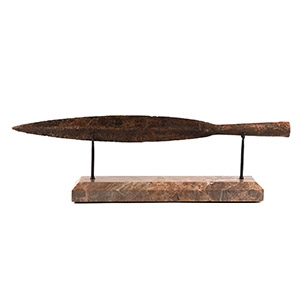
Large Viking Iron Socketted Spearhead
9th-11th century A.D.Sold for (Inc. bp): £442
Comprising a leaf-shaped blade with lozenge cross-section, raised midrib, closed tubular socket; accompanied by a custom-made display stand. 1.76 kg total, 43.5 cm including stand
Acquired 1971-1972. From the collection of the vendor's father. Property of a London, UK, collector.
The spear belongs to the type A of the first main group of Viking spears, the so-called Frankish spearheads, which occur between 750 and 950 A.D., but mainly in the 8th and 9th centuries. The Mediterranean influence is still evident on the foliate shape of the blade. -
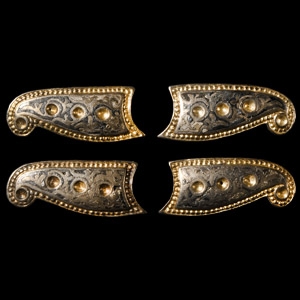
Mongol Silver Belt Mount Group
13th century A.D.Estimate: £200 - 300 (+bp*)
Opening Bid: £89
Each with a broader scooped edge tapering to a volute flourish, pellets adorning the perimeter, three medial circular dimples, fourth dimple to the scrolled end, against a field of foliate scrolls and niello fill; each with a set of mounting lugs to the reverse. 25.7 grams total, 40-41 mm
Fine condition.
Acquired in the 1980s-1990s. Ex an important central London gallery, London W1.
Similar plaques have been found in the burial graves of Mongol commanders and their wives, probably once part of a waist belt from which the sabre and other weapons were hanging. They were found together with arms, unique elements of the costume of fabric and leather, and splendid jewellery of gold and silver. -
.jpg)
Belgian Simonis 12 Shot Pinfire Revolver
1877-1890 A.D.Estimate: £1,000 - 1,400 (+bp*)
Opening Bid: £472
Single and double action twelve shot 9mm calibre revolver with 13cm (5¼") round barrel with extractor rod mounted at right and hinged loading gate with Liege proof marks and marked 'CAL 9mm' to right frame with serial number 2676; fitted with plain wood scale grips and lanyard ring (usually fitted to revolvers intended for military use); action working well. 975 grams, 25 cm
Acquired from Bolk Antique Arms, Netherlands, 2016. The Kusmirek Collection, UK. Accompanied by Bolk invoice and details.
Sold as an exempt item under Section 58 (2) of the Firearms Act, 1968, to be held as a curiosity or ornament. No license required but buyer must be over 18 years of age. Overseas bidders should note that, due to UK regulations governing export of all firearms, overseas buyers will need to make arrangements for shipping this lot out of the UK directly, by air freight, with a specialist company or agent.
