
Loading, please wait...
_900x900.jpg "Silver Ring with Epigraphic Bezel")
_200x200.jpg "Silver Ring with Epigraphic Bezel")
.jpg "Silver Ring with Epigraphic Bezel")
LOT 1956
Silver Ring with Epigraphic Bezel
17TH-18TH CENTURY A.D.
1 in. (3.95 grams, 24.30 mm overall, 18.64 mm internal diameter (approximate size British Q 1/2, USA 8 1/4, Europe 18.12, Japan 17)).
Comprising a D-section hoop, openwork columnar shoulders supporting a hollow disc bezel, the bezel with Arabic inscription above a wreath. [No Reserve]
ProvenanceFrom an English collection formed before 2000.
This lot is accompanied by an illustrated lot declaration signed by the Head of the Antiquities Department, Dr Raffaele D’Amato.
TimeLine Auctions follows a vetting process to ensure the authenticity and legality of all items, reinforcing our commitment to integrity and responsible trading. Each antiquity, antique, and coin lot undergoes thorough examination by a vetting committee of at least ten external specialists, professional trade association members, scientists, and archaeologists: Our Vetting Process
AUCTIONS:
TimeLine is a leading auction house specialising in antiquities, ancient art, collectables, natural history, coins, medals, and books. Our auctions offer museums, collectors, historians, and enthusiasts the opportunity to acquire unique and historically significant pieces.
-
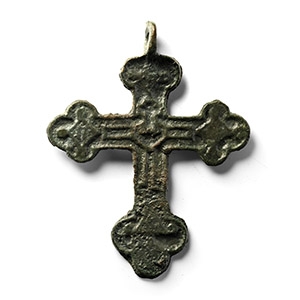
Eastern European Orthodox Bronze Cross Pendant
17th-18th century A.D.Sold for (Inc. bp): £52
Cross pommy type with low-relief cloisonné ornament. 3.06 grams, 41 mm
Acquired from Chris Martin-Zakheim, Iconastas, 5 Piccadilly Arcade, London SW1. From the private collection of a West London, UK, gentleman, formed since the early 2000s. -
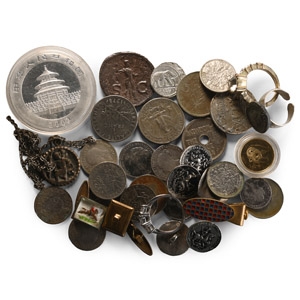
Post Medieval Artefact Group
20th century A.D.Sold for (Inc. bp): £20
Including coins, cufflinks, bent silver love charm, and other items. 145 grams total, 15-44 mm
Found Suffolk, UK. (UK buyers only, not for export) -
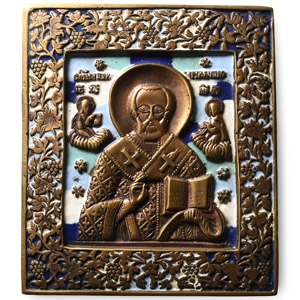
Russian Orthodox Enamelled Bronze Travel Icon with Saint Nicholas
19th century A.D.Estimate: £250 - 350 (+bp*)
Opening Bid: £125
Representing Saint Nicholas of Myra with a book in his left hand and making the gesture of blessing with his right, dressed as a bishop with sticharion, covered by omophorion, and surmounted by an epitrachelion embroidered with crosses; the saint flanked by Jesus and Virgin Mary, Christ holding the gospel, Mary the bishop’s epitrachelion; Cyrillic inscriptions 'Saint Nikolaos the Wonderworker (СВЯТЫЙ НИКОЛА ЧУДОТВОРЕЦ), Iesus Christos (ΙΣ ΧC) and Mother of God (ΜΡ ΘΥ)' on the enamelled background. 348 grams, 10.7 cm
Acquired from Chris Martin-Zakheim, Iconastas, 5 Piccadilly Arcade, London SW1. From the private collection of a West London, UK, gentleman, formed since the early 2000s.
The icon features meticulous craftsmanship typical of Orthodox iconography. The enamel colors, despite the passage of time, retain their vibrant intensity, highlighting the key elements of the depicted images. The refined details and use of enamel give depth and luminosity to the icon, making it a precious example of the Russian Orthodox tradition.
