
Loading, please wait...
LOT 1109
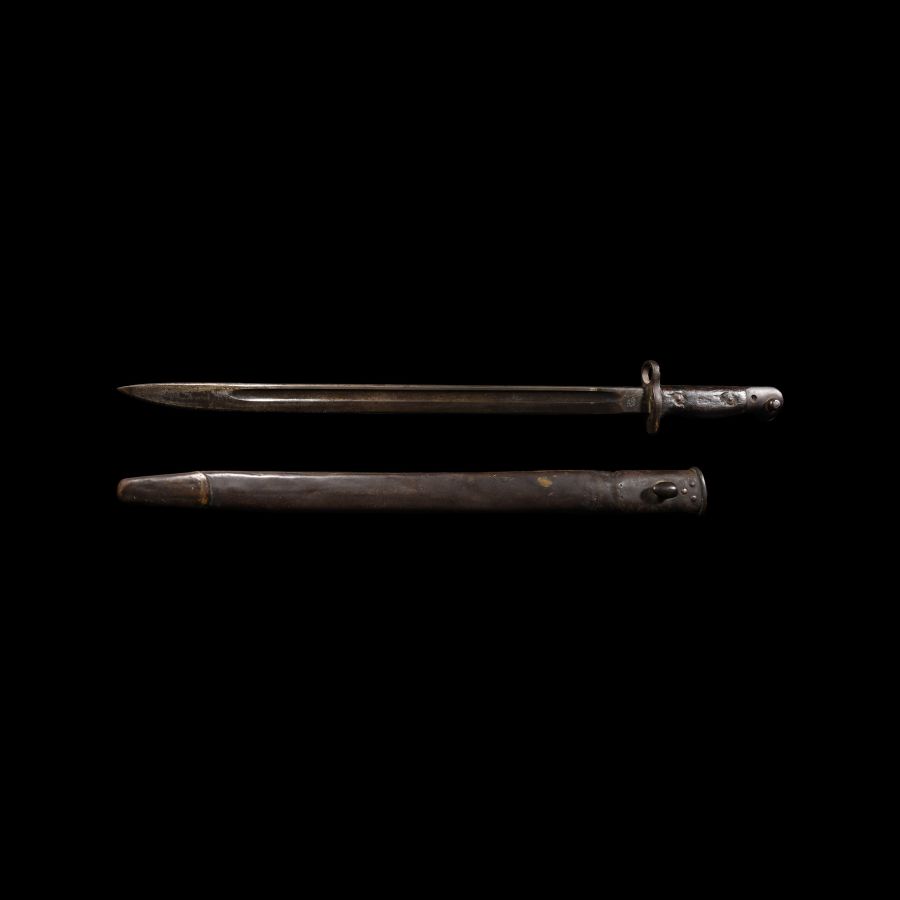
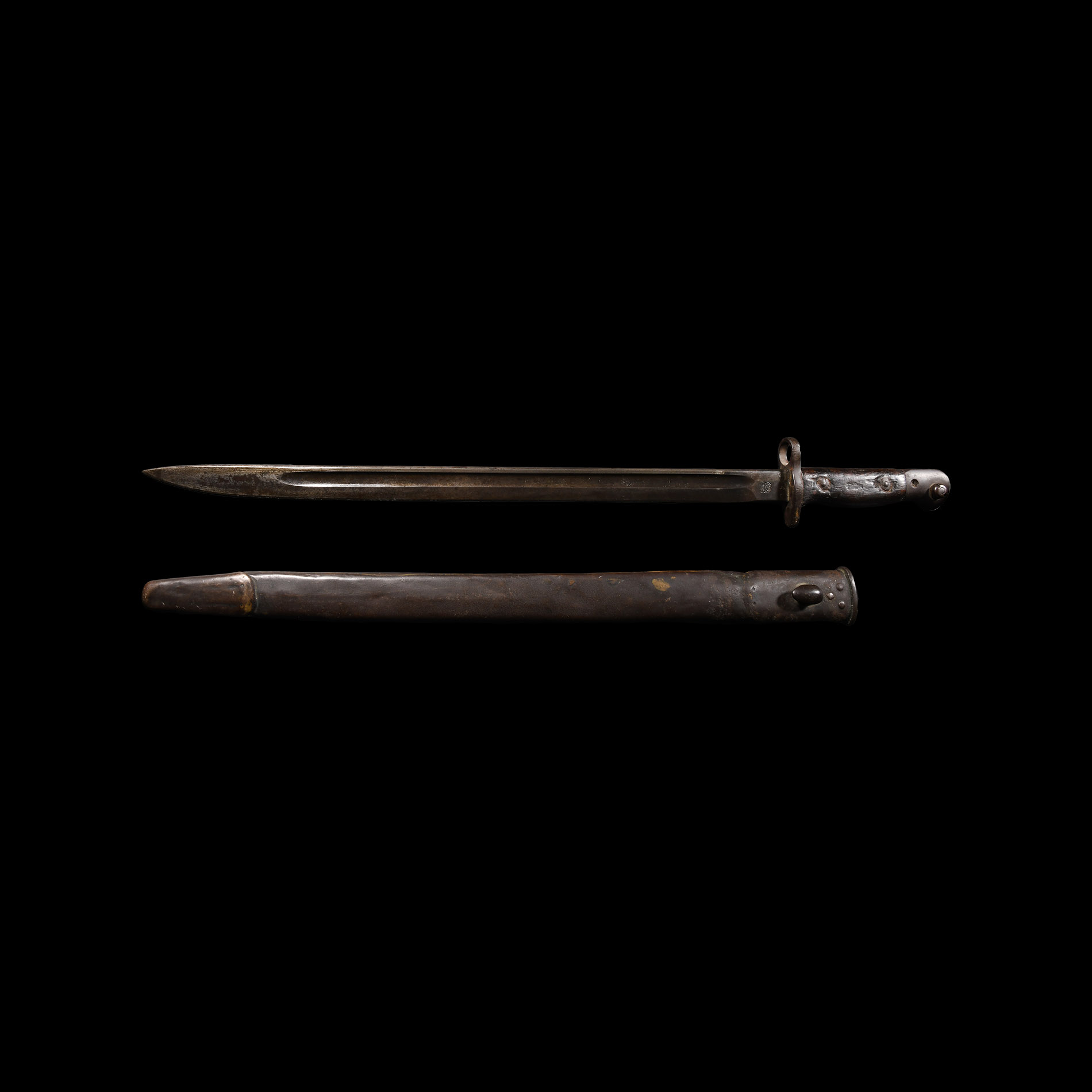
Siamese 'Wild Tigers Corps' Type 62 Pattern 1907 Bayonet and Scabbard
DATED 1919 A.D.
23 in. (726 grams, 58.5 cm).
Stamped 2642 in Thai numerals at top of blade with 'tiger mask' mark for Siam, together with original British marks, fitted with wood grip scales and spring release button; the scabbard with original throat and chape, modified in Thailand to replace the original leather main section. [No Reserve]
ProvenanceProperty of a Luton, UK gentleman, by inheritance.
LiteratureSee Capwell, T., Knives, Daggers and Bayonets, Lorenz, 2009, p.190, for general type and details.
FootnotesThe Type 62 is a re-badged British Pattern 1907 bayonet. Siam purchased 10,000 SMLE rifles and Pattern 1907 bayonets from Britain in 1919 to equip the 'Wild Tiger Corps', royal bodyguard of Vajiravudh, King Rama VI (reigned 1910–1925). The tiger figural on the ricasso is representative of the Wild Tiger Corps. Year 2462 on the Buddhist Calendar corresponds to 1919. SMLE rifles and Pattern 1907 bayonets were taken from British stocks, refurbished by Birmingham Small Arms (BSA), and remarked with Siamese markings. The bayonets were shipped with standard steel-mounted leather scabbards. However, the leather rapidly deteriorated in the tropical climate, so the Siamese made a replacement steel scabbard body to which the original steel mounts were brazed.
CONDITIONTimeLine Auctions follows a vetting process to ensure the authenticity and legality of all items, reinforcing our commitment to integrity and responsible trading. Each antiquity, antique, and coin lot undergoes thorough examination by a vetting committee of at least ten external specialists, professional trade association members, scientists, and archaeologists: Our Vetting Process
AUCTIONS:
TimeLine is a leading auction house specialising in antiquities, ancient art, collectables, natural history, coins, medals, and books. Our auctions offer museums, collectors, historians, and enthusiasts the opportunity to acquire unique and historically significant pieces.
LOT 1109
Siamese 'Wild Tigers Corps' Type 62 Pattern 1907 Bayonet and Scabbard
Sold for (Inc. bp): £78
-
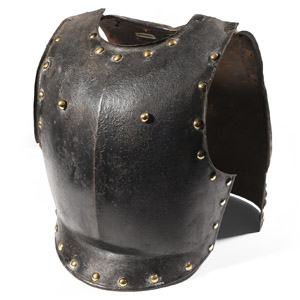
Post Medieval Spanish 'Conquistador' Cuirass Set
17th century A.D.Sold for (Inc. bp): £3,510
The breastplate with pronounced vertical rib and two rivets to front, roll at neck and splay at base with rivets to full perimeter, with inked accession numbers '21238A' (crossed through) and 'SDM - EW1' above '1931 - 30 - 6, a' and inked handwritten paper label reading 'Old Spanish Armour (Conquistador) / Found with remains of Spanish Galleon on / the estate of Leakin family (Georgia) coast. / about 1870. Refer to Trinity College Hertford Ct. / for information in Leakin family. / Given originally to Mrs Mark Howden (Hartford Ct.) / [ ] when I was 7 years old. / Luke W Lee 1944' in eight lines and also with chalked 'Old Spanish Armour / from Georgia 1944' inscription in two lines; the backplate generally matching but with vertical groove at centre and no splay at base, with inked accession numbers '31238B' (crossed through) and 'SDM - EW1' above '1951 - 30 - 6, b'. 3.3 kg, 42.5 cm high
From a Southern Californian museum, with accession numbers. Ex American collector. Acquired from TimeLine Auctions, UK, 2018, lot 181. The Kusmirek Collection, UK. This lot has been checked against the Interpol Database of stolen works of art and is accompanied by search certificate no.204020.
Trinity College, Hartford was founded in 1823; further research in their archives could provide more information on this cuirass set and the site of the 'Spanish galleon' shipwreck discovered in about 1870. -
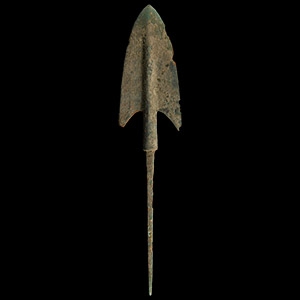
Luristan Bronze Barbed Arrowhead
2nd-1st millennium B.C.Sold for (Inc. bp): £46
Formed with a midrib and tapering rectangular-section tang. 31 grams, 15.5 cm
Acquired 1980-2015. Ex Abelita family collection. -
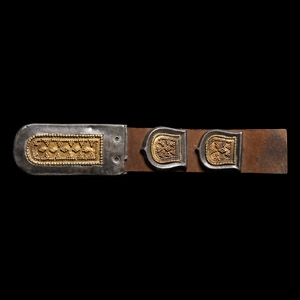
Avar-Byzantine Silver-Gilt Sword Belt Mount Group
7th-9th century A.D.Estimate: £200 - 300 (+bp*)
Opening Bid: £89
Comprising three belt mounts later remounted onto brown leather comprising: a rectangular strap end with rounded terminal, decorated with granulated borders, lozenges and chevrons; two roughly D-shaped mounts with apex flourish and waisted sides, also decorated with granulated lozenges and chevrons. 26.5 grams, 12.2 cm long
Fine condition.
Acquired in the 1980s-1990s. Ex an important central London gallery, London W1.
This type of belt element decorated with granulation, is present in the Avar graves of the second half of the 7th century, and was most likely produced in the workshops of the Eastern Roman Empire, from where they reached the Avar lands as imperial gifts (tomb of Kunbàboni) or spoils of war. They were part of multiple belts, to which sabers and knives were attached, commonly used among Avars, Bulgars and Romans during the 7th and 8th centuries AD.
