
Loading, please wait...
LOT 0271
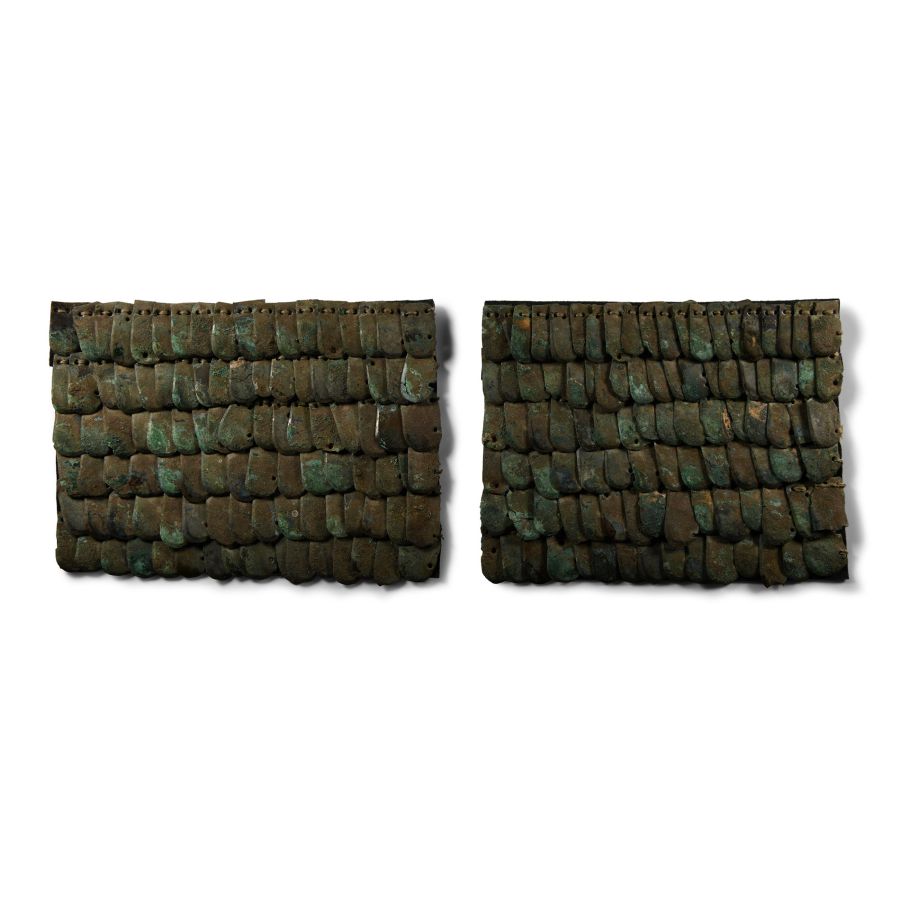
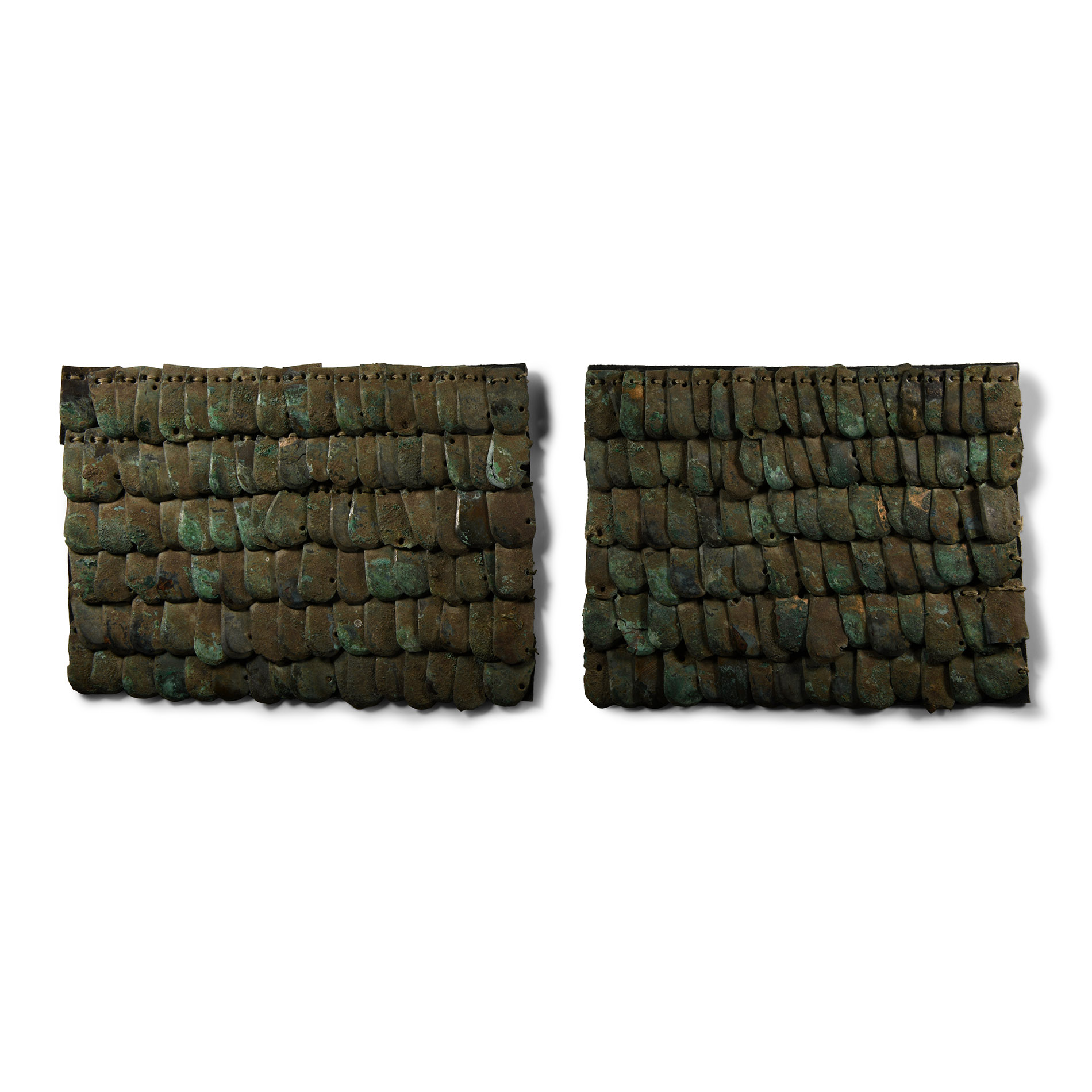
Scythian Scale Armour Sections
6TH-5TH CENTURY B.C.
6 - 6 1/2 in. (255 grams total, 15.2-16.5 cm).
Two panels from a scale armour coat composed of more than two hundred overlapping bronze scales, each mounted onto a custom-made leather panel for purposes of display; the scales formed in different series, some having holes only in the upper part, some with three holes in the upper part and two holes to the left, and others showing three upper holes and one side hole. [2]
ProvenanceFrom the private collection of a London gentleman, from his grandfather's collection formed before the early 1970s.
Accompanied by an academic report by Dr Raffaele D’Amato.
This lot has been checked against the Interpol Database of stolen works of art and is accompanied by a search certificate number no.12044-216404.
Cf. similar scales from Egypt, dated circa 590 B.C., in the Metropolitan Museum, discovered in the palace of Apries, accession no. 09.183.7a–v; Cernenko, E.V., The Scythians 700-300 BC, Hong Kong, 1998, pp.7ff., pl.D & E; for identical scales see Полин, С.В. & Колтухов, С.Г., ‘A Scythian Burial in a mound near the S.Nadezhda in Crimea’ and Лихачёва, О.С., ‘Elements of Scythian tradition in the complex of armament of the Altai forest-steppes population, in the 6th -3rd centuries B.C.’, in Russian Academy of science, The war and the military in the Scythian-Sarmatian world, Proceedings of International Scientific Conference in tribute to the memory of A.I. Melyukova (Kagal’nik, 26–29 April 2014), pp.119-126 and pp.162-171, pl.3 p.126, fig.2 p.165.
FootnotesThe favourite armour of the Scythian noblemen was composed of scales, usually protecting the torso, sometimes the entire body (kataphraktoi). The Scythians found that the most efficient method was to arrange the overlapping ‘fish-scales’ as a corselet made of a number of bronze and iron plates, which then protected the wearer against sword and spear thrusts. Our scales correspond well to bronze scales found in May 1961 in an accidentally destroyed burial in a barrow, near the village of Nadezhda Sovetsky district. They were discovered together with iron scales, a Greek Corinthian helmet, fragments of an amphora, five arrowheads and fragments of an iron sword. Most of these bronze scales were oblong in shape, with a sub-rectangular upper end and a rounded lower end, but slightly bigger than our scales.
CONDITIONTimeLine Auctions follows a vetting process to ensure the authenticity and legality of all items, reinforcing our commitment to integrity and responsible trading. Each antiquity, antique, and coin lot undergoes thorough examination by a vetting committee of at least ten external specialists, professional trade association members, scientists, and archaeologists: Our Vetting Process
AUCTIONS:
TimeLine is a leading auction house specialising in antiquities, ancient art, collectables, natural history, coins, medals, and books. Our auctions offer museums, collectors, historians, and enthusiasts the opportunity to acquire unique and historically significant pieces.
-
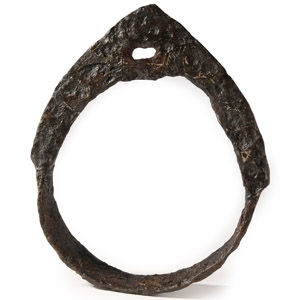
Viking Age Iron Stirrup with Silver Inlay
9th-11th century A.D.Sold for (Inc. bp): £85
Comprising an ovoid body with a rectangular void to accept a strap; the lower section broad with a rib to the underside, the upper flat in section with silver inlay in geometric forms to one face. 244 grams, 16 cm
From the private collection of a London gentleman, from his grandfather's collection formed before the early 1970s. -
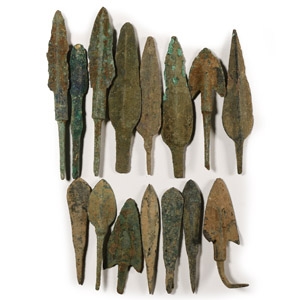
Luristan Bronze Arrowhead Group
Circa 13th-7th century B.C.Sold for (Inc. bp): £130
Including leaf-shaped, barbed-and-tanged, ribbed and other types. 200 grams total, 6.1-10.6 cm
Acquired 1980-2015. Ex Abelita family collection. -
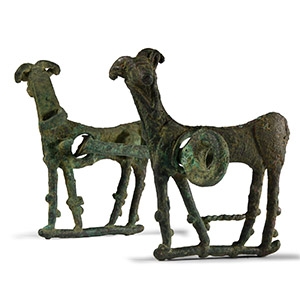
Luristan Bronze Horse Bit with Animals
Circa 11th-7th century B.C.Estimate: £1,000 - 1,400 (+bp*)
Opening Bid: £500
Comprising a pair of ram-shaped cheek-pieces with a hole through the body for the straight mouthpiece with looped terminals. 690 grams, 17.5 cm wide
From a collection formed in Paris in the 1990s.
The horse bits were transformed by Luristan people in to expressions of applied art. Metalworkers employed animal motifs, both realistic and imaginary, for their cheek-pieces. The question of whether these horse bits were for real use or only for use in a funerary context is superfluous, as signs of wear have been documented, and the goads and loops on interiors are functionally designed. The use of such horse bits is clearly documented in Assyrian reliefs of the time of Sennacherib (705-681 B.C.).
