
Loading, please wait...
LOT 0304
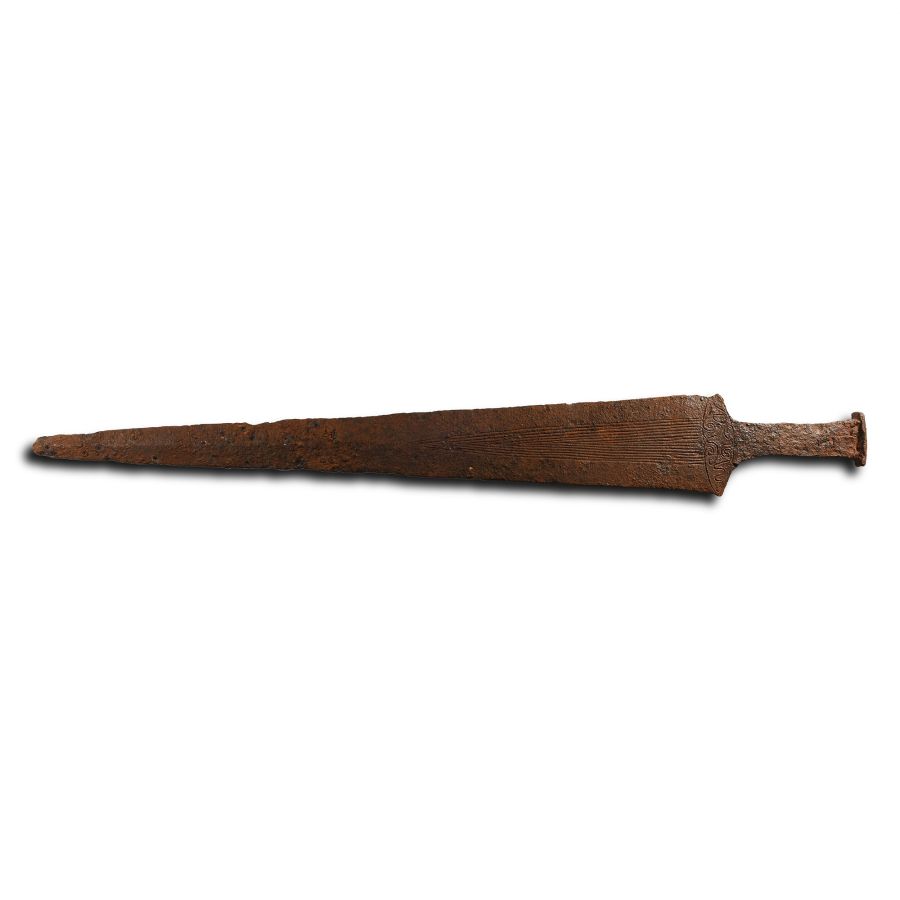
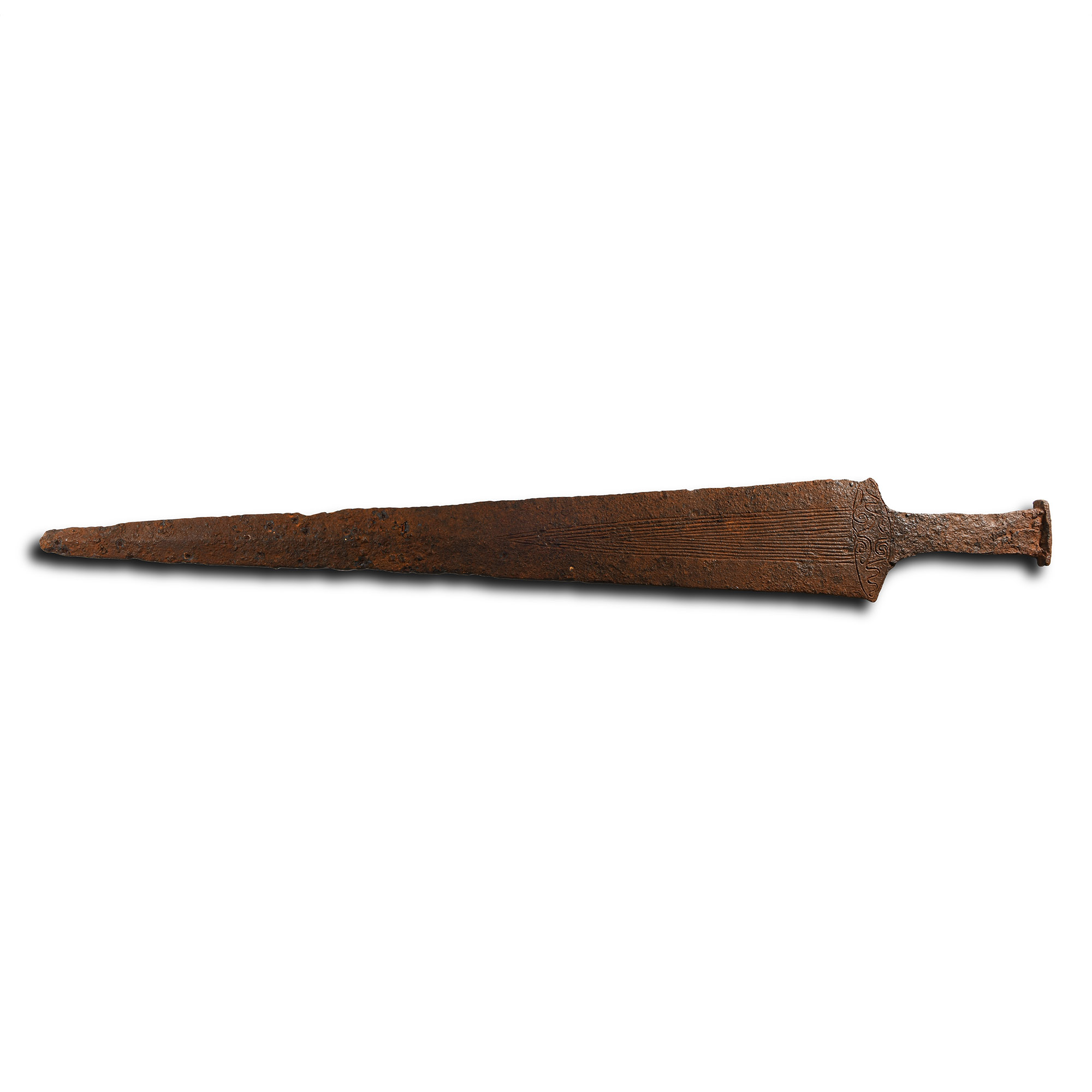
Scythian Iron Akinakes Sword with Decorations
4TH CENTURY B.C.
23 in. (481 grams, 58.5 cm).
Of Central Asian typology, strong hilt and narrow ogival guard with Steppe style ornamentation, tipped hilt, triangular tapering blade fitted with a central triangular blood channel with sixteen grooves.
ProvenanceEx private collection of Mr M.B., Mainz, Germany, since the 1980s.
Acquired from the above, 2004.
This lot has been checked against the Interpol Database of stolen works of art and is accompanied by a search certificate number no.12283-214520.
See Gorelik, M., Weapons of Ancient East, IV millennium BC-IV century BC, Saint Petersburg, 2003, in Russian, see pl.VIII, no.53, for a similar sword; cf. Meliukova, A.I., Vooruzhenie skifov. Moskva: Nauka Svod arheologicheskih istochnikov, Moscow, 1964, pl.18,10, for a near identical sword from Sofievska.
FootnotesThe akinakes was a characteristic Scythian type of weaponry, which was used throughout their history (7th-3rd centuries B.C.). With the departure of the Scythians from the steppe in the 3rd century B.C., and the appearance of the Sarmatian tribes in the Northern Black Sea region in the 2nd-1st centuries B.C., Sarmatian types of bladed weapons spread in the region. This particular shape of akinakes belongs to the nomadic cultures of Central Asia.
CONDITIONTimeLine Auctions follows a vetting process to ensure the authenticity and legality of all items, reinforcing our commitment to integrity and responsible trading. Each antiquity, antique, and coin lot undergoes thorough examination by a vetting committee of at least ten external specialists, professional trade association members, scientists, and archaeologists: Our Vetting Process
AUCTIONS:
TimeLine is a leading auction house specialising in antiquities, ancient art, collectables, natural history, coins, medals, and books. Our auctions offer museums, collectors, historians, and enthusiasts the opportunity to acquire unique and historically significant pieces.
LOT 0304
Scythian Iron Akinakes Sword with Decorations
Estimate £1,500 - 2,000€1,740 - 2,320 (for guidance only)$2,030 - 2,700 (for guidance only)
-
.jpg)
Migration Period Iron Sword with Bronze Pommel
5th-6th century A.D.Sold for (Inc. bp): £1,235
A spatha with a double-edged parallel-sided blade, battle nicks to both cutting edges; long tang with a fastening rivet in situ; small trapezoidal bronze pommel. 707 grams, 91 cm
From the private collection of a London gentleman, from his grandfather's collection formed before the early 1970s. Accompanied by an academic report by Dr Raffaele D’Amato. This lot has been checked against the Interpol Database of stolen works of art and is accompanied by a search certificate number no.12040-216429.
The spatha, often with an elegantly decorated hilt with golden elements, was characterised by a relatively light handle so that the centre of gravity of the weapon was moved towards the tip. The evolution of the 'barbarian' long sword in the west, during the invasions, began around the 5th century. -
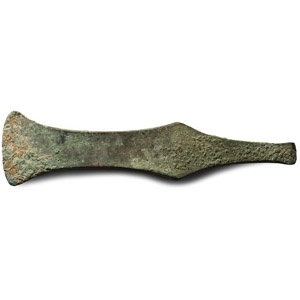
Luristan Bronze Tanged Chisel
13th-7th century B.C.Sold for (Inc. bp): £33
With scooped edges to the flat-section blade, one broad cutting edge and one narrow. 154 grams, 14.5 cm
From a collection of a gentleman, acquired on the London art market in the 1990s. -
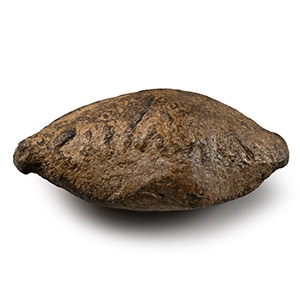
Roman 'Pompey the Great' Lead Slingshot
1st century B.C.Sold for (Inc. bp): £182
Biconical lead slingshot (glans) with inscription in Latin letters 'CN' (Cneius) 'MAG' (Magnus) on one side, and 'IMP' for 'IMPERATOR' (victorious general) to the other side, i.e Gnaeus Pompeius Magnus Imperator (Pompey the Great the victorious general). 59.6 grams, 40 mm
Ex German art market, 2000s. Acquired from an EU collector living in London. From the collection of Surrey, UK, gentleman. Accompanied by an academic paper by military specialist Dr Raffaele D'Amato, dated 4th May 2022 and titled 'Roman Res Publica - Lead Slingshots (glandes) of Caesarian Age - 45 B.C circa'.
The shot (Völling type 1C) is marked with the abbreviated name of Gnaeus Pompey; it was used in quantity at the Battle of Monda (or Munda) against Julius Caesar, 17th March 45 BC. The projectiles were made of different materials: lead (glandes) or in pottery or stone (lapides missiles). Sometimes they were signed with the name of the general, like our specimen.
