
Loading, please wait...
_900x900.jpg "Scythian Gold Repoussé Animal Mount")
_200x200.jpg "Scythian Gold Repoussé Animal Mount")
.jpg "Scythian Gold Repoussé Animal Mount")
LOT 0652
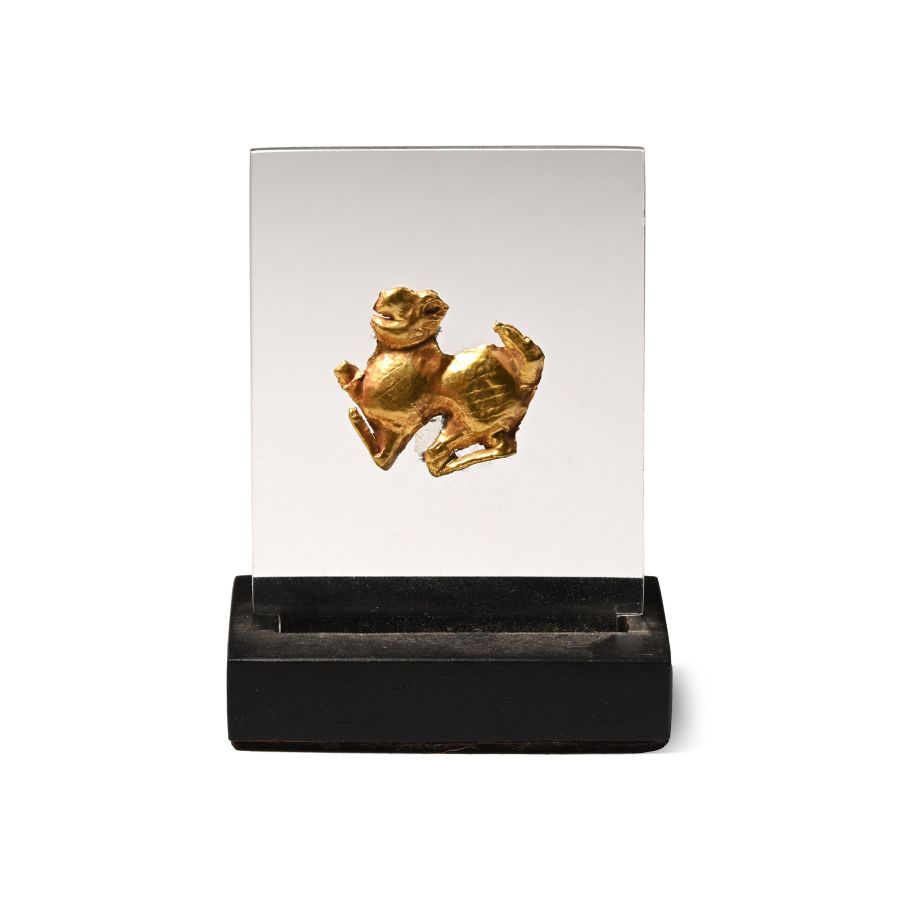
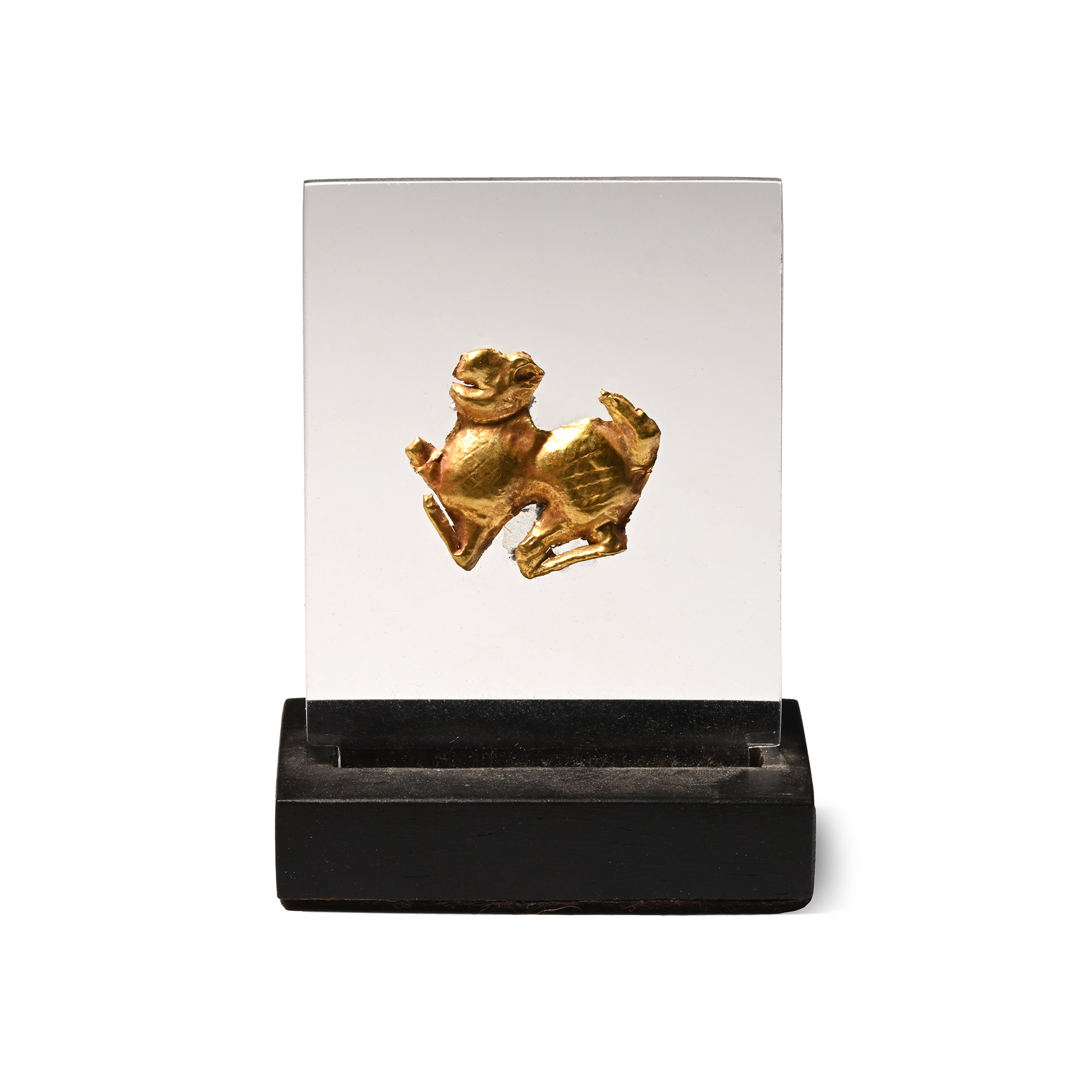
Scythian Gold Repoussé Animal Mount
EARLY 1ST MILLENNIUM B.C.
7/8 in. (2 3/4 in.) (29.63 grams total, 22 mm wide (62 mm high including stand)).
Formed as an advancing lion, hatching to hips and shoulders; mounted on a custom-made stand.
ProvenanceFrom the Robin Symes Mayfair gallery before 1999, and part of a collection exhibited at the gallery.
Ex London, UK, collection.
This lot is accompanied by an illustrated lot declaration signed by the Head of the Antiquities Department, Dr Raffaele D'Amato.
TimeLine Auctions follows a vetting process to ensure the authenticity and legality of all items, reinforcing our commitment to integrity and responsible trading. Each antiquity, antique, and coin lot undergoes thorough examination by a vetting committee of at least ten external specialists, professional trade association members, scientists, and archaeologists: Our Vetting Process
AUCTIONS:
TimeLine is a leading auction house specialising in antiquities, ancient art, collectables, natural history, coins, medals, and books. Our auctions offer museums, collectors, historians, and enthusiasts the opportunity to acquire unique and historically significant pieces.
-
.jpg)
Greek Glass Cameo with Dolphin
Late 1st millennium B.C.Sold for (Inc. bp): £468
Ellipsoid in plan and plano-convex in section with low-relief dolphin modelled in the half-round. 2.75 grams, 26 mm
Acquired on the German art market, 1989-1995. with The Museum Gallery, 19 Bury Place, London, WC1, UK, 1998-2003. Property of a London based academic, 2003 to present. -
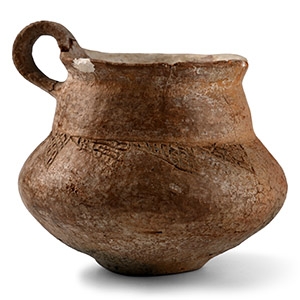
Greek Terracotta Juglet
5th century B.C.Sold for (Inc. bp): £91
Biconvex in profile with tapering shoulder, flared rim, loop handle; hatched triangles to the shoulder. 66 grams, 69 mm
From an old European collection formed mainly in the 1980s. From the property of a late Lincolnshire, UK, gentleman. -
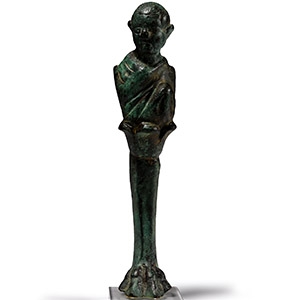
Hellenistic Bronze Furniture Mount with Mime Actor
Alexandria, 1st century B.C.Estimate: £700 - 900 (‡+bp*)
Opening Bid: £350
Modelled with large prominent ears and neatly cut short hair, rounded facial detailing with large eyes and flattened nose, the upper body and hands wrapped inside a pleated cloak, hollow to the reverse; the bust emerging from a lotus flower resting atop a lion's claw foot with a mounting spike on the reverse; mounted on a display stand. 130 grams total, 11.9 cm including stand
Collection of Ambassador G.P., nr.126, before 1965. with Galerie Rhéa, Zurich, Switzerland.
