
Loading, please wait...
_900x900.jpg "Scythian Bronze Mirror with Panther Handle")
_200x200.jpg "Scythian Bronze Mirror with Panther Handle")
_900x900.jpg "Scythian Bronze Mirror with Panther Handle")
_200x200.jpg "Scythian Bronze Mirror with Panther Handle")
.jpg "Scythian Bronze Mirror with Panther Handle")
.jpg "Scythian Bronze Mirror with Panther Handle")
LOT 0046
Scythian Bronze Mirror with Panther Handle
5TH-4TH CENTURY B.C.
17 3/4 in. (1.8 kg total, 45 cm high including stand).
Comprising a discoid body with raised rim, ribbed handle and openwork stylised panther to the terminal; mounted on a custom-made display stand; some restoration.
ProvenanceAcquired 1971-1972.
From the collection of the vendor's father.
Property of a London, UK, collector.
This lot has been checked against the Interpol Database of stolen works of art and is accompanied by search certificate number no.202711.
Cf. Trofimova, A., Greeks on the Black Sea: Ancient Art from the Hermitage, J. Paul Getty Museum, 2007, item 29j; see also Leypunskaya, N. A., Olbian-Scythian Trade: Exchange Issues in the Sixth to Fourth Centuries BC, Oxford, 2007.
FootnotesThe 'Olbian type' mirror takes its name from the Greek colony of Olbia, a port on the Black Sea, which enjoyed close commercial links with the neighbouring Scythian territories. Olbian mirrors form an important element in this trade network, although whether the craftsmen who made them were Scythians or Greeks working in Scythian style for the Black Sea market is still undecided. The animal ornament of the mirrors reproduces the zoomorphic art used elsewhere by the Scythian elite.
CONDITIONTimeLine Auctions follows a vetting process to ensure the authenticity and legality of all items, reinforcing our commitment to integrity and responsible trading. Each antiquity, antique, and coin lot undergoes thorough examination by a vetting committee of at least ten external specialists, professional trade association members, scientists, and archaeologists: Our Vetting Process
AUCTIONS:
TimeLine is a leading auction house specialising in antiquities, ancient art, collectables, natural history, coins, medals, and books. Our auctions offer museums, collectors, historians, and enthusiasts the opportunity to acquire unique and historically significant pieces.
-
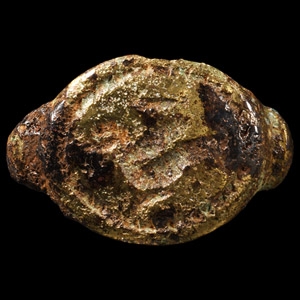
Greek Bronze Ring with Bird
5th-3rd century B.C.Sold for (Inc. bp): £33
The hoop leading to stepped shoulders and an oval-shaped bezel, displaying an incuse bird facing left. 5.49 grams, 23.66 mm overall, 19.10 mm internal diameter (approximate size British N 1/2, USA 6 3/4, Europe 14.35, Japan 13)
UK collection, early 1990s and before. Acquired on the UK art market since the early 2000s. From a private collection, Lancashire, UK. -
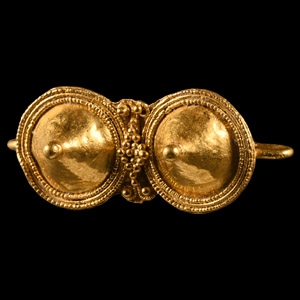
Hellenistic Gold Double Boss Brooch
3rd-2nd century B.C.Sold for (Inc. bp): £585
Or an attachment, comprising two conjoined conical bosses, each with a central knop and rim with two narrow bands of granulation; to the centre, a delicate granulated lozenge with scrolling details to the upper and lower points; to the reverse, an applied double hook for attachment; Alexandrian. 4.42 grams, 36 mm
UK art market, acquired prior to 1985. -
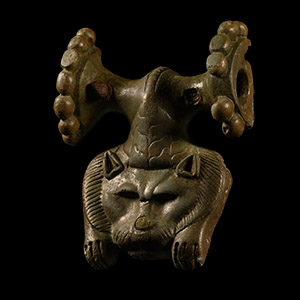
Greek Bronze Handle with Lion-Skin Head
Circa 5th-4th century B.C.Estimate: £1,000 - 1,400 (+bp*)
Opening Bid: £400
Formed as the skinned head and forepaws of a lion, together with two lateral handles with fastening holes surmounted by a pearled edge. 159 grams, 80 mm
Acquired on the UK art market 2000s.
The handle appears to be a device once attached to a wine vessel or pan-like vessels. The vessel handles were usually formed as divinities or animals linked with gods (ie. lions for Herakles). The lion's skin is hanging down like in the images representing Herakles resting and drinking after his labours.
