
Loading, please wait...
LOT 0397
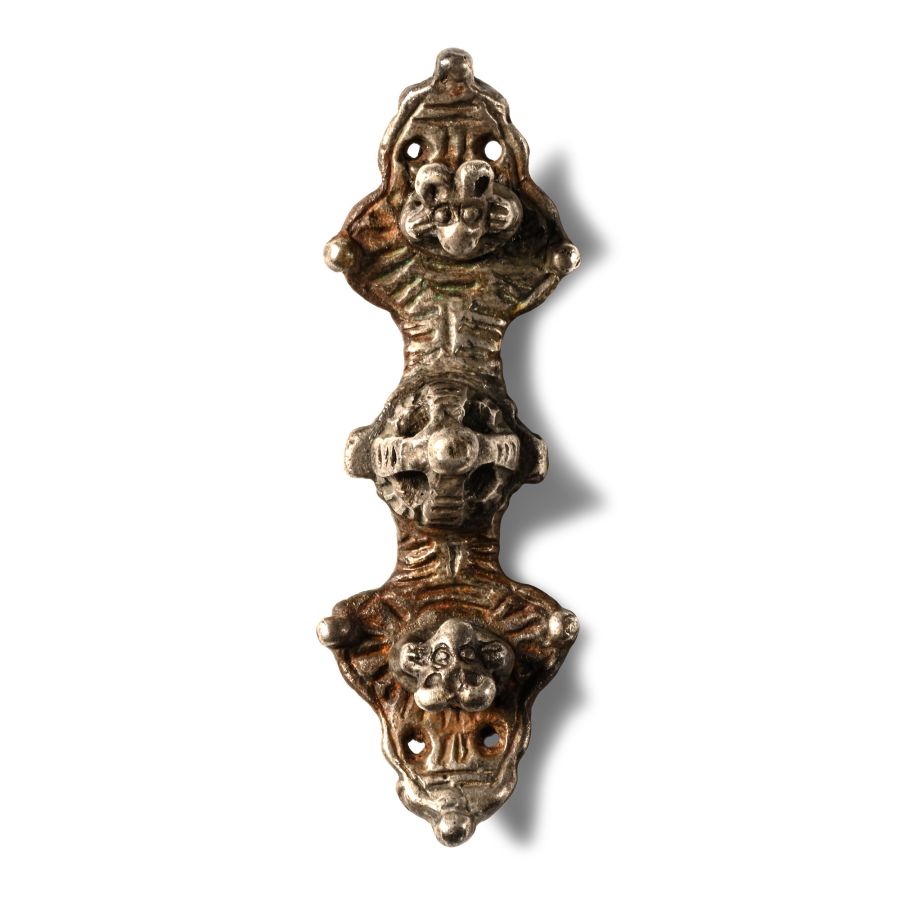
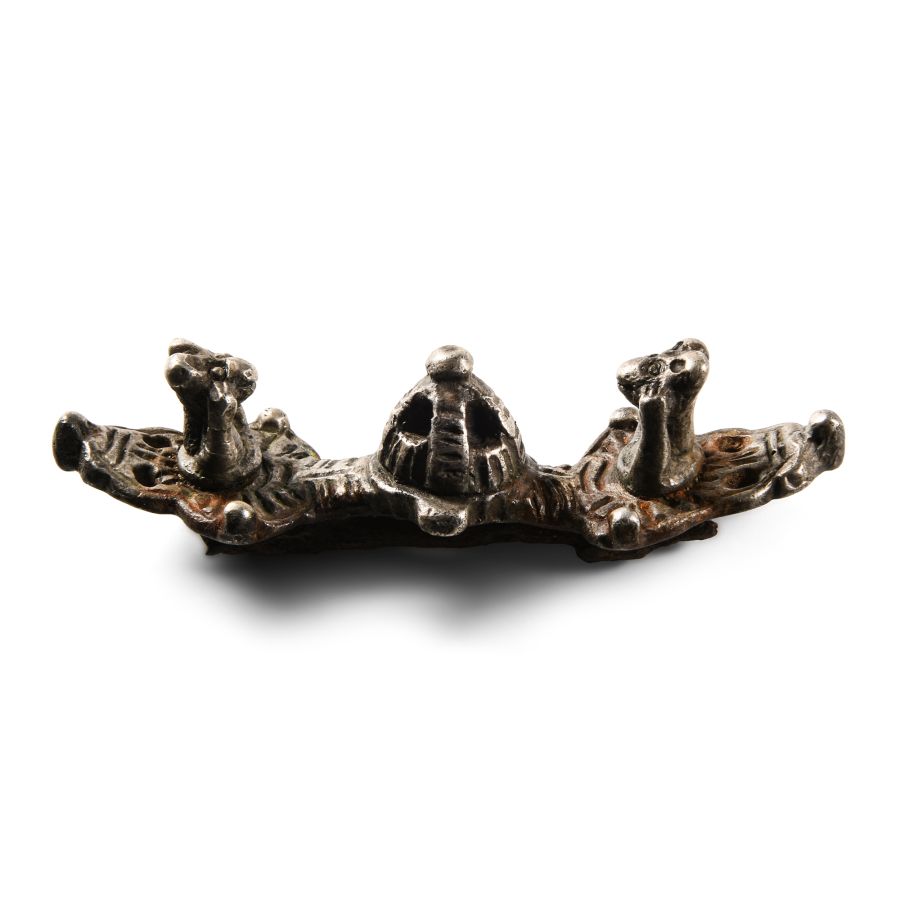
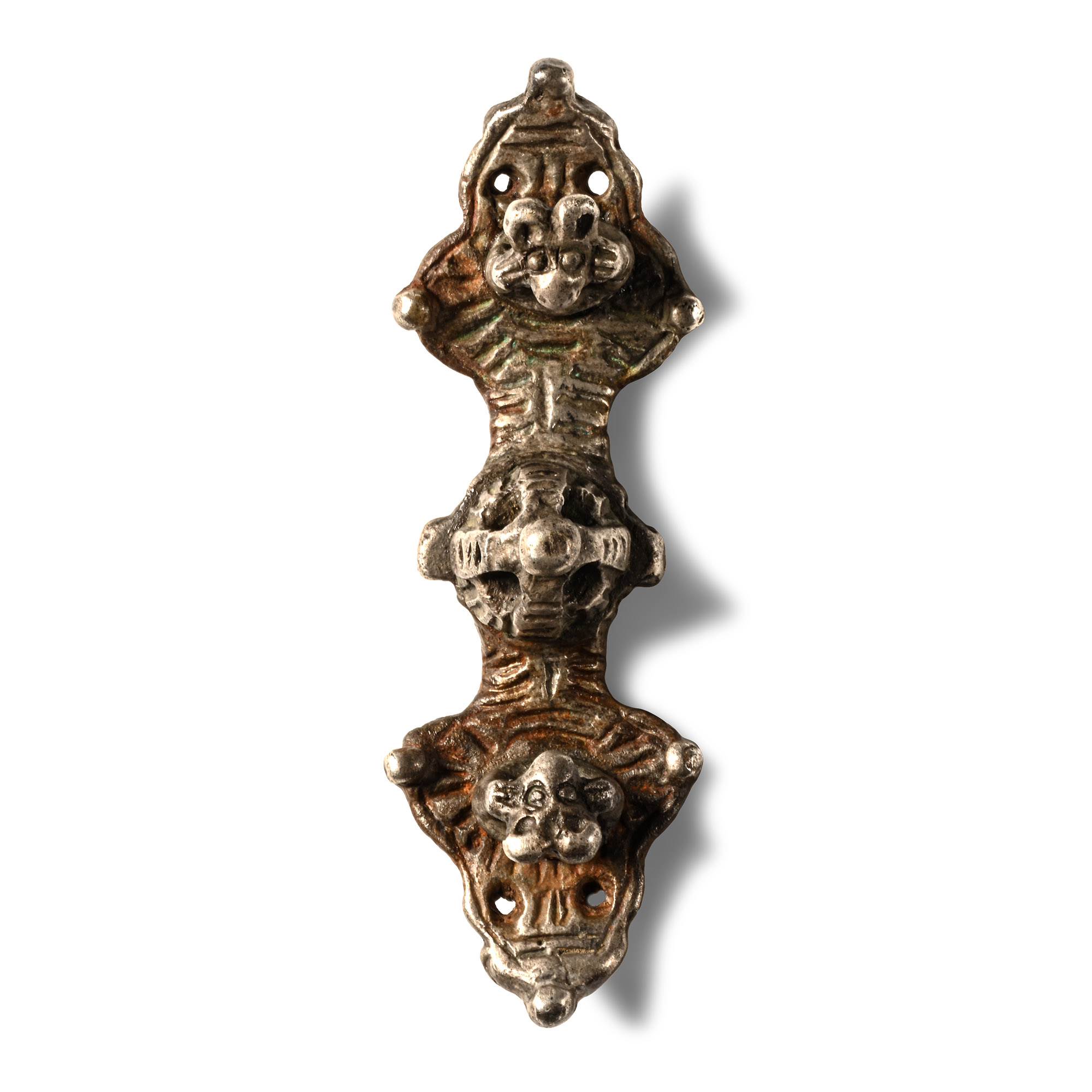
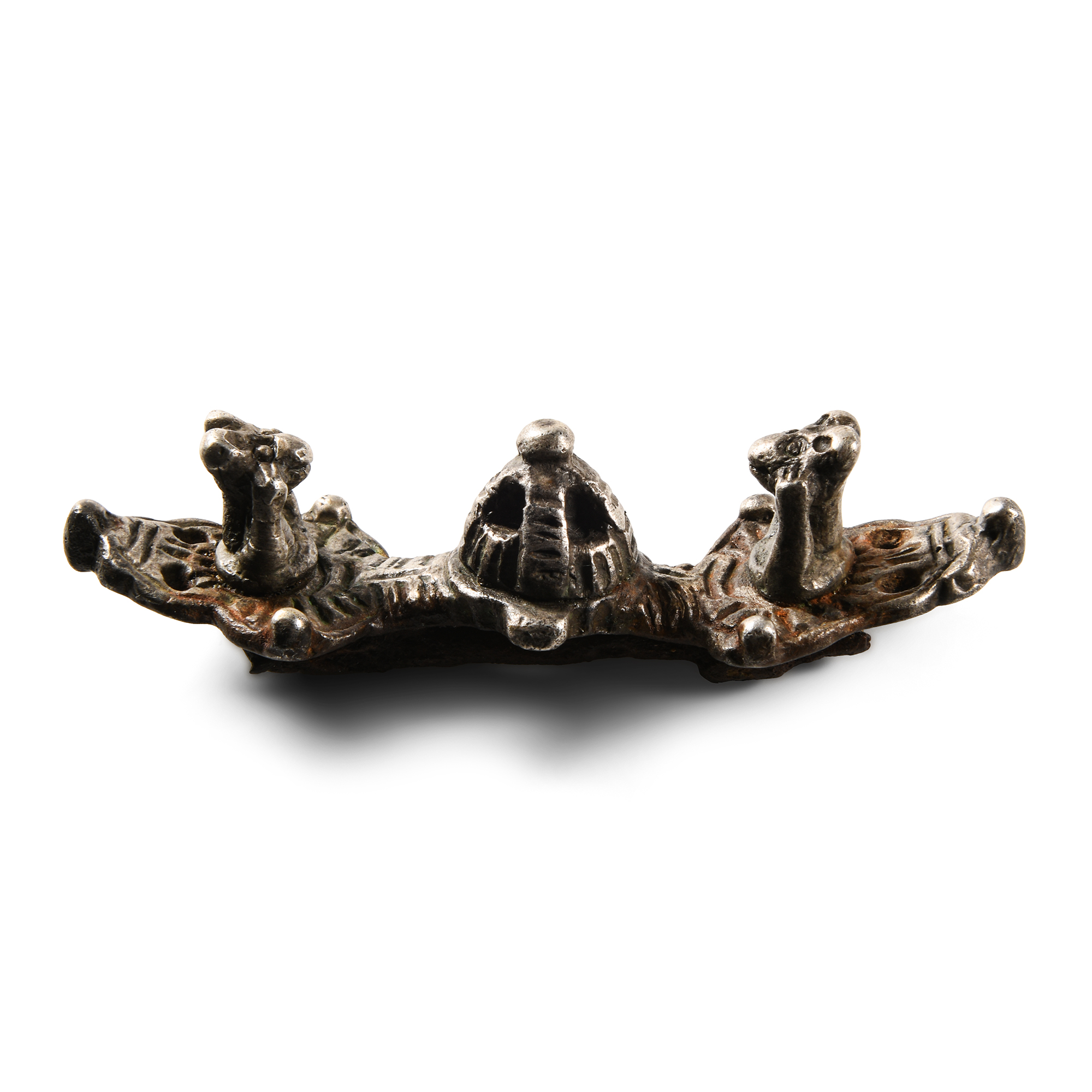
Scandinavian Viking Silver Equal-Arm Brooch with Animals
CIRCA 8TH-10TH CENTURY A.D.
3 1/8 in. (64 grams, 80 mm).
With flexed bow and trefoil ends, each with a granule to each lobe and incised geometric hatching, two small voids and applied bust of a bear with forepaws raised to the cheeks; central disc with hatched crown and knop finial; iron pin and catch to the underside.
ProvenanceFrom the private collection of a London gentleman, from his grandfather's collection formed before the early 1970s.
This lot has been checked against the Interpol Database of stolen works of art and is accompanied by search certificate no.12071-213599.
Cf. Arbman, H., Birka I: Die Gräber, Uppsala, 1940, pl.82(4a).
FootnotesThe exact identity of the animals is disputed: on some examples, such as those from Birka published by Arbman, the animals have an ursine quality whereas the present ones look more like mice or squirrels.
CONDITIONTimeLine Auctions follows a vetting process to ensure the authenticity and legality of all items, reinforcing our commitment to integrity and responsible trading. Each antiquity, antique, and coin lot undergoes thorough examination by a vetting committee of at least ten external specialists, professional trade association members, scientists, and archaeologists: Our Vetting Process
AUCTIONS:
TimeLine is a leading auction house specialising in antiquities, ancient art, collectables, natural history, coins, medals, and books. Our auctions offer museums, collectors, historians, and enthusiasts the opportunity to acquire unique and historically significant pieces.
LOT 0397
Scandinavian Viking Silver Equal-Arm Brooch with Animals
Sold for (Inc. bp): £1,170
-

Hiberno-Viking Enamelled Bronze 'Balladoole Type' Trade Weight
9th-10th century A.D.Estimate: £800 - 1,000 (+bp*)
Opening Bid: £240
A discoid lead insular Scandinavian domed trade weight with inset boss; the copper-alloy bridle mount very similar in design to one found at the late 9th/early 10th century Balladoole Viking Boat Burial on the Isle of Man in the 1940s; enamel-inlaid copper-alloy mount from a horse-harness set with a ribbed rim; the obverse decorated with a series of rectangular cells filled with opaque yellowish-green and reddish enamel, forming a circular border around a zoomorphic interlaced and spiral design formed by a series of sub-triangular and curving cloisons surrounding a circular central cell; the lead weight undecorated on the reverse. 194 grams, 43.5 mm
Possibly found in Hampshire, UK. Acquired at a boot sale in Alton, Hampshire, UK in August 2023. Property of an Australian collector. Accompanied by a copy of the British Museum’s Portable Antiquities Scheme (PAS) report no.HAMP-7AD372. Recorded with Winchester City Museum and later the Finds Liaison Officer, Hampshire Cultural Trust, who in turn consulted with Medieval experts at the British Museum.
This is an Insular Scandinavian weight which would have had an original weight of 8 ounces which is towards the heavier extreme for weights of this type, which re-use a variety of insular metalwork items as ready-made decoration. They appear to have originated in Viking contexts in England and/or Ireland in the late 9th century-early 10th century. Manufacture in the Isle of Man has been suggested for the entire group with similar designs and manufacturing techniques. The copper-alloy element is likely to be part of a Hiberno-Norse, Manx or possibly Scottish horse-harness boss; it probably has a pierced lug to the reverse, now embedded in the lead plug. It is very similar to pieces of the harness set from the ship burial at Balladoole, Arbory Isle of Man. No find spot is available, but the majority of weights with decorative insets do come from archaeological contexts such sites such as Torksey, Aldwark and Woodstown, or graves such as Kiloran Bay. -

Viking Age Gold 'Elf Shot' Pendant
9th-10th century A.D. or earlierSold for (Inc. bp): £1,105
Bell-shaped cup with suspension loop, inset irregular amethyst. 0.73 grams, 15 mm
From a late Japanese specialist collector, 1970-2000s.
This amulet was believed to offer protection against 'Elfshot'. The attack of elves was believed responsible for mysterious suffering in men and livestock. 'Elfshot' described sudden shooting pains localised to a particular area of the body, such as in rheumatism, arthritis or muscle stitches or cramps. Elves were thought to shoot darts or arrows where such pains had no obvious external cause. Belief in elfshot persisted into the 20th century in rural areas, and as proof country folk would sometimes find small arrowheads (the remains of Neolithic or Mesolithic flints, or naturally-occurring spear-shaped stones) that were believed to be the magical weapons that caused the afflictions. Belief in elfshot began in the Pagan Germanic period. -
Anglo-Scandinavian Viking Bronze Stirrup Apex Mount Group
Circa 11th century A.D.Sold for (Inc. bp): £222
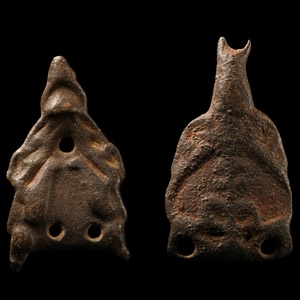
Comprising: one mount of Class A Type 8 with three attachment holes, and one of Class A Type 6 with upper loop broken. 27 grams total, 44-47 mm
Found near Lyndhurst, New Forest, Hampshire, UK.
