
Loading, please wait...
LOT 0332
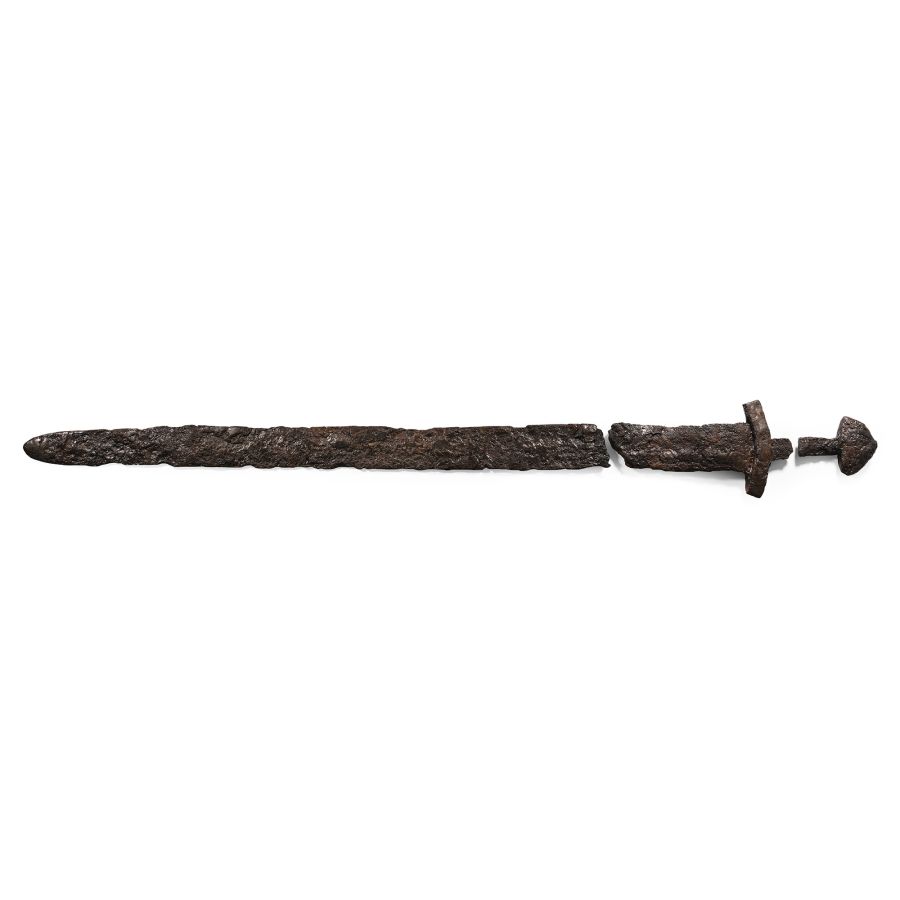
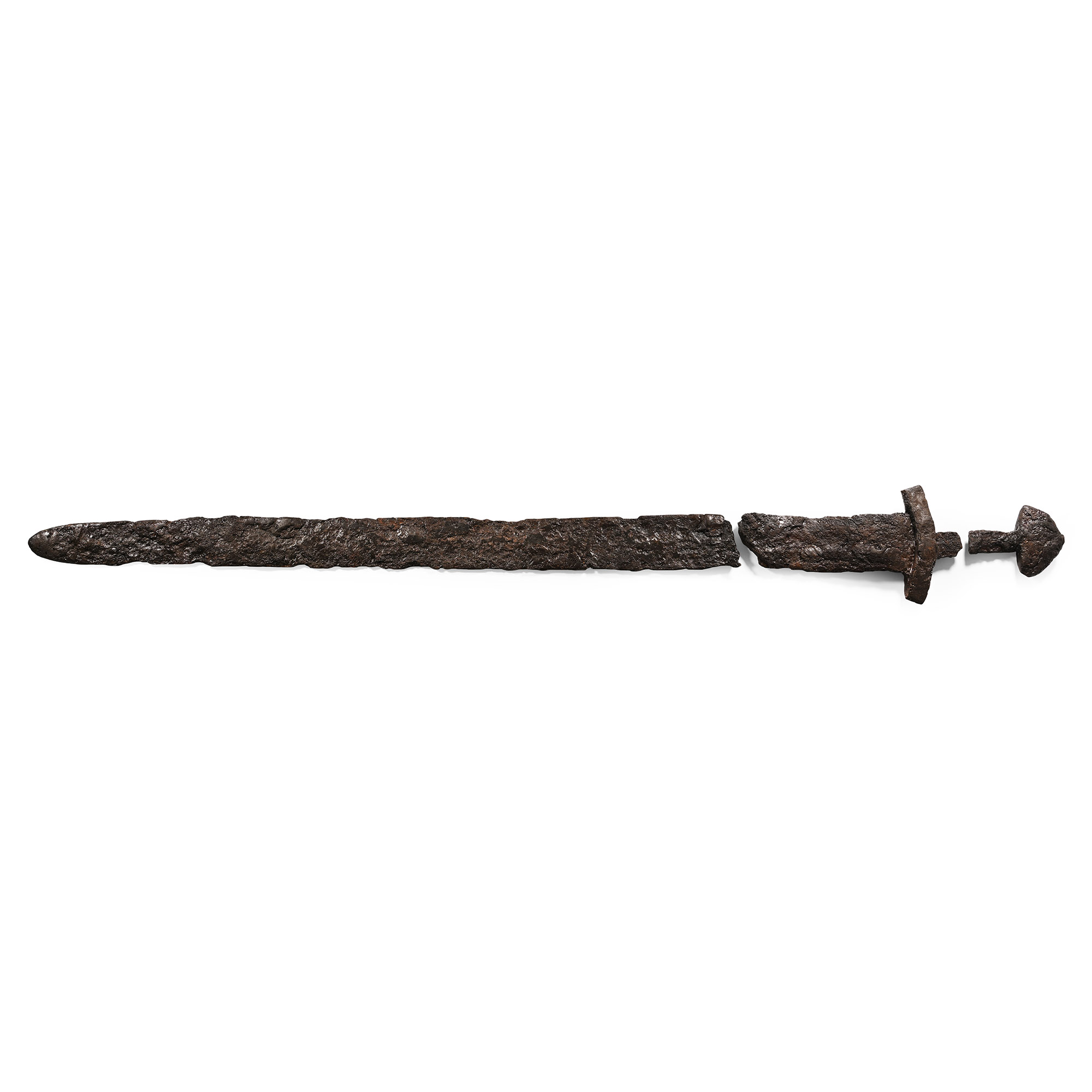
Scandinavian Viking Sacrificed Iron Sword
10TH-11TH CENTURY A.D.
3 1/2 - 26 in. (1.15 kg total, 9-66 cm).
Deliberately broken up on deposition, Petersen's Type L variant, comprising: D-shaped pommel with peened tang above and upper portion of tang forming the grip; lower section of tang with separate lower guard, scaphoid in plan and gently drooping in profile with convergent ends; upper portion of double-edged lentoid-section blade; lower section of parallel-sided blade with rounded tip. [3]
ProvenanceFrom the private collection of a London gentleman, from his grandfather's collection formed before the early 1970s.
This lot has been checked against the Interpol Database of stolen works of art and is accompanied by a search certificate number no.12726-234732.
This lot has been cleared against the Art Loss Register database, and is accompanied by an illustrated lot declaration signed by the Head of the Antiquities Department, Dr Raffaele D'Amato.
Cf. Peirce, I., Swords of the Viking Age, Woodbridge, 2002, p.80-1, for a similar sword in the BM.
CONDITIONTimeLine Auctions follows a vetting process to ensure the authenticity and legality of all items, reinforcing our commitment to integrity and responsible trading. Each antiquity, antique, and coin lot undergoes thorough examination by a vetting committee of at least ten external specialists, professional trade association members, scientists, and archaeologists: Our Vetting Process
AUCTIONS:
TimeLine is a leading auction house specialising in antiquities, ancient art, collectables, natural history, coins, medals, and books. Our auctions offer museums, collectors, historians, and enthusiasts the opportunity to acquire unique and historically significant pieces.
-
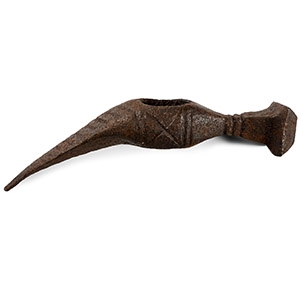
Tudor Period Renaissance Iron War Hammer
Western Europe, late 16th century A.D.Sold for (Inc. bp): £169
A (reiterhammer) head made as a single solid iron bar, one end shaped as a squared hammer and the other as a pointed curved spike; the head showing a strong quadrangular outline; the spike is a 'raven beak' shape of pointed section, oval socket with saltire cross flanked by two vertical lines on either side. 174 grams, 14.2 cm
From a North American collection formed in the 1970s-1990s. This lot is accompanied by an illustrated lot declaration signed by the Head of the Antiquities Department, Dr Raffaele D'Amato.
This war hammer is of the type used by European cavalry in the 16th century, represented in iconography (battle of San Romano, painting by Paolo Uccello of 1455 AD; portrait of Maurice of Saxony made in 1578 AD by Lucas Cranach the Younger) and showing parallels with similar examples in the Deutsches Historisches Museum in Berlin. Reiterhammers of this type are called ‘raven’s beak’ (bec de courbin) in the sources; the shaft was originally a wooden shank reinforced by metal shafts with one-handed handle, but in the later models, like our specimen, the astile could be entirely in metal, thinner than the wooden one, with guard and knob to better ensure the grip on the handle for a user wearing a glove. The war hammer was developed to counter the protection offered by plate armour, which made simple cutting weapons useless. In a military context dominated by the figure of the knight in plate armour, the sword lost its status as a weapon par excellence. The evolution of this offensive weapon ran in parallel with that of complete armour. When the latter developed ridges to limit the damage from thrusting hits, the war hammer gained prominence as a penetrating weapon. Weapons capable of concentrating a considerable force on a narrow target, a joint or a precise point of the armour proved to be more effective in the fray. As much as the mace of arms and the archer’s axe, the war-hammer became a decisive melee weapon for the knight. The weapon, descended from the East-Roman akouphion, began to be used by armoured knights in the 14th century, due to the need to better the axe and the mace of arms with a piece of equipment capable of inflicting injuries through armour. It reached its full development only at the end of the 15th century, but its wide use in the 16th century is widely documented by archaeological artefacts and iconography, like the one representing the battle of Dreux, in an engraving of 1588 AD, one of the first clashes of the Wars of Religion in France, where knights are visible fighting on horseback with such weapons in their hands. The war hammer was often visible in tournaments, and, much like sword hilts, war hammers became richly decorated with etching and gilding, often appearing to be works of art. However, they never lost their primary function as dangerous weapons (Edge-Miles Paddock, 1988, p.149). With the seventeenth century and the establishment of portable firearms (pistol and petronel) as weapons of the new heavy cavalry (Cuirassiers and Reiters) the war hammer disappeared from western battlefields. In Eastern Europe, its variants, such as the Polish nazdiak, remained in use among cavalry forces until the 18th century, when it finally fell into disuse along with the axe and mace, starting from the Napoleonic Wars, when the model of the horseman armed only with sabre and pistol became dominant. -
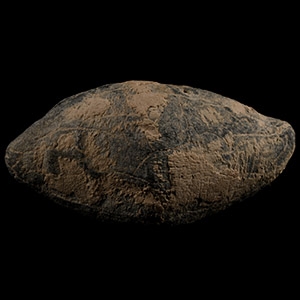
Roman Julius Caesar 'Battle of Munda' Lead Slingshot
45 B.C.Sold for (Inc. bp): £390
A biconical facetted lentoid-section lead sling shot (glans), inscription monogram a combination of letters 'C', 'A' and 'E', for 'C A E S' referring to Julius Caesar. 32.7 grams, 33 mm
Acquired on the UK art market. Property of a gentleman collector. Accompanied by an academic paper by military specialist Dr Raffaele D'Amato, dated 4th May 2022 and titled 'Roman Res Publica - Lead Slingshots (glandes) of Caesarian Age - 45 B.C circa'. This lot is accompanied by an illustrated lot declaration signed by the Head of the Antiquities Department, Dr Raffaele D'Amato.
The shot (type IIb of the Völling classification) is marked with the abbreviated name of Julius Caesar; it was used in quantity at the Battle of Munda (or Monda) against the last fellows of Pompey, the leaders of the Optimates, on the 17th March 45 BC. Similar shots were used in the Caesar's wars. The slingers of Caesar's age were part of the light infantry. Caesar speaks of his Balearic slingers during the conquest of Gaul. They wore a short tunic, with leather or rope sandals to the feet, and a warm overcoat which could also have been used to store projectiles. They also used a satchel to carry very deadly lead-like stones or bullets. -
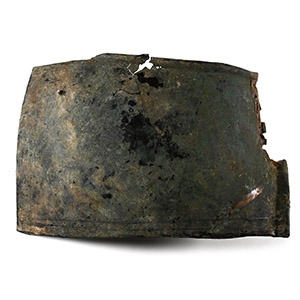
Hellenistic Bronze Cuirass Section
3rd-1st century B.C.Sold for (Inc. bp): £286
Possibly the upper right front element of a composite cuirass for a cataphract (armoured horseman), part of the edge around the neck and shoulders preserved, rivets and clasp for attachment of the back section present. 261 grams, 23 cm
UK private collection, acquired in 1996. This lot is accompanied by an illustrated lot declaration signed by the Head of the Antiquities Department, Dr Raffaele D'Amato.
A near complete armour for cataphract was found in the French excavations in Al-Khanoum, a Hellenistic city in Afghanistan. The cavalry of Seleucid, Ptolemaic and other Hellenistic Kingdoms formed regiments of heavy armoured horsemen, who in the west, employed a combination of lamellar and segmented armour together with muscled armour of Greek type. Cataphract armour in the West had more Greek element, for example more plate armour and less scale and lamellar.
