
Loading, please wait...
_900x900.jpg "Scandinavian Viking Bronze Box Brooch")
_200x200.jpg "Scandinavian Viking Bronze Box Brooch")
_900x900.jpg "Scandinavian Viking Bronze Box Brooch")
_200x200.jpg "Scandinavian Viking Bronze Box Brooch")
_900x900.jpg "Scandinavian Viking Bronze Box Brooch")
_200x200.jpg "Scandinavian Viking Bronze Box Brooch")
.jpg "Scandinavian Viking Bronze Box Brooch")
.jpg "Scandinavian Viking Bronze Box Brooch")
.jpg "Scandinavian Viking Bronze Box Brooch")
LOT 1630
Scandinavian Viking Bronze Box Brooch
9TH-10TH CENTURY A.D.
2 1/8 in. (93 grams, 53 mm).
Featuring a squat cylindrical body, ornate cruciform motif to upper face, zoomorphic panels to the side wall; hollow-formed; remains of pin lug and catchplate to reverse.
ProvenanceFrom the collection of a North American gentleman, formed in the 1990s.
LiteratureCf. The British Museum, museum number 1921,1101.120, for broad type.
CONDITIONTimeLine Auctions follows a vetting process to ensure the authenticity and legality of all items, reinforcing our commitment to integrity and responsible trading. Each antiquity, antique, and coin lot undergoes thorough examination by a vetting committee of at least ten external specialists, professional trade association members, scientists, and archaeologists: Our Vetting Process
AUCTIONS:
TimeLine is a leading auction house specialising in antiquities, ancient art, collectables, natural history, coins, medals, and books. Our auctions offer museums, collectors, historians, and enthusiasts the opportunity to acquire unique and historically significant pieces.
LOT 1630
Scandinavian Viking Bronze Box Brooch
Estimate £1,200 - 1,700€1,390 - 1,970 (for guidance only)$1,620 - 2,300 (for guidance only)
-
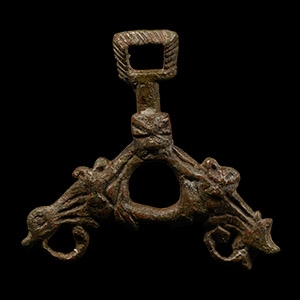
Viking Bronze Bridle Strap Junction with Beast Heads
10th-11th century A.D.Estimate: £600 - 800 (‡+bp*)
Opening Bid: £320
Comprising a rectangular suspension loop with D-section shank and mask below, two flanking arms each with a zoomorphic (bear?) face, one terminating in a wolf's head and the other in a bird's head; small loops below the terminals. 30 grams, 63 mm
Found Bardney, Lincolnshire, UK, in the early 1990s.
This bridle junction is decorated in the Anglo-Scandinavian Ringerike style. On each side of the central hole is an outward facing animal, their beaked heads positioned on the outer edges. The details on the face are carried out in moulded relief as well as engraving. -
.jpg)
Viking Age Gilt Bronze Openwork Roundel with Interlaced Snakes
10th-12th century A.D.Sold for (Inc. bp): £286
With rilled edge and pierced hub, the field a network of dense interlaced tendrils. 48.9 grams, 70.7 mm
Fine condition.
Acquired 1971-1972. From the collection of the vendor's father. Ex property of a London, UK, collector. -
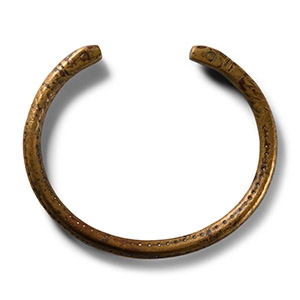
Viking Age Bronze Snake-Headed Bracelet
Circa 9th-11th century A.D.Sold for (Inc. bp): £182
Penannular, round in section with bands of punched points to the shank, snake-head finials. 36.9 grams, 76 mm
Property of the vendor's grandfather, thence by family descent, circa 1985. From the private collection of a New York, USA gentleman.
