
Loading, please wait...
LOT 1450
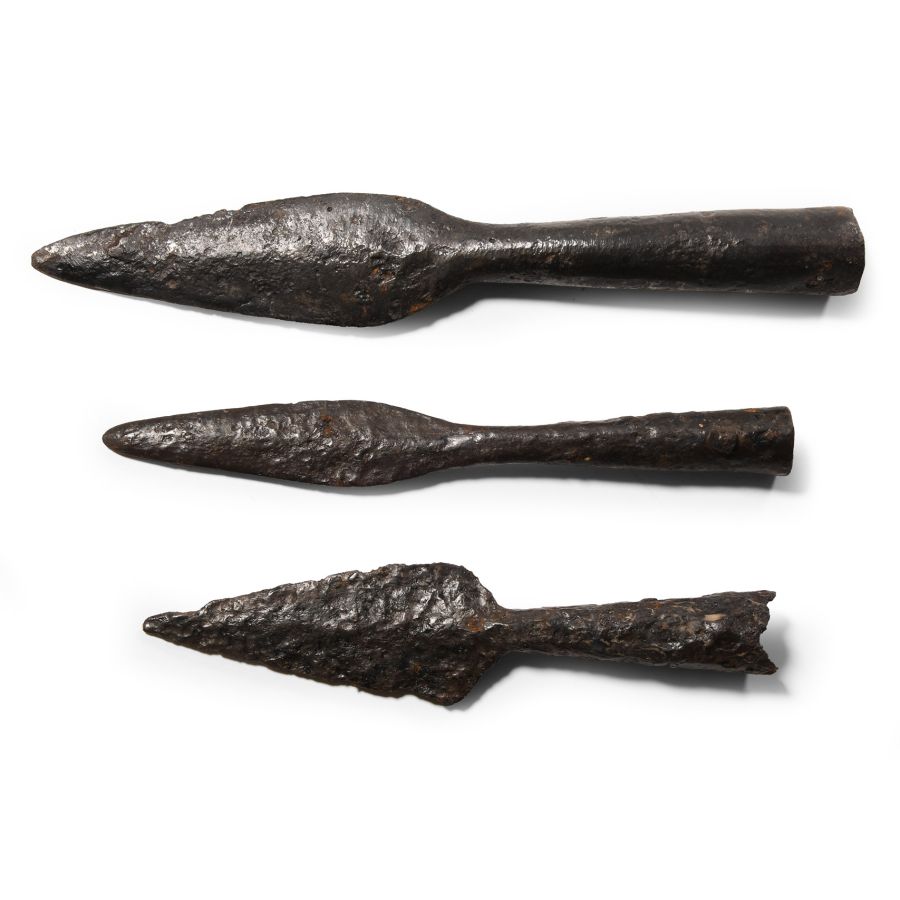
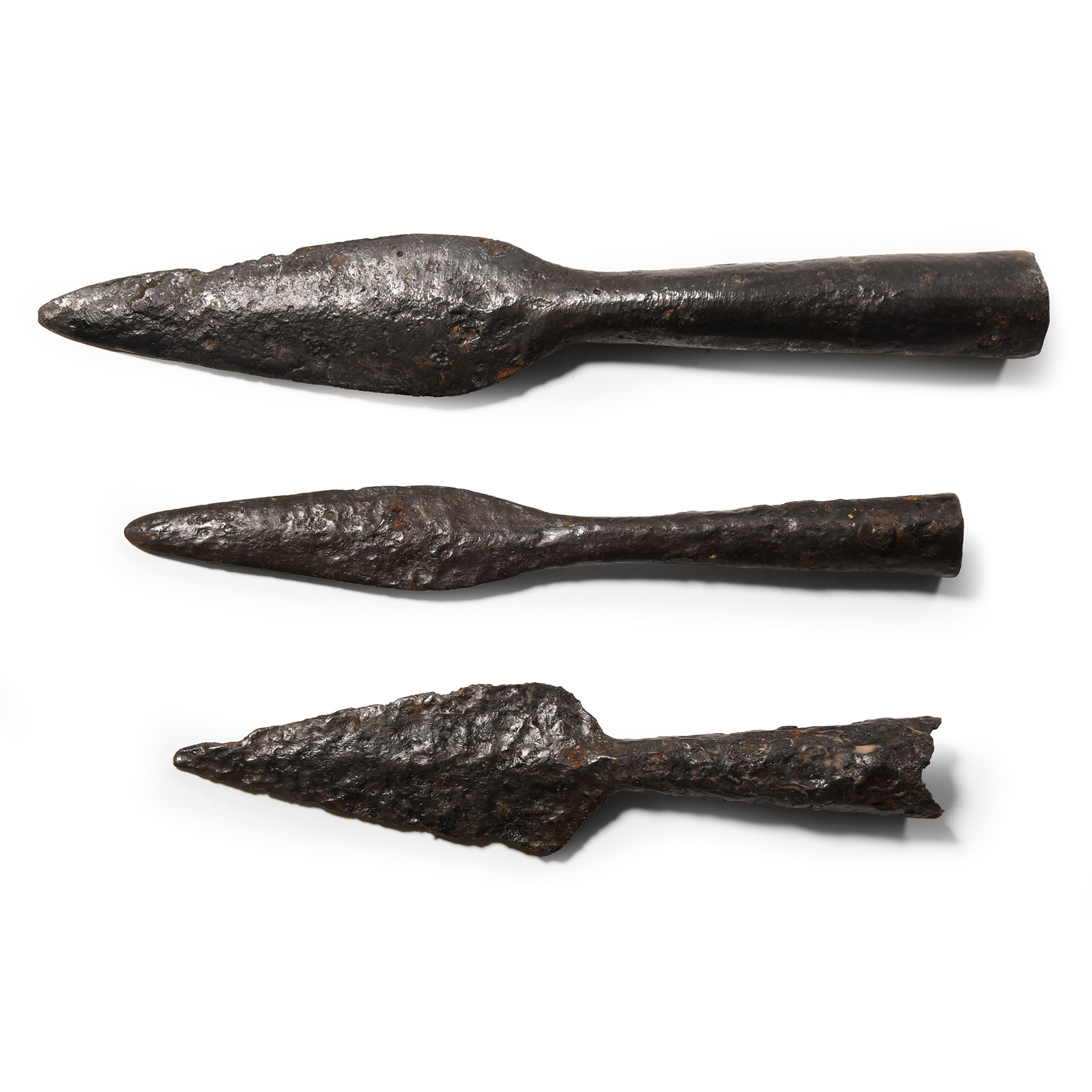
Saxon to Medieval Iron Spearhead Collection
7TH-15TH CENTURY A.D.
5 3/4 - 7 3/4 in. (286 grams total, 14.5-19.5 cm).
Comprising socketted spearheads or javelin heads with small lanceolate and lozenge-shaped heads, lentoid in section; one with a split socket and fastening rivet, another with the fastening hole for the shaft still in situ. [3, No Reserve]
ProvenanceFrom the collection of the famous author, writer and speaker, Gordon Bailey, Essex, UK; formed since 1968.
PublishedBailey, G., Detector Finds 5, Witham, 2002, p.61, fig.7 & 10, for two examples.
FootnotesThe distinction between the early medieval lance and spear is difficult, However the lance (or the javelin), normally employed by mounted warriors, had a small slender and stouter blade, and a short wider socket. Both the spear and javelins could be used as throwing weapons by the 14th-15th century light cavalry, like the Spanish Jinetes.
CONDITIONTimeLine Auctions follows a vetting process to ensure the authenticity and legality of all items, reinforcing our commitment to integrity and responsible trading. Each antiquity, antique, and coin lot undergoes thorough examination by a vetting committee of at least ten external specialists, professional trade association members, scientists, and archaeologists: Our Vetting Process
AUCTIONS:
TimeLine is a leading auction house specialising in antiquities, ancient art, collectables, natural history, coins, medals, and books. Our auctions offer museums, collectors, historians, and enthusiasts the opportunity to acquire unique and historically significant pieces.
-
.jpg)
Migration Period Iron Sword with Rock Crystal, Gold and Garnet Sword Bead
5th-6th century A.D.Sold for (Inc. bp): £1,235
Comprising a double-edged blade with pointed tip, battle nicks to both cutting edges; short bronze guard and a long tang; accompanied by a facetted rock crystal hilt pendant with a granulated gold mount above, set with a garnet cabochon; Eastern Roman or Alano-Gothic. 750 grams, 4-91.5 cm
From the private collection of a London gentleman, from his grandfather's collection formed before the early 1970s. Accompanied by an academic report by Dr Raffaele D’Amato. This lot has been checked against the Interpol Database of stolen works of art and is accompanied by a search certificate number no.12041-216428.
A characteristic type of the Migration period, originally used by nomadic people such as the Alans and Sarmatians. An important element of these swords was the presence (in tombs) of amber or rock crystal fittings, which some authors have identified being part of the pommel (Zasetskaya), and others as pendants hanging from the hilt of the sword. Interestingly the sword of grave 9 from the Necropolis of Novohryhorivka is decorated with a similar pendant, made of amber and fitted with a silver mount decorated with a filigree border. -
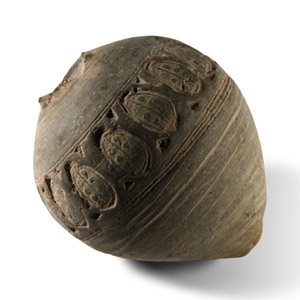
Byzantine 'Greek Fire' Ceramic Fire Bomb or Hand Grenade
9th-11th century A.D.Sold for (Inc. bp): £98
A piriform ceramic missile with band of impressed roundels to the shoulder and filler-hole above, intended to be filled with explosive liquid and wick, used as a hand grenade. 567 grams, 10.5 cm
From a military inspired collection formed from the 1990s. Accompanied by an academic paper by military specialist Dr Raffaele D'Amato, dated 15 July 2019 and titled 'Eastern Roman Empire - Greek Fire Bomb or Hand Grenade (μεσαίον kακάβιον) 9th-11th century AD'.
Apart from the use of siphons or manual flame-throwers called cheirosiphona, special corps of Roman soldiers employed terracotta grenades, in the form of small jars, abundantly evidenced in archaeological excavations. They were called μεσαία kακαβιά or κυτροκακάβια where the former had a bulbous shape and the latter a more cylindrical form. -
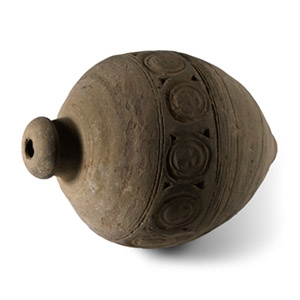
Byzantine 'Greek Fire' Ceramic Fire Bomb or Hand Grenade
9th-11th century A.D.Sold for (Inc. bp): £124
An ovate ceramic missile with impressed band of roundels to the equator, with a domed filler-hole, intended to be filled with explosive liquid and wick, used as a hand grenade. 616 grams, 12.7 cm
From a military inspired collection formed from the 1990s. Accompanied by an academic paper by military specialist Dr Raffaele D'Amato, dated 15 July 2019 and titled 'Eastern Roman Empire - Greek Fire Bomb or Hand Grenade (μεσαίον kακάβιον) 9th-11th century AD'.
Apart from the use of siphons or manual flame-throwers called cheirosiphona, special corps of Roman soldiers employed terracotta grenades, in the form of small jars, abundantly evidenced in archaeological excavations. They were called μεσαία kακαβιά or κυτροκακάβια where the former had a bulbous shape and the latter a more cylindrical form.
