
Loading, please wait...
_900x900.jpg "Saxon 'Sutton Hoo' Type Iron Cauldron Chain")
_200x200.jpg "Saxon 'Sutton Hoo' Type Iron Cauldron Chain")
.jpg "Saxon 'Sutton Hoo' Type Iron Cauldron Chain")
LOT 1353
Saxon 'Sutton Hoo' Type Iron Cauldron Chain
6TH-7TH CENTURY A.D.
40 1/2 in. (3.1 kg, 1.03 m).
Or a hanging-bowl chain comprising: nine sets of two parallel-twisted 8-shaped links, with interstitial H-shaped twisted elements, the lower four each with a standing bull figure with prominent horns; a lateral hook with herringbone twisted shank; lower hooked flange with four herringbone-twist bars with looped ends; suspension ring and four-bar herringbone-twisted shank. [No Reserve]
ProvenanceAcquired 1971-1972.
From the collection of the vendor's father.
Property of a London, UK, collector.
The chain and fittings closely resemble those recovered from Mound 1 at Sutton Hoo, Suffolk, England (British Museum accession ref. 1939,1010.167). It is understood that the chain was used to support a cauldron above the hearth, with additional hooks and suspension brackets for ancillary vessels. The bull-head detailing was present on the wrought-iron stand (ref. 1939,1010.161) from the same grave.
CONDITIONTimeLine Auctions follows a vetting process to ensure the authenticity and legality of all items, reinforcing our commitment to integrity and responsible trading. Each antiquity, antique, and coin lot undergoes thorough examination by a vetting committee of at least ten external specialists, professional trade association members, scientists, and archaeologists: Our Vetting Process
AUCTIONS:
TimeLine is a leading auction house specialising in antiquities, ancient art, collectables, natural history, coins, medals, and books. Our auctions offer museums, collectors, historians, and enthusiasts the opportunity to acquire unique and historically significant pieces.
-
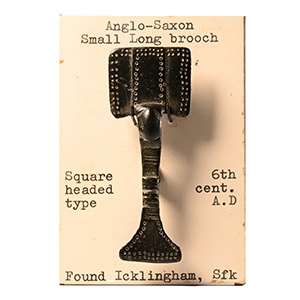
Anglo-Saxon Bronze Square-Headed Long Brooch
6th century A.D.Sold for (Inc. bp): £286
Decorative dimples and annulets over the body; pin lug and catchplate to reverse; mounted on a custom-made display stand and accompanied by descriptive text reading: 'Anglo-Saxon Small Long brooch Square headed type...Found Icklingham, Sfk [Suffolk] Leeds# square-headed (panelled) type as classified in Arch: XCI, 1945. Cf. Fig. 20 a, and others there for the decoration and foot shape.' 75 grams, 86 mm high including stand
Found Icklingham, Suffolk, UK. From the Hattatt collection, 1985. Ex Astarte collection with reference no.00/561/09. -
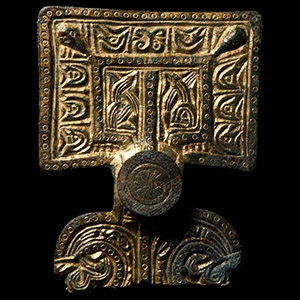
Anglo-Saxon Gilt Bronze Great Square-Headed Brooch
5th-6th century A.D.Sold for (Inc. bp): £3,900
Displaying chased panels populated with Style I zoomorphs and geometric forms, borders of annulets, raised masks to the upper corners of the headplate; applied discoid boss to bow decorated with a rosette, addorsed beast heads below; extensive remains of gilding; pin lug and catchplate to reverse and remains of ancient repair, lower part absent. 80 grams, 82 mm
Cambridgeshire collection, 1990s.
The fractured lower edge shows signs of an ancient repair using a separate panel of sheet bronze pinned to the reverse. -
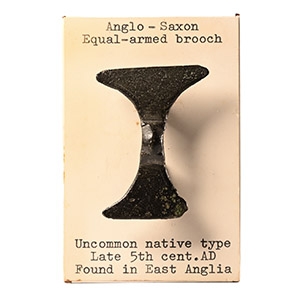
Anglo-Saxon Bronze Equal-Armed Brooch
5th century A.D.Sold for (Inc. bp): £65
Of bow-tie form with raised central section; pin lug and catchplate to reverse; mounted on a custom-made display stand with accompanying description reading 'Uncommon native type / Late 5th cent. AD / Found in East Anglia / Evolved from continental brooches, the few known are from East Anglia. cf. Salin 1940, 176; Reichstein 1975, Taf. 110, 2 and 3.' 68 grams, 86 mm high including stand
Found East Anglia, UK. From the Hattatt collection, 1985. Ex Astarte collection with reference no.00/531/09.
